His name was Thomas Reddick, and I had fixed his cufflink at 4:12 in the morning without knowing I was closing a circle that had been open for twenty-six years.
Let me explain how I ended up in that elevator.
I was thirty-one hours into a stretch that was supposed to be twelve. Two nurses had called out, a bad multi-car crash had come through, and I’d stopped being fully a person somewhere around hour twenty. I was riding the elevator down to grab something from my car that I no longer remember, running on the particular autopilot that long-shift nurses know, where your hands keep working even after your brain has clocked out.
The man beside me was fussing with his left sleeve. His cufflink had come loose and he was trying to fasten it one-handed, the way men in expensive suits do when they’re used to someone else handling the small things. I reached over and did it for him before my tired brain caught up with my hands. “You’ve been fighting that cufflink all day, haven’t you?” I said, threading it through and folding the cuff neat, the same motion I use forty times a night on IV lines and gown ties.
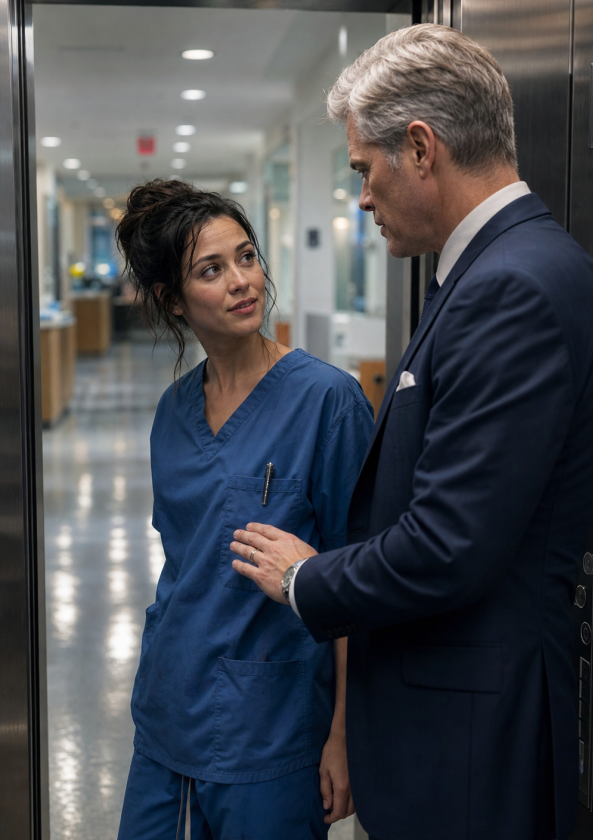
Then the doors opened on my floor and I stepped out, and I registered, a beat too late, the cut of his suit and the stillness of a man who is not used to being touched by strangers. My stomach dropped. I was sure I’d overstepped, that I’d fixed the sleeve of some hospital board member or major donor and was about to be written up for it.
So I kept walking. Fast.
He followed me. Two floors, quiet and intent, and I could feel him behind me the way you feel a storm changing the pressure in a room. I turned around ready to apologize, and found him staring — not at my face, but at my chest. At the pen clipped to my scrub pocket.
It’s an old pen. Engraved. It has a small crest on it and a name that isn’t mine: my mother’s. She was a nurse too, and that pen was given to her by a family she’d cared for, and it’s the only thing of hers I carry on every shift because it makes me feel like she’s still working beside me.
“Where,” Thomas said, and his voice wasn’t steady, “did you get that pen?”
I told him. My mother. Her name. The crest.
And this composed, guarded man in a thousand-dollar suit put his hand against the corridor wall like the floor had moved.
Here is what I didn’t know, standing there in my rumpled scrubs.
Twenty-six years ago, before I was old enough to remember, my mother had been the night nurse on a unit where a man came in dying — Thomas’s father. Not a VIP, then. Just a man having a massive cardiac event, whose case had been half-managed and nearly missed on a chaotic night. My mother caught what the overwhelmed team hadn’t. She stayed past her shift, escalated when the resident wouldn’t, and physically would not leave the bedside until the right doctor was standing there. She saved his life. The family, in gratitude, had a small foundation crest engraved on a pen and gave it to her, because she’d refused anything larger.
Thomas’s father lived another eleven years because of her. And Thomas, who was a young man then, had spent a good part of his adult life and his money trying to find the nurse who’d done it — to thank her, to endow something in her name, to close his own open circle. But hospitals lose records, people move, names change with marriage. The trail had gone cold. He’d told himself, finally, that he’d never find her.
He’d built a foundation crest into his search — the same crest on the pen. And here it was, twenty-six years later, on the pocket of the exhausted woman who’d just fixed his cufflink in an elevator at four in the morning without knowing who he was.
“She sounds extraordinary,” Thomas said carefully, when he could speak. “Is she — is your mother still—”
“She passed four years ago,” I said. “This is all I have of her at work.”
And this stranger, this man I’d been terrified I’d offended, had to look away down the corridor for a moment before he could tell me who he was and why a pen had nearly knocked him off his feet.
We sat in the family lounge for an hour after that. He told me about his father’s extra eleven years — the weddings his father saw, the grandchildren, all of it borrowed time my mother had bought without ever knowing what she’d purchased. I told him about her, about the pen, about how I became a nurse because I wanted to be the person she was on that unit.
I want to be honest about the part that matters, because people always assume this story ends with a check. Thomas did, eventually, endow a fund in my mother’s name — a real one, for exactly the kind of exhausted, overlooked night nurses who catch what tired teams miss. But that isn’t the part I carry.
The part I carry is that two people who had each quietly given up finding something ended up in the same elevator at 4:12 in the morning. He’d stopped looking for the nurse who saved his father. I’d stopped believing my mother’s kindness had ever really been seen. And a loose cufflink and an engraved pen put both of those things to rest in the same corridor.
I still work nights. I still carry her pen. But now, when I clip it to my pocket at the start of a shift, I don’t just feel like she’s beside me. I know that the good she did is still out there, moving through the world, closing circles I’ll never see.
Full story in the first comment — including what Thomas told me his father said, every single year, on the anniversary of the night she wouldn’t leave.
Comments are closed.