Damian Wolfe was not a man who knelt for anyone. But that night he was on the marble floor of his own penthouse, and he was watching me the way a drowning man watches a rope.
“What did you just ask me,” he said.
“This blanket.” My hands were shaking. The baby had gone quiet against my shoulder, one tiny fist curled into my collar. “Where did your sister get it. When. I need to know exactly.”
He didn’t know. Of course he didn’t. Rich men rarely know where the soft things come from. But he knew who would, and within the hour a very frightened family attorney was on speakerphone, and a hospital administrator two states away was being woken up, and the story came apart one careful thread at a time.
Three years ago I delivered a baby girl at a regional hospital during the worst week of my life. She was early. She was fragile. And on the second night, a nurse came to tell me my daughter hadn’t made it. They let me hold her — a small still bundle wrapped in the blanket I’d stitched in the chair beside the incubator — and then they took her away, and I signed papers I could barely read through the tears, and I buried an empty grief I’ve carried every day since.
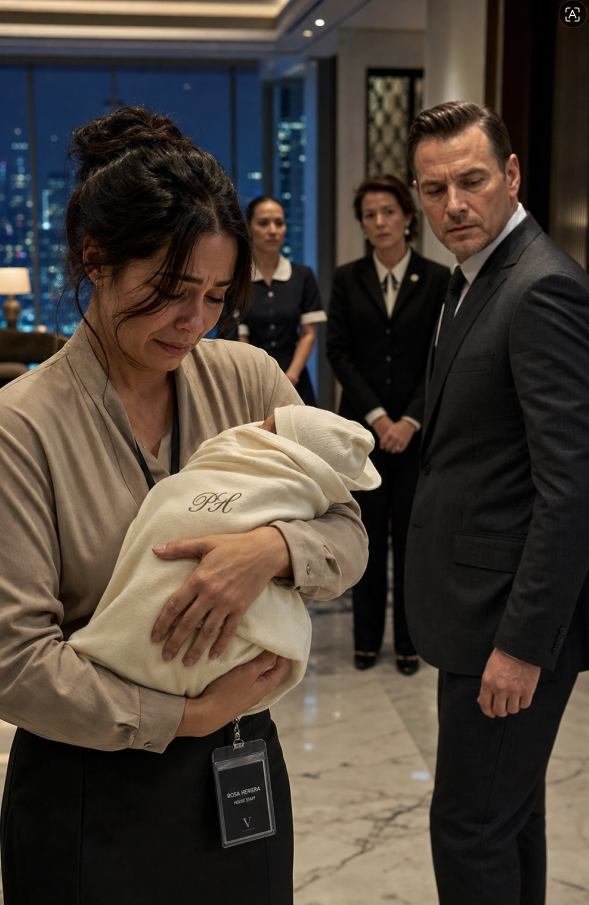
But that same night, in the same overwhelmed ward, Damian’s sister had also given birth. Her baby had died. And in the chaos of a understaffed night shift, two bracelets were misread, two charts were crossed, and a mistake was made that no one ever caught — because who checks, when everyone is already grieving?
The baby they told me was dead was alive.
She’d been going home in another woman’s arms for three years. Damian’s sister had raised her, loved her, named her — and then died in a car accident the week before, sending the child to the only relative left. To a blanket I’d sewn. To a penthouse. To me, a temp who wasn’t supposed to touch anything.
The DNA test took nine days. Damian paid to have it rushed and it still felt like nine years.
When the results came, he called me into the same office where he’d told me not to touch anything, and he couldn’t speak for a moment. Then he said, “She’s yours. She was always yours. And my sister —” He stopped. “My sister loved a daughter who was never legally hers, and never knew. I don’t know what to do with that.”
Neither did I. That’s the thing no one tells you about a miracle: it can arrive already broken. My daughter was alive. And another woman had been her mother for three years, a woman who had also lost a child that night, a woman who could no longer explain or apologize or ask me for anything.
I did not take my daughter and run. I wanted to. But she was three years old and she had just lost the only mother she’d ever known, and grabbing her out of grief would have made me feel whole while breaking her all over again.
So I did it slowly. I stayed. Damian gave me a real position and a real salary and a floor of that penthouse, and I became, at first, the kind woman who was always around. Then the woman she reached for. Then, one ordinary morning, “Mama,” said without anyone teaching it, and I had to leave the room so she wouldn’t see me come apart.
The hospital settled quietly, which is what hospitals do. The money went into a trust for her. I didn’t want it near me; it smelled like the worst night of my life.
Damian and I are not a fairy tale, whatever the building gossip says. He is still difficult and I still tell him when he’s being impossible, which no one else on that floor will do. But he stood beside me through DNA tests and custody filings and a grief with no clean shape, and he never once told me not to touch anything again.
People ask me, when they hear pieces of this, whether I’m angry at the hospital. I was, for a while — a white, useless anger with nowhere to go. But the two nurses on that ward that night weren’t villains. They were two people covering a shift built for six, in a system that counts beds and not the mothers in them. The mistake that took three years of my daughter’s life away from me was not one cruel person. It was a hundred small ordinary failures stacked on one terrible night. That’s harder to forgive than a villain, and I’m still working on it.
My daughter is four now. She sleeps under the blanket I stitched with shaking hands in a hospital chair, the one I thought I’d buried. The uneven corner is still uneven. The little knot I tied to say goodbye is still there.
Except it turned out not to be goodbye at all.
Comments are closed.