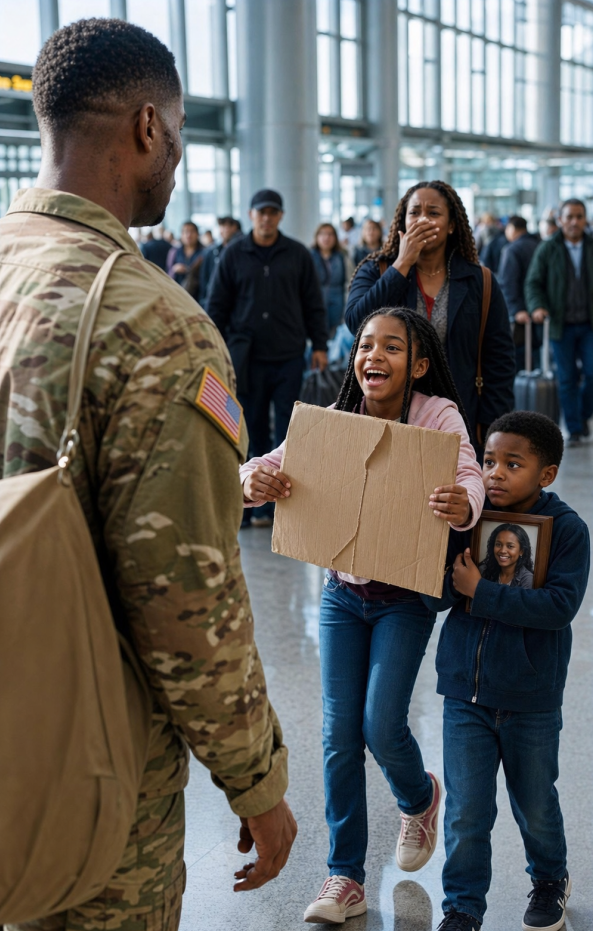
Luis went down to his knees before he reached them, so the kids hit him at the level of his chest instead of his waist, and he wrapped one arm around each of them and made a sound into their hair that I don’t have a word for. Half the terminal had stopped to watch by then. A gate agent was crying. A stranger in a business suit was filming with his hand over his own mouth.
For about sixty seconds it was the pure thing. The thing the sign promised. WELCOME HOME DAD, in eight-year-old Sofia’s careful marker, the D in DAD bigger than the rest because she’d run out of room.
Then Mateo, who is five and does not understand what he is holding, pushed the little framed photo up into his father’s face and said, “Look, Daddy, we brought Mommy so she could see you too.”
And I watched Luis go still.
I am the aunt. Diana. My sister Elena was Luis’s wife, and it falls to me to tell you the part the children could not.
When Luis’s convoy went down eighteen months ago and he was listed as missing, Elena did not fall apart the way people expected. She got quiet and strong and terrifying. She kept his coffee mug in the cabinet. She told the kids, every single night, “Daddy is lost, not gone, and lost people can be found.” She wrote letters to congressmen. She kept his side of the bed made. She believed, with a ferocity that frightened the rest of us, that he was coming home.
Six months ago, she was killed by a drunk driver two miles from the kids’ school. Instantly. Senselessly. After surviving the unsurvivable wait, she was taken by something stupid and ordinary on a Tuesday afternoon.
We didn’t know how to tell Luis. We didn’t even know if Luis was alive to tell. And then, three weeks ago, the call came that he had been recovered, and was coming home, and in all the shock and joy of it, the Army’s family liaison and I made a decision I will second-guess for the rest of my life: we did not tell him about Elena over the phone. Not while he was still in a medical facility overseas, fragile, being debriefed. We told ourselves he needed to be home, on solid ground, held by his children, before he learned that the woman who kept the light on for him had gone out.
The kids knew their mother had died. But they are five and eight, and grief at that age is not a straight line. Sofia had helped Elena start that sign months ago, before the accident — “for when Daddy comes home” — and after Elena died, finishing it became the thing Sofia held onto. In her mind, bringing Mommy’s photo to the airport was not tragic. It was completeness. Everyone who loved Daddy, present for the moment he came back.
So there it was. Luis, on his knees on an airport floor, holding his living children and a photograph of his dead wife, and reading the truth off Mateo’s face and mine in the space of a single breath.
He didn’t drop the photo. That’s the detail I can’t shake. A lesser moment would have had him drop it. Instead his hand closed around it, and he pulled both kids in tighter, and he looked up at me over their heads with a question in his eyes, and I nodded, and I watched eighteen months of hope for one particular reunion die in a man who had already died once on paper.
Then he did something I will be grateful for until I’m gone. He did not let the children see it break him. He kissed the top of Sofia’s head and said, “This is the best sign anybody ever made.” He took the photo from Mateo and held it up so it faced out, toward the three of them, and said, “There. Now she can see. She never stopped waiting for this, you know. Not for one day.” And Mateo beamed, because to him that was simply true, and Sofia’s chin trembled because she is old enough to hold two things at once.
We grieved Elena properly, later, the four of us, once Luis had his feet under him. He stood at her grave in his uniform and told her she’d been right. Lost, not gone. Found. He’d made it home. He was just three seasons too late to be found by her.
He is a good father, made better and quieter and more careful by everything he lost. He kept the cardboard sign. It’s framed now, in the front hall, next to the photo Mateo carried. Two homecomings, he calls it. One that arrived, and one that was already waiting on the other side.
I still can’t walk through an arrivals gate without scanning the crowd for a crooked sign. I don’t think I ever will again.
Comments are closed.