The attorney’s name was Mr. Whitfield, and he had been trying to reach me since before the funeral even started. He told me that later, apologetic, as if the timing were his fault. He’d called three times that morning while my phone sat silenced in my coat pocket, because you don’t take calls at a graveside.
I only picked up the fourth time because Bradford Vance had just finished telling a semicircle of mourners, loudly enough for me to hear, that “the help always circles back for the money.” His mother had laughed her small cold laugh. And I stepped away from the grave more to get out of earshot than anything else, and my phone was buzzing again, and I answered it just to have something to do with my shaking hands.
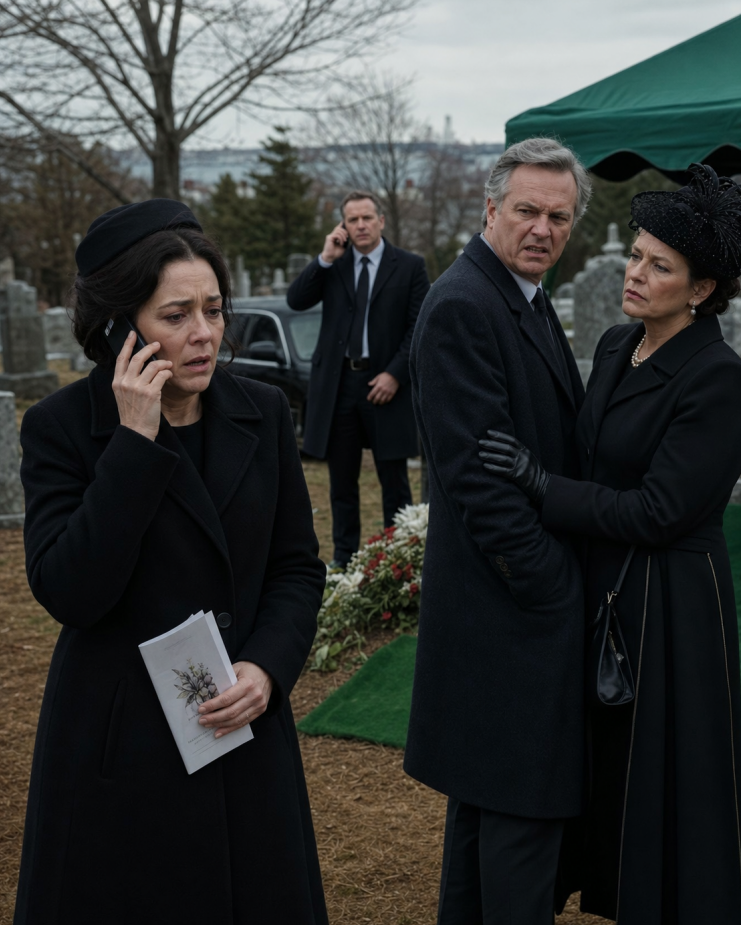
“Mrs. Okafor,” Mr. Whitfield said. “I’m the executor of Mr. Ellison’s estate. I need to confirm you’re aware of the provisions he made for you.”
I said I wasn’t aware of anything. I said I’d cared for the man for two years and expected nothing, which was the truth. I had a folded funeral program in my other hand and I remember pressing it flat against my leg while he talked, the way you hold onto something solid when the ground moves.
Because what he told me, standing in that cold wind with the dirt still fresh, was that Harold Ellison had made me chair of his foundation. Not a beneficiary of some small remembrance. Chair. And he had left the foundation’s endowment — the whole of it — under my direction.
I need you to understand what Harold’s foundation was. It wasn’t a vanity fund. It gave millions a year to hospice programs and caregiver-respite grants, the kind of quiet money that keeps exhausted families from breaking. And Bradford’s nonprofit — the one he ran like a personal brand, the one that threw the galas he liked to be photographed at — had been counting on absorbing Harold’s endowment the moment the old man died. It was in their projections. It was, I would learn, already half-spent on paper.
Harold knew that. That was the part that undid me. In his last clear months, when I thought we were just passing the afternoons, he had been paying very close attention to who his family really was.
I’d started with him two years earlier through the agency, a standard assignment: elderly gentleman, widower, needs daytime care, some overnight coverage. I learned his medications. I learned that he took his tea too strong and pretended the doctor had never said otherwise. I learned the exact pitch of the panic that came over him at three in the morning when he woke not knowing the year, and how to talk him down by naming small ordinary things until the room came back to him.
Bradford visited twice in two years. His mother, Margery, sent a fruit basket at Christmas with a card signed by a service. When Harold was in the hospital that final spring, it was me in the chair by his bed, not them. I didn’t resent it at the time. I told myself grief made people strange, that they’d show up when it counted.
They showed up at the graveside, all right. In good coats, with the right expressions, and the first thing Bradford did when he saw me was decide out loud what I was.
“Chasing money,” he’d said. “Watch. She’ll have a lawyer by the end of the week.”
He was wrong about the direction of it. I didn’t have a lawyer. Harold’s lawyer had me.
I stood there with the phone against my ear and I could feel my face doing something I couldn’t control — the grief was still real, he was still gone, and I was still the woman who’d held his hand at the end — but underneath it something else was rising, and it took me a moment to name it. It wasn’t triumph. It was being seen. Harold had seen exactly what I gave him, and he had seen exactly what they hadn’t, and from wherever he was now he had reached back and made sure the difference would matter.
Mr. Whitfield asked if I could come to his office that week. He said there were people who would want to meet with me quickly — he was too polite to say it, but I understood he meant Bradford’s board, the ones with the projections, the ones who were about to learn that the fund they’d already spent belonged to a caregiver they’d never bothered to learn the name of.
I said I could come Thursday.
When I hung up and turned back toward the grave, Bradford was watching me with that same sneer, sure he’d read the whole scene correctly. Margery had her gloved hand on his arm. Behind them the green burial tent snapped in the wind, and Harold’s flowers had already started to wilt.
I walked back over. I didn’t gloat — Harold wouldn’t have wanted the fight at his own graveside, and honestly I didn’t have it in me, not with the wound of him still that fresh. I just said, quietly, that I’d be in touch through Mr. Whitfield about the foundation.
I watched Bradford’s face try three different expressions and land on none of them.
The bittersweet part — the part I still sit with — is that Harold never got to see it. He’d arranged the whole thing and then he’d had to die before it could land, and I would have traded every dollar of that endowment for one more strong-tea afternoon with him complaining about his doctor.
But he’d known what his family was. And he’d made sure that the last thing he did in this world was hand the people who shamed the caregiver a reason to answer to her for the rest of their lives.
Comments are closed.