The lawyer came in out of the cold while they were still laughing about me.
I want to set the table exactly, because the geography of that room matters. The marina club puts its best people by the tall windows, where the moonlight lays a silver road across the harbor and the moored boats rock like they’re breathing. That’s where they seated Roger, my ex-husband, and his investor friends — six of them in cocktail dresses and open collars, tanned from a summer of pretending to sail. And they put me at the small round two-top back by the service door, where the waiters come and go and the light is bad, with a card that said my name misspelled.
I didn’t ask to be moved. I had come because I was invited, technically, as a member’s former spouse, and because I had nowhere else to be that night and the club had good soup. That is the honest truth. I was fifty-two years old, freshly nobody, and I had spent the last four years of my life driving a reclusive old man named Captain Ambrose to his doctor’s appointments and reading him the shipping news because his eyes had gone.
Roger’s table found that hilarious.
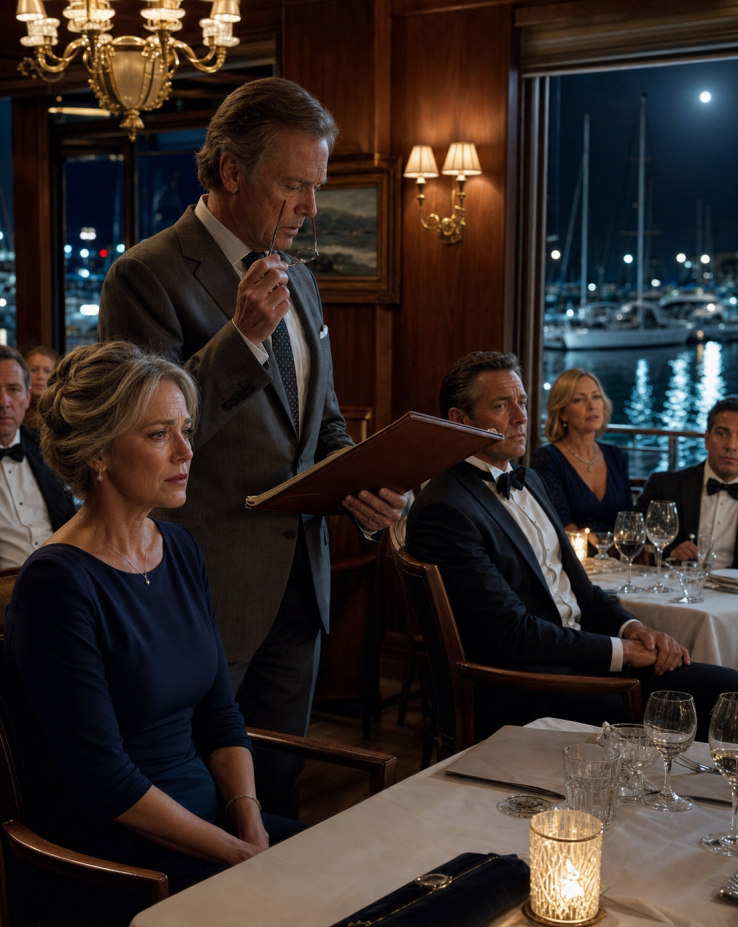
I could hear them. That’s the thing about the worst table — you’re close enough to the good one to hear everything. Roger was telling the story of me the way he liked to tell it, the version where I was the foolish woman who’d thrown away a comfortable marriage and then, instead of landing a wealthy second husband like a sensible person, had gone and made myself the unpaid nurse of a “crazy old barnacle” down at the docks. “Four years,” he said, swirling his drink. “Four years wiping the chin of a man with no family and no money, and for what? A thank-you? She could’ve had the lake house.”
They laughed. One of the investors, a florid man named Perle who I’d later learn was the money behind the whole scheme, laughed hardest. “Sentimental,” he said, like it was a diagnosis.
What none of them knew — what I barely let myself feel that night because the grief was still so new — was that Captain Ambrose had died three weeks earlier. In his sleep, in the little house above the boat works, with the harbor lights on the ceiling the way he liked. I had been the one to find him. I had been the one to close his eyes. And I had assumed, because he had told me a hundred times he had nothing, that the reading of his affairs would be a short and lonely thing.
I did not know that “nothing” was the old man’s joke.
Because here is what Roger’s investors were toasting that same night, at that same window table: they had spent two years quietly buying up the tired old parcels around the north basin of the harbor — the boat works, the bait shop, the long-term slips — assembling them into one footprint big enough for a luxury resort and marina. A hundred million dollars of glass and infinity pools where the fishing boats now tied up. They had almost everything. They toasted “the last piece” that night. I heard Perle say it. “Once we’ve got the keystone, gentlemen, we break ground in spring.”
The keystone was the deep-water harbor frontage. The one parcel the whole resort was worthless without.
The one parcel that belonged to a reclusive old man named Captain Ambrose.
The lawyer’s name was Mr. Fenwick, gray suit, older than me, and he came to the club that night not for the dinner but because the estate had listed me as a party to be notified and this was where he’d been told I would be. He found me at my bad little table by the service door. He asked, quietly, if I was Marta. And then, because Roger’s table had gone curious and quiet watching a stranger bend down to the club’s least important guest, Mr. Fenwick did something I will be grateful for until I die.
He straightened up. He opened his leather folder. He put on his reading glasses. And in a clear, unhurried voice that carried across that whole silver-lit room, he read the relevant clause of Captain Ambrose’s last will and testament.
The captain had left everything he had — which turned out to be far from nothing — to “Marta, who came when no one else did.” The house. The boat works. And the deep-water harbor frontage at the north basin. Free and clear. To me.
I watched Roger’s face while Mr. Fenwick read the legal description of the parcel. I watched him do the arithmetic. I watched Perle set his drink down very carefully, as if it had become fragile. Because the men who had spent two years and a fortune assembling a resort had just learned, in a room full of witnesses, that the single piece they needed most now belonged to the sentimental woman they’d seated by the trash.
They came to me, after. Of course they did. Perle first, all warmth now, talking numbers with a lot of zeroes. Roger, who hadn’t said a kind word to me in six years, suddenly remembering our history. I let them talk. I have not decided yet what I’ll do with the harbor — whether I’ll sell it to them for a sum that would let me live like the queen they never thought I’d be, or keep it exactly as the captain left it, fishing boats and bait shop and all, out of pure stubborn love.
But I’ll tell you the truth that sat under the whole triumphant evening, the part they couldn’t see. I would give the harbor back. All of it. Every dollar it’s worth. I would hand it to Perle tomorrow if it meant one more afternoon of reading the shipping news out loud to a blind old man who, it turns out, had been listening to every word — and who had decided, quietly, that the woman no one valued was the only person in the world he trusted with the water he loved.
He saw me. That was the whole inheritance. The harbor was just the receipt.
Comments are closed.