I answered her in Mandarin first. Then French. Then Arabic. Then, finally, in the English she’d just told two hundred people I couldn’t speak.
Diane’s champagne glass was still raised. She hadn’t put it down yet, because in her mind the joke was still landing, the room was still hers, and the help had been put in its place. It took her a few seconds to understand that the room had gone quiet for a different reason now.
“My name is Amara,” I said. “And I’d like to talk about your son.”
I want to be honest about something. I wasn’t supposed to make a scene. That’s not what I was hired to do. My job was to observe, document, and report — quietly, professionally, the way I’ve done it for eleven years as a licensed private investigator. The bride, Katherine, had hired me three weeks earlier, sitting across from me in my office with her hands twisted in her lap, saying the words that bring so many people to my door: something isn’t right, and everyone tells me I’m imagining it.
She wasn’t imagining it.
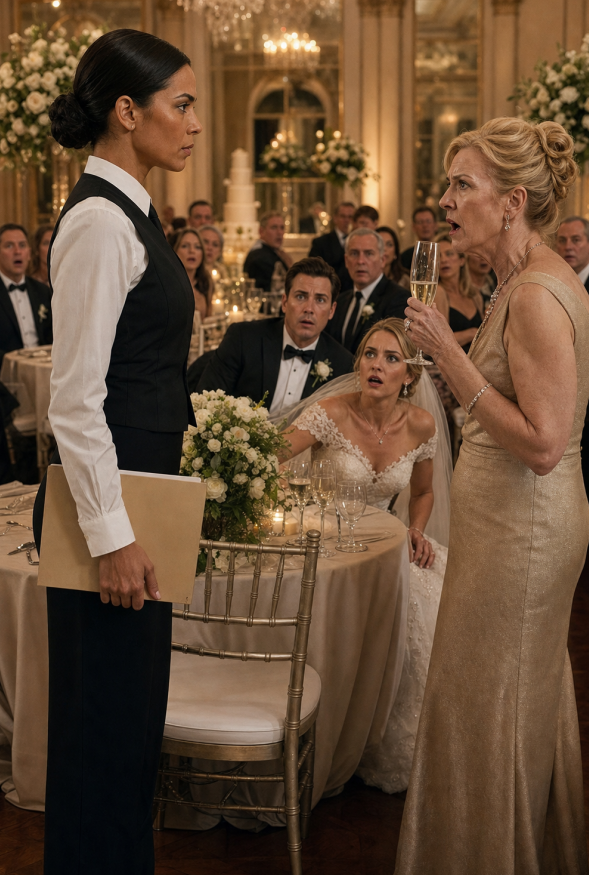
I’d taken the serving job because the family’s rehearsal-dinner venue needed extra staff and it was the cleanest way inside. For three weeks I’d been invisible in the exact way Diane assumed I was — pouring water, clearing plates, unseen and unheard while people who think servers are furniture said all kinds of things in front of me. It’s remarkable what people reveal when they’ve decided you don’t count.
I hadn’t planned to reveal myself tonight. I had enough. Katherine and I were going to meet Monday, and I was going to hand her a folder and let her decide what to do with her own life.
And then Diane tapped her glass and decided to make me the entertainment.
Here’s the thing about being underestimated: it’s a weapon, if you can keep your temper long enough to use it. I felt the old heat climb up my neck when the room laughed. I’ve felt it my whole life — the assumption that an accent means an empty head, that quiet means slow. I could have swallowed it one more time.
But Katherine was sitting at that head table in her wedding dress, going pale, about to marry into this. And I thought: no. Not tonight. Tonight the invisible woman talks.
So I told them.
I told them, in plain English, that the groom — their golden son, Daniel — had a second phone. That it lived in the lining of his gym bag and lit up most nights after eleven. I told them there was a woman named Rachel in a suburb forty minutes north, and a lease with both their names on it, and a toddler whose daycare pickup Daniel handled every Thursday under the story that he had “standing client dinners.”
I recited the address. I recited the daycare’s name. I watched Daniel’s face go from amused to white to something like drowning.
“You’re lying,” Diane said, but her voice had lost its edges.
“I have photographs,” I said. “I have the lease. I have eight weeks of documentation. I’m very thorough, Mrs. Ashford. It’s my job.” I set the slim folder on the head table, right next to the untouched wedding cake. “I’m not a server. I’m a private investigator. Katherine hired me a month ago because she trusted her own instincts more than she trusted the people telling her to ignore them.”
The hall was so silent I could hear the ice settling in the buckets.
Katherine stood up. In front of everyone, in that enormous white dress, she walked over, and for one terrible second I didn’t know what she’d do. Then she picked up the folder, held it against her chest like something precious, and turned to face the man she’d almost married.
She didn’t scream. She was quieter than I expected, and that made it worse for him. She just asked him one question: “Is her name Rachel?”
He didn’t answer. That was the answer.
What happened after that took about twenty minutes and felt like an hour. Daniel followed Katherine into a side room, still trying to spin it, and she came out alone. Diane cornered me by the coat check and hissed that I’d ruined her family, that I was a hired liar, that I’d never work in this city again — and then Rachel herself walked into the reception hall.
Because here’s the part even I hadn’t planned: Rachel had found out about the wedding two days earlier. She’d thought she was Daniel’s only one. She’d come to see it with her own eyes, toddler on her hip, and she arrived just in time to watch the whole thing collapse. Two women, one man, and the truth standing between them holding a diaper bag.
I left before the police were called about the scene Daniel’s father made in the parking lot. That part wasn’t my business anymore.
Katherine called me a week later. She sounded lighter than I’d ever heard her. She thanked me — not for finding the truth, she said, anyone with a camera could have done that. She thanked me for standing up in that room when I could have stayed invisible one more night. “You didn’t have to do it like that,” she said. “In front of everyone. For me.”
I told her the truth. “She handed me the excuse,” I said. “I just decided to stop being polite about it.”
Diane never did get me blacklisted. Turns out when a mother spends a reception mocking a stranger’s intelligence and that stranger turns out to be the investigator who saves the bride from marrying a bigamist, the story doesn’t travel the way she’d hoped.
I still get quiet in rooms full of people who assume things about me. I still pour the water. But I’ve stopped mistaking their assumptions for the truth about myself. Four languages, eleven years, one very good folder. They called me the woman who could barely speak.
They should have wondered why I was listening so carefully.
Comments are closed.