The admiral’s name was Vice Admiral Harlan Grost, and I had never met him before in my life, and he walked past the woman in the black designer coat as if she were a coat rack.
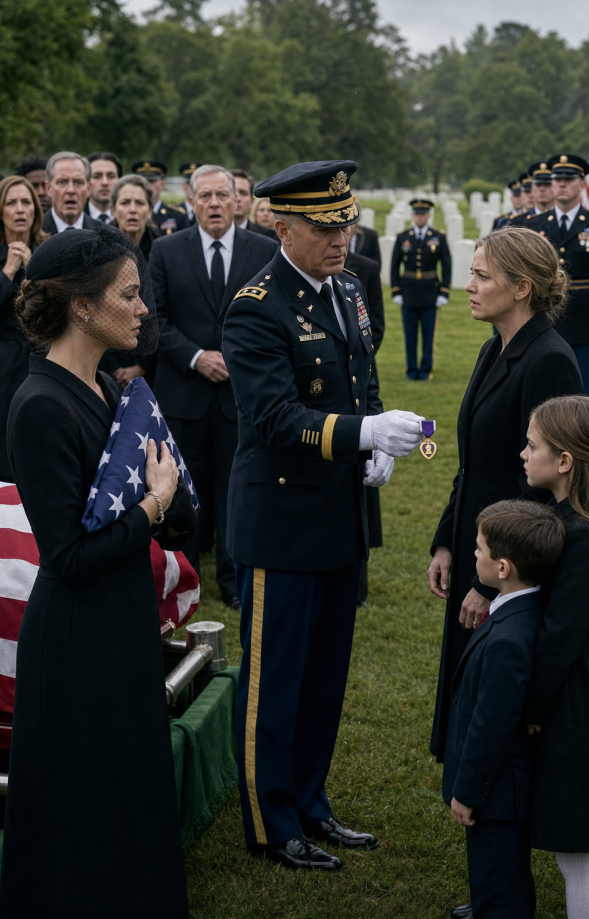
I was in the third row of folding chairs, in the section they’d quietly steered me to — “family friends,” the usher had said, checking his list twice and not finding me where I should have been. Up front, in the seat that should have been mine, sat a woman I’d seen exactly once, in a photograph on my husband’s phone that he’d sworn was “just someone from work.” She wore black beautifully. She dabbed at dry eyes with a black-gloved hand. And when the honor guard lifted my husband’s medal from its velvet cushion, she leaned forward, chin up, ready to be honored.
Let me back up.
My husband, Daniel, was a Navy officer. We’d been married nine years. Eight months ago he was killed in what the Navy would only describe as an “operational accident,” and in the fog of those first weeks — the casualty officers, the paperwork, the funeral I could barely stand up through — a woman had inserted herself. Somewhere in the machinery, her name had ended up on forms where mine belonged. She had documents. She had a story. She had, I would later learn, a forged marriage certificate and a very good lawyer, and she had used the eight months since Daniel’s death to position herself as his widow for one specific reason: the ceremony where the Navy would present his posthumous decoration, and the benefits and the standing that came with being the woman who accepted it.
I’d tried to fight it. I’d called and written and stood in offices and been handed tissues by people who clearly thought I was a confused, grieving woman making trouble. She was so polished. I was so wrecked. It’s amazing how much the world will believe about a woman based on which one of them is crying more elegantly.
So by the day of the ceremony I had almost given up. I came anyway. I sat in the third row because I could not stay away from the last honor my husband would ever receive, even if I had to watch a stranger accept it.
Then Vice Admiral Grost arrived.
He wasn’t on the program. You could feel the ripple when he came in — junior officers straightening, the presiding captain going pale and hurrying over. Grost waved him off. He walked to the front, and the impostor rose with her practiced sad smile and extended her black-gloved hand, and the admiral looked at it, and looked at her, and did not take it.
“You’re not Sarah Voss,” he said. Not cruelly. Just flatly, the way you’d correct a clerk. “I’ve seen Sarah Voss’s photograph in Lieutenant Commander Voss’s file every time I signed off on his deployments for six years. You are not her.”
The room went very, very quiet.
Then he turned, and he scanned the folding chairs, and I realized with a jolt of pure terror that he was looking for me. Our eyes met. He didn’t know my face — but he knew, somehow, where to look, and later I’d learn why. He walked down the aisle to the third row, and he stopped in front of me, and this decorated man with more ribbons than I could count came to attention and saluted me.
“Mrs. Voss,” he said. “I apologize. This should never have gotten this far. Would you come with me, please.”
I don’t remember standing. I remember his hand under my elbow, steadying me, and I remember the sound the impostor made, and I remember that no one moved to help her.
Here is what Grost told me, later, in a small office with the door closed. Daniel had, in the last year of his life, been assigned to work that the admiral oversaw. Daniel had known it was dangerous. And Daniel — this is the part that undid me — had sat in Grost’s office nine months ago and said, in that quiet way he had, “Sir, if anything happens to me, my wife’s name is Sarah. There may be someone who tries to make trouble about that. I don’t know why I feel the need to say it. Just — remember her name. Sarah.”
He’d had a feeling. My careful, unsentimental husband had had a feeling, and he’d planted my name in the memory of the most powerful man he knew, like a seed, like an insurance policy written in nothing but trust. And when the ceremony landed on the admiral’s desk with the wrong widow’s name attached, Grost had looked at it, and remembered, and gotten on a plane.
The impostor’s scheme came apart fast once someone with stars started pulling threads. The forged certificate, the lawyer, the benefits she’d already begun to claim — all of it unwound over the following weeks into fraud charges I understand are still working their way through the courts. I don’t follow it closely. I find I don’t need to. She was never really the point.
They redid the presentation. Quietly, in that same small office, just me and the admiral and two officers as witnesses. Grost lifted Daniel’s medal from its cushion himself, and he told me what my husband had done to earn it, the real story, the one that wasn’t in any press release, and then he placed it in my hands and closed my fingers around it.
“He talked about you,” Grost said. “For a man who kept everything close, he talked about you. I think he’d want you to know that.”
I’ve thought a hundred times about that feeling Daniel had. About him sitting in that office, healthy, alive, deciding for no reason he could name to say my name to a superior officer. I used to think it was luck that saved me from that woman. I don’t anymore.
I think it was him. Reaching forward through time, the only way he could, to make sure that when the moment came, someone in that room would look past the polished stranger in black and find the real one, in the third row, and know her name.
Sarah. He remembered her name. Because Daniel made sure he would.
Comments are closed.