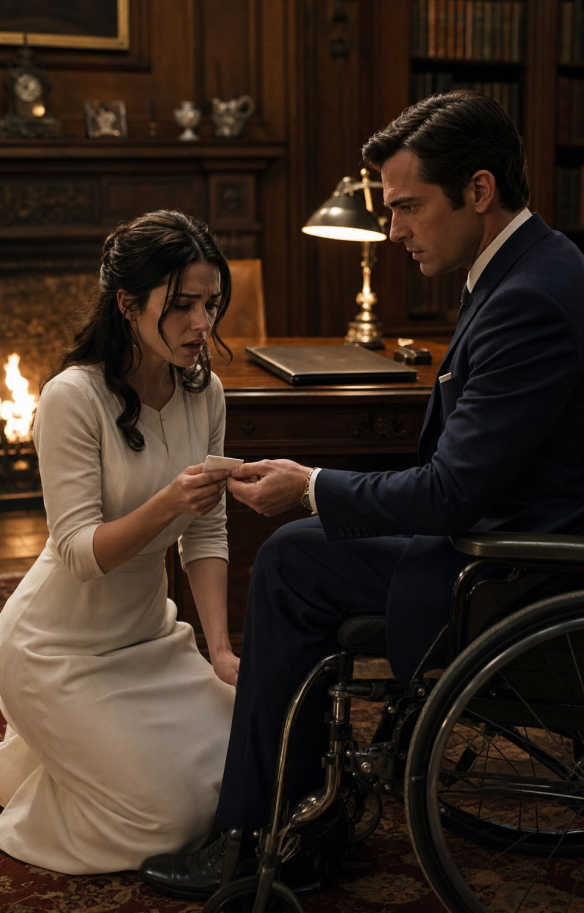
I opened my hand under the lamp and unfolded the note, and there were three words in it, in handwriting that shook so badly each letter looked like it had been dragged across the paper.
They stole everything.
I looked up at Julian. His eyes — which the whole family swore were empty, which the doctors described in front of me like he was a piece of furniture with a pulse — were fixed on mine with an intelligence so sharp it frightened me. He gave the smallest nod toward the desk. Toward the black folder marked ASHFORD MARITIME — MERGER that his uncle had left there for him to sign by Friday.
I need to explain how I got there, because otherwise the note means nothing.
My mother was dying. Not dramatically — slowly, expensively, in the way that empties a family without a single villain to blame. The bills came in envelopes I stopped opening. And then a man named Gerald Ashford, who I’d met exactly once, offered a solution so clean it should have terrified me more than it did: marry his nephew Julian. Julian was thirty, wheelchair-bound and mute after an accident two years prior, the sole heir to a shipping fortune, and — per the family trust — required to be married before his thirty-first birthday or lose control of the company to the wider family.
They needed a wife. Not a real one. A signature in a dress. Someone with no money and no family power who would sign what she was told to sign and be grateful.
I signed. My mother’s debts vanished the day after the ceremony. I told myself I was doing a kind of transaction, that no one was hurt, that Julian couldn’t even know I existed.
That first night, alone with him in the study, the guilt got to be too much. I knelt down beside his chair — I don’t know why, it just felt wrong to loom over him — and I confessed. I told him I never wanted his money. I told him I’d have chosen a kind poor man in a heartbeat. I told him I was sorry he’d been sold off same as me, to a stranger who’d knelt beside him and called it a marriage.
And his hand moved.
They stole everything.
Over the next weeks — slowly, secretly, in the pockets of time when the “nurse” the family had hired stepped out — Julian showed me the rest. He could hear perfectly. He could think perfectly. His speech and his hands had been damaged in the accident, but not destroyed, and here is the thing that turned my stomach: the family had known his recovery was possible, and had made sure it didn’t happen. The “physical therapy” that never came. The medications that kept him foggy and weak. The doctor who was Gerald’s man, paid to describe Julian as hopeless to anyone who asked.
Because a hopeless heir who couldn’t communicate was an heir whose company you could loot. And they had been looting it — Gerald and a cousin named Jason — for two years, through fake vendor contracts and a “merger” that was really a mechanism to move the last clean assets into a structure they controlled. Once Julian signed that folder, the theft would be finished and legal and permanent.
They’d married him off to satisfy the trust, and they’d chosen me precisely because they thought I was too poor and too desperate and too grateful to ever look up from the paperwork.
They chose wrong, but not for the reason they’d have feared. I wasn’t clever. I wasn’t connected. I was just the first person in two years who had knelt down to Julian’s eye level and spoken to him like a man instead of over him like a problem.
So we did it carefully. I was the one person in that house who could move freely, who could carry things out, who could make phone calls the “nurse” wasn’t monitoring. Julian directed and I ran. We got a blood sample to an independent lab that showed the sedative levels no one had prescribed. We got the real accounting to a forensic attorney — not the family’s lawyer, a stranger from three states away, because Julian’s shaking note had warned me lawyer, not family, the attorneys presenting the merger served the cousins, not him. We documented every fake contract. And when we had enough, we did not confront Gerald across a dinner table like something out of a film. We went to the authorities, and we let the paperwork — the thing they’d tried to use to erase Julian — bury them instead.
Gerald and Jason are facing charges I don’t fully understand the names of. The merger is void. The doctor lost his license. Julian, on real therapy, on the right side of the medications, has some words back now — slow, effortful, but his — and he can move his right hand well enough to sign his own name, which is the only signature that folder ever actually needed.
People ask if it’s a real marriage now. I don’t have a clean answer. We were two people sold to each other by a family that wanted us both compliant and quiet. What we became, saving each other from that, is something I don’t have a tidy word for.
But I know that the first honest moment either of us had experienced in years was a woman kneeling in a firelit study saying she’d have chosen kindness, and a man who everyone called empty deciding — with three shaking words — to trust her with his life.
He needed me to move first. I did. And everything they stole is coming back into the hands they tried to still.
Comments are closed.