I looked at Tomás, and I told him the truth. Just not all of it, and not in the order that would get me killed.
“There are two,” I said. “Your cousin is carrying twins. The first one is breech, which is why she’s in trouble. I can turn him, or we lose time and lose them both. I need my hands and I need everyone who isn’t holding a light to step back.”
Something moved through the room then. The woman on the bed — Elena, they called her — made a sound that was half sob, half relief, because a frightened person will grab onto a competent voice like a rope. The two men by the door shifted. And Tomás, who had emptied my bag onto the floor twenty minutes earlier and stood over me with a pistol on his hip, took one step back.
That step was everything. That step was me becoming the person in charge of the room without anyone deciding to let me.
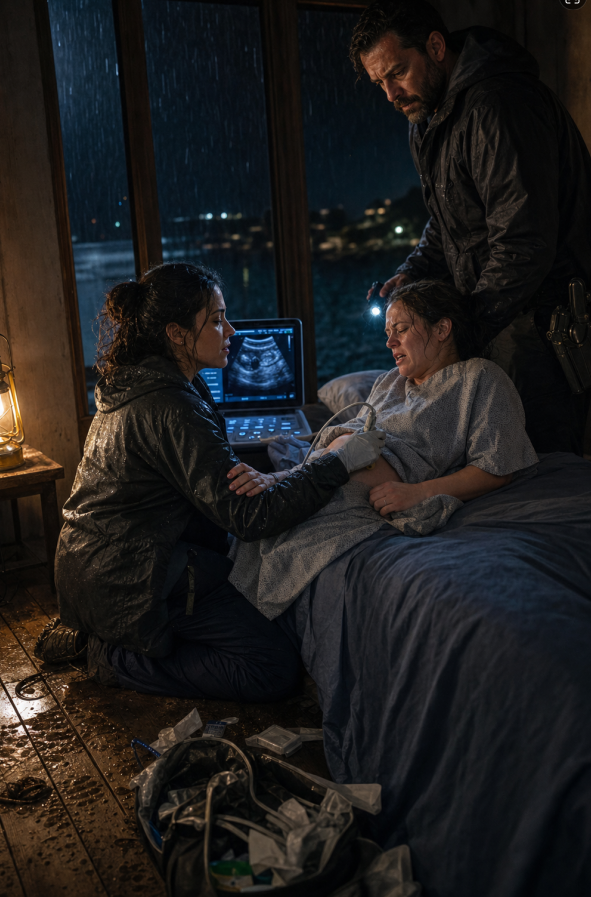
I worked. I won’t pretend it was clean or calm inside my own chest, but my hands have done this a hundred times in places with lights and monitors and a second doctor, and they did it now in a lakehouse bedroom lit by a camp lantern and two phone flashlights, with rain coming through a gap in the window frame and running down the wall. I turned the first baby. It took longer than I wanted. Elena screamed and gripped the sheets and I talked her through it in the low steady voice I use when I’m most afraid, because the voice is for them, not for me.
The first baby came. A boy. He was blue for three seconds that lasted a year, and then he wasn’t, and he cried, and the whole room exhaled like one animal.
The second baby came easier. Another boy. And when I laid him on Elena’s chest and wiped him clean, I saw again the thing the ultrasound had shown me, the thing I’d kept off my face in the dark. On the second baby’s tiny left forearm was a birthmark. Wine-dark, distinct, shaped like a comma. I had seen that exact birthmark before. Not on a baby. On the forearm of the man standing across the room with a gun on his hip.
Tomás wasn’t the cousin’s driver. Tomás wasn’t muscle. Tomás was the father of the child he’d been guarding at gunpoint, and he didn’t know Elena had been carrying two, and he didn’t know one of them would come out wearing his own mark on its skin.
I understood, in the space of one breath, the whole shape of the thing. Elena wasn’t the boss’s cousin. She was the boss’s problem — a woman carrying evidence of something that happened inside that organization that was never supposed to leave a trace. And the men who’d dragged me up that canyon at gunpoint weren’t there to protect a birth. They were there to make sure of an outcome, one way or another, and to have a doctor’s word for whatever they decided the outcome had been.
But now there were two babies. And one of them belonged to the man they’d sent to watch.
I didn’t say any of it out loud. I didn’t have to. I wiped the second baby’s arm a little longer than I needed to, and I looked up, and I let Tomás see me see it. Just that. A doctor’s eyes moving from the birthmark to his face and back.
His jaw went tight. His hand drifted off the pistol.
“I need to take both boys and the mother to a hospital,” I said, still in the steady voice. “Tonight. There are complications with the second delivery that need monitoring.” There weren’t. Both boys were fine. But I was the only person in that room who could say what did and didn’t need a hospital, and I had just become a person no one in that room wanted to contradict. “I’ll need a car, and I’ll need it to be me who drives them in. Alone.”
Tomás looked at the baby on Elena’s chest. The one with his mark. You could watch the arithmetic happen behind his eyes — what it would mean if that child left in a car he controlled, and what it would mean if it left in one he didn’t, and how much he suddenly, desperately did not want anyone above him deciding which.
“You’ll drive them,” he said. “I’ll ride with you.”
“You’ll ride with me,” I agreed. And I started packing my bag off the floor, piece by piece, taking my time, because a person in charge of a room does not hurry.
They put us in an SUV as the storm was breaking up over the lake. Elena in the back with both boys, Tomás in the front passenger seat with his hands empty and his eyes on the child, me at the wheel on a mud road I’d been blindfolded for on the way in and had to feel my way back out of.
I got them to a county hospital an hour before dawn. I filed the birth under real names, in a real system, in a place with cameras and witnesses and a paper trail that could not be dumped onto a bedroom floor — and the moment that record existed, so did the leverage. Elena and the twins were suddenly people the world knew about. You cannot make a documented mother of two vanish the way you can make a rumor vanish. I had traded one hidden truth on a glowing screen for the only currency that mattered: a public one.
Tomás never came inside. He sat in the parking lot until the sun came up, and then the SUV was gone.
I don’t know the whole of what I stepped into that night, and I’ve made my peace with not knowing. But I know Elena and her boys are alive and on a grid, and I know the man with the comma-shaped mark on his arm learned there was a version of his son’s story that lived somewhere he couldn’t reach.
I still keep my field bag packed by the door. But now I keep the ultrasound charged, always, and I think about how the thing that saved all four of our lives wasn’t my hands. It was one small mark on a newborn’s arm, and the fact that I saw it first, and had the sense to say nothing until it was worth everything.
Comments are closed.