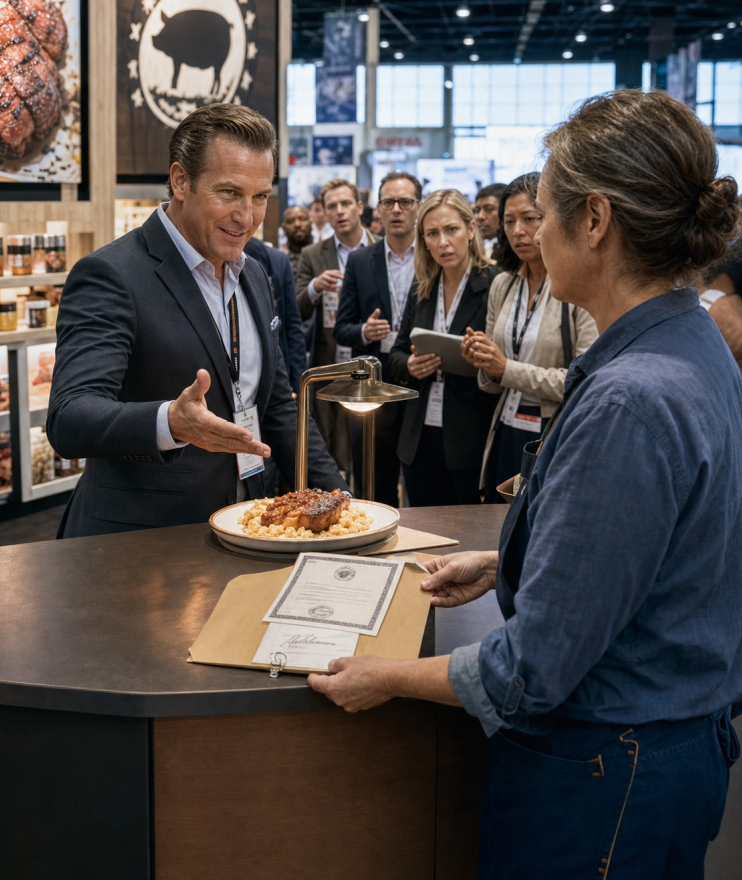
The young brand manager read the top page first. I watched her lips move over the words “federal trademark registration” and then stop moving altogether.
Grant Whitlock — that was the executive’s name, I’d learn it a dozen times over the next hour — kept his showman’s smile up for exactly four more seconds. Long enough to say, into the microphone, “I’m sure there’s a simple explanation.” Then he actually read what was in front of him, and the smile came off his face like a sticker peeled from a cold window.
The certificate was plain enough. The name of the dish, the recipe, the plating description — all registered to me, Della Mercer, eleven years ago. My lawyer friend Harold had walked me through it back then over a slice of pie, telling me I was being paranoid but humoring me anyway. “Nobody’s going to steal a diner recipe, Della,” he’d said, stamping the forms. “But it’ll cost you forty dollars to sleep better, so let’s do it.” Forty dollars. Eleven years. And now it was the only thing standing between me and a man with a marketing budget bigger than my whole county’s economy.
But it was the second page that emptied the room.
The licensing agreement. My name, signed in a looping hand that wasn’t mine, dated eight months back. It “granted” the conglomerate the rights to my registered dish for a licensing fee of one dollar. One dollar. They hadn’t even bothered to fake a real number. Somebody in that company had decided the cleanest way to take what was mine was to manufacture my permission and bury it in a stack of paperwork nobody expected me to ever see.
I only saw it because a distributor three states away had a conscience and a fax machine. He’d sent me the “signed” agreement “to confirm the terms before the national rollout,” and I’d stared at my own forged signature for a full ten minutes at my kitchen table before I understood what I was looking at.
I didn’t cry. I called Harold.
So when Grant Whitlock looked up from that counter, past the beautiful spotlighted plate that was supposed to be his crowning moment, he wasn’t looking at a quaint small-town operator anymore. He was looking at the legal owner of the brand he had just spent a fortune launching in front of every major buyer in the region — and at the proof that his company had committed forgery to get there.
“This is a misunderstanding,” he tried. His voice had lost the microphone polish.
“It’s a federal one,” I said.
Harold arrived twenty minutes later in his good jacket, the one he wears to church and funerals. He didn’t raise his voice once. He just laid out, for the buyers who hadn’t fled and the two reporters who very much had not, exactly what they were looking at: a trademark infringement resting on a forged licensing document, which is not a lawsuit so much as it is a criminal referral with a lawsuit stapled to it.
The buyers who had flown in from three states to place orders for the conglomerate’s exciting new signature dish came, one by one, to the back of the hall. To me. In the diner apron. They wanted to know whether the dish would still be available — because a dish with a story like this one attached to it, it turns out, is worth more than a dish without one.
The conglomerate settled within the month. They didn’t want that forged signature read aloud in a courtroom any more than Grant Whitlock had wanted it read aloud at his own launch. The terms are sealed, so I can’t tell you the number, but I can tell you Harold whistled when he saw it, and Harold does not whistle.
I still run the diner off Route 9. Same cracked booths. Same pie case my husband built. But there’s a licensing deal on the wall now — a real one, signed by my own hand — that pays me every time that dish leaves a kitchen with my brand on it, in restaurants I will never visit, in states I’ve never seen.
Grant Whitlock is not with the company anymore. I heard that secondhand, and I won’t pretend I was sorry to hear it.
A few weeks after it all settled, my supplier — the one who’d stared at his shoes — came by for coffee and an apology. I gave him both. Then I cut him a slice of the pie my husband’s case was built for, off a recipe nobody will ever be able to sign my name away from again.
“Forty dollars,” I told him. “Eleven years ago. Best money I ever spent.”
Comments are closed.