“Who are you?”
I let the question sit in the airless room for a moment before I answered it. Eleven months is a long time to wait for a single sentence, and I wanted to say it right.
“My name is Yasmin Haddad,” I said. “I’m a special agent with the Treasury Department. And you, Mr. Brandt, have just discussed three sanctioned contracts out loud in front of a federal officer.”
I reached into my apron and took out the thing I never touch until the end. The credential wallet flipped open in my hand, the badge catching the hard noon light off the windows. His two foreign partners saw it and went very still, the way men go still when they realize the room they walked into is not the room they thought.
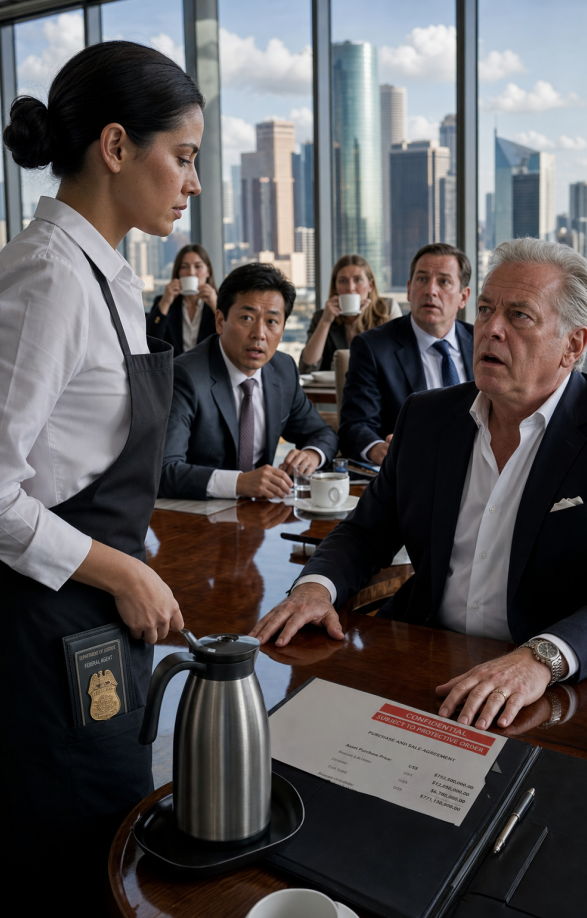
For a year I had poured his coffee. I had learned that he took it black before ten and with cream after, that he grew loud after the second cup, that he believed, all the way down to his bones, that the people who served him could not possibly understand him. That belief is the most useful thing a man like Carl Brandt can give an investigator. It is a door left open.
We had suspected the sanctions violations for two years. We had the wire patterns, the shell in a country that pretends not to exist, the tankers that changed names mid-ocean. What we did not have was him, in his own voice, tying it together. Prosecutors need a man to say the thing. They rarely do, not when their lawyers are in the room.
But Carl Brandt did not think there was anyone in the room worth guarding his tongue around. He thought there was him, his partners, and the furniture.
So he said the account numbers. He said the dates. He bragged, actually, about how the last shipment had been “papered clean.” And the quiet woman refilling the carafe wrote none of it down, because the quiet woman was wearing a wire under her apron and did not need to.
“You’re bluffing,” he said, but his voice had gone thin. “You’re a caterer. You’re—”
“I speak six languages, Mr. Brandt. I have a master’s in forensic accounting. I took this contract through a staffing company we control, and I have served you two hundred and eleven lunches.” I closed the wallet. “You told your guests I couldn’t read a menu. I’ve read your books for a year.”
The doors opened. They always open on time; that part is choreographed. Two more agents came in, and behind them the building security he thought answered to him, and it did not, not today. One of the foreign partners started speaking rapidly into his phone in a language Brandt didn’t know, and I did, and what he was saying was that the deal was dead and they had never met this man.
Brandt stood up too fast and his chair went over. “This is entrapment,” he said.
“You invited me to lunch,” I said. “You did the talking.”
They read him his rights by the window with the whole city spread out gold behind him, the view he was so proud of, the view he thought made him untouchable. His hands shook when they cuffed him. Ruddy, confident men always shake the most; they have the furthest to fall.
The junior executives were separated and interviewed. One of them, a young woman who had laughed the loudest at his joke about me, would not meet my eyes. Later she asked, quietly, if she was in trouble. I told her that depended entirely on how honest she was in the next hour. She was very honest.
The case ran for months after that lunch. The recordings I gathered over eleven months became the spine of it. The shell company was unwound, the tankers seized in two ports, the partners barred from ever doing business under American law again. Brandt took a plea rather than let the tapes play in open court, because on the tapes he is not a titan of industry. On the tapes he is a man mocking a waitress while confessing to federal crimes, and juries do not forgive that particular flavor of arrogance.
I keep one thing from that year. Not the badge; they issue you a new one. I kept a laminated lunch menu from that boardroom, the one he said I couldn’t read. On the back, in my own hand, I wrote the date of his arrest.
People ask me if it was hard, serving a man I was building a case against, smiling, refilling, absorbing the insults. It wasn’t. Every rude word was a brick I got to hand back to him at the end. The trick of my job, the real one, was never that I couldn’t read the menu.
It was that he never once wondered what I could.
Comments are closed.