He cried for a long time, and I stood in that doorway not knowing whether to run to my daughter or run for my job.
Lily didn’t run. That’s the thing about her. Where a grown person would have backed away from a weeping stranger, she climbed up onto the arm of his enormous chair and patted his shoulder and told him it was okay, that the song was a happy one, that she could teach it to him if he wanted.
Mr. Ashford — Richard, though no one on the staff had ever dared call him that — wiped his face with the heel of his hand like a boy caught crying at school. When he finally looked at me, his eyes were wrecked.
“Where did she hear it,” he said again. Not angry. Begging.
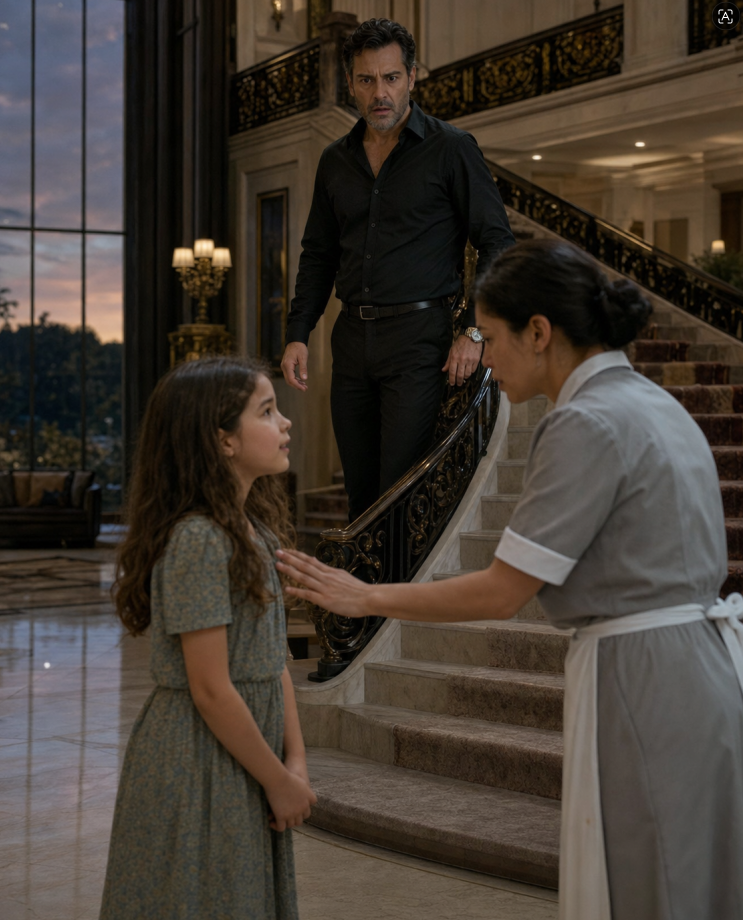
“She didn’t hear it anywhere,” I told him, honestly. “She makes up songs all day. She sings to the vacuum. I promise you, sir, she doesn’t even know what she’s—”
“My mother sang that.”
The room went very still.
“She sang it to me every night until I was seven,” he said. “And then she died, and I have not heard it since. It was never written down. She made it up too.” He laughed, and it broke apart in the middle. “I have paid people. Do you understand? Music historians. I hummed what I could remember into a recorder and paid experts to tell me if it was a known lullaby, a folk song, anything I could find again. They all said the same thing. It didn’t exist anywhere but in my own head.”
He looked at my six-year-old like she was a door he’d thought was bricked over.
“And your daughter just sang it to me. All of it. The bridge I couldn’t even remember.”
I don’t have an explanation. I’ve had two years since that afternoon to look for one, and I don’t have it. Lily can’t tell you where songs come from any more than she can tell you where dreams come from. Maybe she caught a few notes of it somewhere in that house, some old recording, and her strange little mind stitched the rest. Maybe some things pass between people in ways we don’t get to understand. I only know what I saw.
I saw the coldest man in the state get down on the floor of his study so he’d be level with a housekeeper’s child, and ask her, very seriously, if she would teach him his mother’s song.
And she did. She sat on the rug and taught a billionaire to hum, correcting him when he got the bridge wrong, entirely unbothered by who he was supposed to be.
Everything changed after that, and not in the way the staff feared.
I braced for the fallout. In houses like that, when the owner has a private moment witnessed by the help, the help usually disappears. I spent a week certain I’d be paid off and shown the gate. Instead Richard asked me to stay. Then he asked me to bring Lily on the days I worked. Then, awkwardly, like a man relearning a language, he started to be in the rooms we were in.
He asked me about my life. He found out I’d been working double shifts, that Lily’s father was long gone, that I’d been terrified every single day that someone would decide a child didn’t belong in a house like that and I’d lose the best-paying job I’d ever had. He listened to all of it with the still attention of a man who had spent decades making sure no one ever saw the boy underneath the fortune.
Because that was the truth he’d buried. He told me himself, on a night Lily fell asleep on his study couch and neither of us wanted to move her. He’d grown up poor. His mother raised him alone, sang him a song she invented because they couldn’t afford a radio, and died when he was seven. He’d been passed to a wealthy uncle who taught him that softness was a liability, that a poor boy who wanted to survive that family had to become harder than all of them. So he did. He buried the lullaby and the mother and the boy, and he built a man no one could touch, and he’d been alone inside that man for forty years.
A six-year-old humming to the vacuum had reached straight through all of it.
The family — the cousins and hangers-on who circled his money and called my daughter “the kid who shouldn’t be here” — did not like what was happening. They liked it a great deal less when Richard began changing things. He set up a trust for Lily’s education, in full, through any university she chose. He put my employment on a real contract with real protection, the kind that can’t be undone by a relative’s temper. And when his cousin Marcus made the mistake of telling Lily, at a garden lunch, to “go play somewhere the adults can’t see her,” Richard stood up at the head of the table and told the assembled family, in a voice none of them had ever heard him use, that this child was the most welcome person on the property, and that anyone who felt otherwise could find out how quickly they were escorted off it.
No one tested him.
Lily still hums that song. She’s eight now. She doesn’t fully understand what it means to the tall quiet man she calls “Mr. Richard,” only that it makes him happy and a little sad at the same time, which she has decided is a good kind of feeling. He’s teaching her piano. She’s teaching him, in the way only a child can, how to be a person again.
People ask me if it feels strange, the housekeeper and her daughter woven so tightly into a life like that. It doesn’t. Because that house had forty rooms and no warmth in any of them, and a little girl with no fear and too much heart walked in and gave a lonely man back the one song he thought he’d lost forever.
The last time I passed the study, the door was open. He was at the piano, picking out a melody with one finger, and Lily was beside him on the bench, swinging her feet, telling him he’d gotten the bridge wrong again.
He was smiling.
Comments are closed.