Daniel counted to three, and then he stopped counting, because three was all there were, and three was enough.
The boys crossed the ballroom floor the way I’d taught them to walk into a room — chins up, unhurried, like they belonged anywhere they chose to stand. The middle one, Mateo, carried the framed portrait against his chest with both hands. The other two flanked him. Nine years old and already they understood, in the wordless way children understand things, that this was a moment their mother had waited a long time for, and that their job was simply to be exactly who they were.
The bride — I didn’t know her name and I’ve made a point of never learning it — looked at Daniel, then at the boys, then back at Daniel, and I watched the first crack of a very bad suspicion cross her face.
“Daniel,” she said. “Who are these children?”
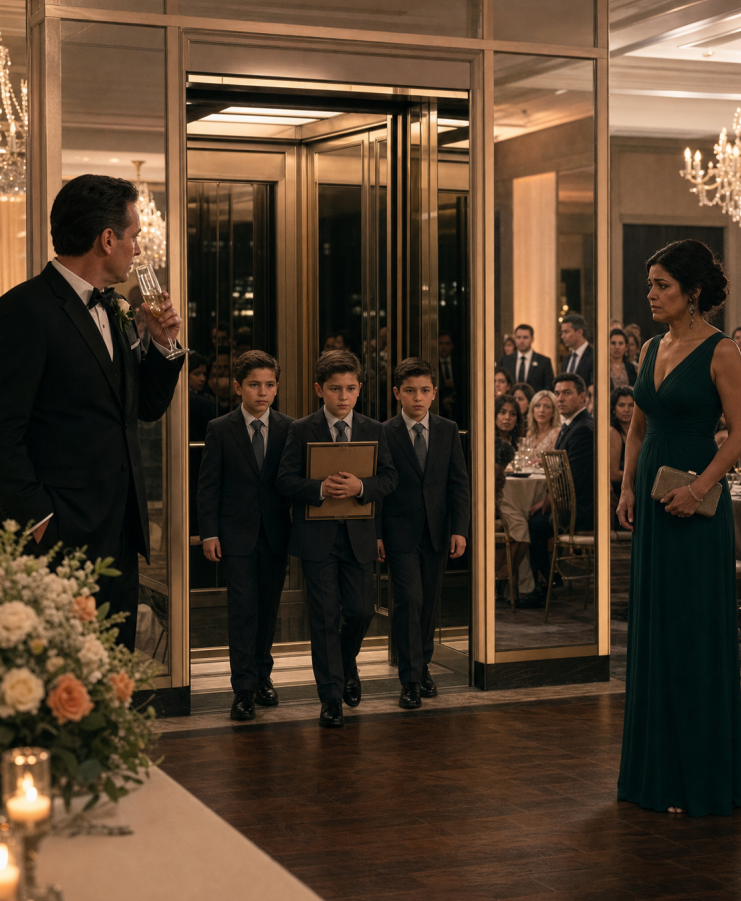
He couldn’t answer. His mouth opened and nothing came out of it. So Mateo answered for him. He turned the portrait around and held it up so the nearest tables could see.
It was a photograph of the three of them as newborns, wrapped in white, lined up in a hospital bassinet. And on the little card clipped to the bassinet in the picture, in the nurse’s neat hand, was a date — a date exactly eight months after Daniel signed the papers that ended our marriage, and the surname on the card was his.
“You told everyone I was barren,” I said. I hadn’t planned the words; they just arrived, level and clear, and the room was so quiet they carried. “You told your mother. You told our friends. You built a whole story about the wife whose body failed, and you let them pity you for it, and you married this poor woman on the strength of it.”
Daniel found his voice at last. “That’s not — you can’t just—”
“I was eleven weeks pregnant the day you handed me those papers,” I said. “I didn’t know yet. I found out in a motel room two states away, alone, after I’d already signed. And by then I’d learned something from your family I’m actually grateful for. I’d learned that the safest place for anything precious is somewhere you people don’t know to look.”
His mother had come forward out of the crowd, the woman whose little sighs had started all of it, and she was staring at the boys with a look I’d waited six years to see. Because the thing about the story they’d told — the barren wife, the failed body — was that it required a villain, and they’d cast me. And now the villain was standing in a green dress with three grandsons her son had never met, and there was no version of the next five minutes that made any of them look like the wounded party.
“The diagnosis,” Daniel said, and his voice had gone strange. “There was a diagnosis. The doctor said—”
“The doctor said one of us had a problem,” I said. “You assumed it was me. You never once asked to see the report with both our names on it. It’s a very human mistake, Daniel. It’s just not the mistake you told everyone I made.”
I didn’t say the rest of it out loud, in the ballroom, in front of the bride and the mother and the guests with their forks frozen over the salmon. It wasn’t the place. But it’s the reason I came, so I’ll tell you.
The specialist we saw, the winter before he left me, sent one letter with both our names on it and the results laid out plainly. I read it. Daniel never did — he’d stormed out of the office before the doctor finished the sentence, already certain, already building the version where the failure was mine. I kept the letter. I kept it for six years in a shoebox with the boys’ hospital bracelets, and I brought it to the wedding in my clutch, and I never had to take it out. The portrait was enough. The letter was just insurance.
Here’s what happened after. His mother sat down, hard, in a chair that a guest pulled out for her, and she didn’t get up again for a long time. The bride left before the cake — I heard later she’d had no idea, none, and I hope she landed somewhere kinder. Daniel followed the boys and me out to the lobby, saying my name over and over like it was a door he could still open, and I stopped at the revolving doors and let him catch up, because I owed the boys the chance to decide for themselves.
They looked at him. This tall stranger in a tuxedo saying he was their father. And Mateo, my careful, watchful Mateo, said the truest thing anyone said all night. He said, “We already have everything we need.” And he took my hand, and his brothers took his, and we went out into the parking lot where the air was cold and clean and entirely ours.
Daniel has a lawyer now. He wants “access.” The courts will sort out what he’s owed, which by my math is exactly the amount of fatherhood he showed up for, and we’ll see what a judge makes of a man who publicly declared his children didn’t exist. I’m not afraid of it. I stopped being afraid of the Ashworths the night I stood in a hotel motel two states away, alone, pregnant, and decided that fear was a luxury I couldn’t afford anymore.
The boys asked, in the car, if they’d done okay. I told them they’d done perfectly. Then Mateo asked if we could get pancakes, because apparently walking into a ballroom and rewriting your mother’s entire history works up an appetite. So we got pancakes. It was nearly midnight. Nobody minded.
Comments are closed.