The attorney’s name was Mr. Okonkwo, and he had a voice made for reading wills — low, unhurried, the kind of voice that makes a marble room go still on its own. He tapped the microphone once, apologized for interrupting the reception, and asked if he might read a short statement on behalf of the estate of Harold Vance before the collection was formally presented.
Preston Hale still had the champagne halfway to his lips. He’d spent the last ten minutes telling a cluster of buyers that the collection was “as good as sold,” and he’d spent the ten minutes before that telling me, quietly, near the draped Rothko-that-wasn’t, that I should be ashamed to show my face at a memorial for a man I’d “schemed my way next to.”
I hadn’t answered him. I’d been holding the sealed envelope Harold gave me eight months before he died, the one with the wax seal I’d promised not to open until — his words — “until they laugh at you, Meg. Not before. You’ll know.”
They’d laughed at me twenty minutes earlier, when the board realized the “caregiver” had come to the benefit and someone joked, loud enough to carry, about the help getting ideas.
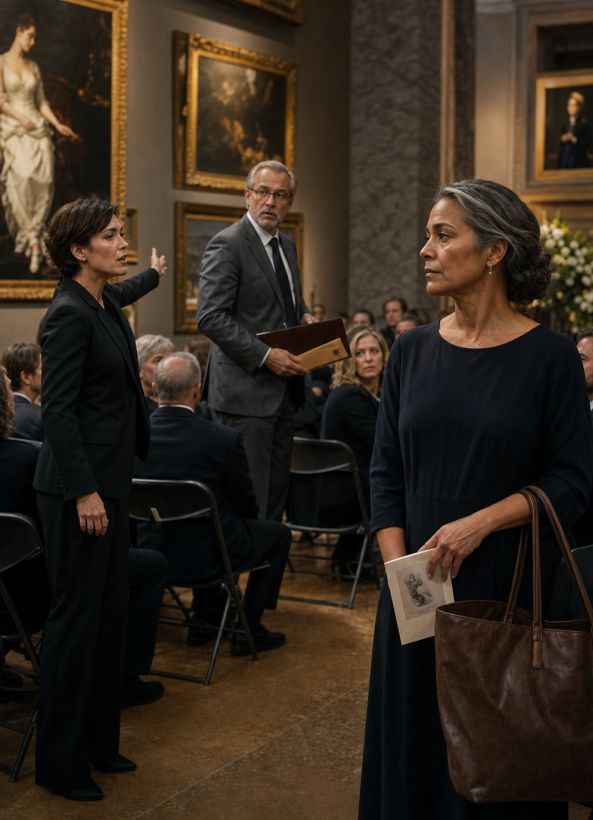
So I’d broken the seal in the ladies’ room with shaking hands, and I’d read it, and then I’d walked back out and stood by the draped painting and waited, because Harold had told me exactly what would happen next and I hadn’t believed him until Mr. Okonkwo tapped that microphone.
“The entire collection,” the attorney read, “comprising thirty-one works, the gallery building at 400 Ferren Street, and the associated endowment, is bequeathed in full and without condition to Margaret Ellison, who cared for Mr. Vance in the final two years of his life and who, in his words, ‘was the only person in this city who looked at me and not at the walls.'”
I have never heard a room of well-dressed people go so quiet so fast.
Preston set his champagne down on a passing tray without looking at it. The glass tipped and spilled and no one moved to catch it.
“That’s—” he said. “There must be a prior arrangement. Mr. Vance and I discussed the sale of the—”
“Mr. Vance discussed a great many things,” Mr. Okonkwo said mildly. “He committed one of them to writing. This one.”
Here is what Preston had done, and what he didn’t know I knew. For the better part of a year he’d been quietly promising the collection to a private buyer overseas — a handshake deal, a finder’s fee, a career-making sale. He’d been so certain the works would come to market through him that he’d already spent the commission in his mind. He’d been maneuvering the board, positioning himself as the natural steward, and treating me — the woman who drove Harold to dialysis, who learned to cook the soft foods he could still taste, who sat with him through the nights the pain wouldn’t let him sleep — as an inconvenient smudge on the plan.
And now not a single canvas could leave that building without my signature.
I should tell you I felt triumphant. People always want that part. The mocked woman, vindicated; the smug man, undone in front of the exact crowd he’d performed for. And there was a flicker of it, I won’t lie. When Preston turned to me with his face rearranging itself from contempt into calculation — into the dawning understanding that he would now have to be kind to me, that everything he wanted ran through the woman he’d called a fraud ninety seconds ago — I felt the flicker.
But mostly I felt tired. And I felt the envelope in my hand.
Because the will was the public thing. The envelope was the private one, and Harold had known the difference. When the murmuring started and the buyers began, subtly, to migrate in my direction, I stepped back into the alcove by the draped painting and I read his letter one more time.
“Meg,” it said, in the careful hand of a man whose fingers had started to fail him. “By the time you open this, they will have shown you their true faces. They will call you a schemer, a gold-digger, a fraud. Let them. I made you wait because I wanted you to feel exactly how little they think of you — and then feel how much I did. The collection is a burden and a fortune and a headache; do with it what you like. Sell it, keep it, give it to a school. It was never the real gift. The real gift is that someone saw you. I saw you. You made an old man’s worst two years into something I was sorry to leave. Don’t let them turn you into one of them. — H.”
I folded it back along its worn creases.
Preston found me there. He’d rebuilt his smile into something oily and collaborative. “Meg,” he said — first time he’d ever used my name. “Obviously this changes things. I think you’ll find you need someone who understands the market. We should talk about representation, storage, insurance—”
“Mr. Hale,” I said. “You called me a fraud by that painting forty minutes ago. You didn’t lower your voice.”
His smile held, barely.
“I’m going to think very carefully about what happens to this collection,” I said. “And I’m going to do it slowly. And you’re going to be very patient with me, aren’t you.”
I walked out past the draped canvas without lifting the cloth. I didn’t need to see it. I already knew what Harold’s collection was worth, and it wasn’t the number the buyers were whispering.
The victory, if that’s the word, was hollow in exactly the shape Harold had warned me it would be. The only person in that whole gleaming room who had ever actually seen me was the one whose ashes sat in a bronze urn on a mantel across town, and no bequest was going to change that.
But I kept the envelope. I keep it still. And on the days the board’s lawyers call, and the buyers’ lawyers call, and everyone is suddenly so warm, I take it out and read the last line, and I remember that being seen once, truly, by the right person, is worth more than being flattered by a roomful of people who only learned my name when it appeared in a will.
Comments are closed.