The bottle in my hand was a 2016 estate reserve, and it was a fake.
I knew it was a fake the same way I knew the export manifests in the office safe were fakes, and the way I knew the “single-vineyard” bottling that Celeste Marchand poured for her most important guests came, in fact, from three different bulk lots blended in a stainless tank and dressed up in a label printed to look forty years more prestigious than the wine inside. I knew all of it. I had spent six weeks in a server’s apron learning all of it, one poured glass and one whispered instruction at a time.
What Celeste knew was that I was the quiet one. The help. The woman who refilled water and cleared the spit buckets and, in her words that afternoon, “couldn’t read a wine label if it was written in English.”
She said it to a table of six. Buyers, mostly — two restaurant groups, an importer, and a wine writer whose column could make or break a season. She’d been performing for them all afternoon, the grande dame of the valley, and she landed the line about me the way you land a rehearsed joke, with a little flick of her hand in my direction as I stood at the tasting counter. “Don’t mind her,” she said. “Bless her heart, she’s decorative. Couldn’t read a label if it was written in English.”
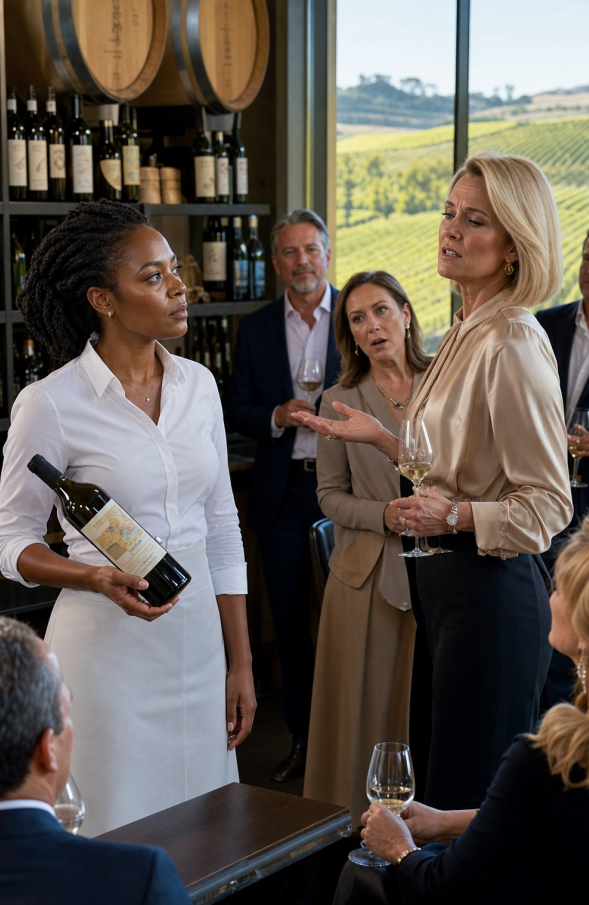
The table laughed. Politely, the way people laugh when the host makes a joke at a servant’s expense and they’d rather not be rude to the host. The importer didn’t laugh. He looked a little uncomfortable. I filed that away.
Here is the thing about being treated as decoration: people say everything in front of you. For six weeks Celeste and her cellar master had discussed, over my head, which lots to blend for the counterfeit reserve, which labels to run for the shipment bound for Antwerp, which for the one bound for Seoul, and which set of numbers to show the distributor versus the set to keep in the real book. They spoke freely because furniture doesn’t testify. They had no idea that the languages on those fraudulent labels — the French on the domestic fakes, the Flemish on the Antwerp export, the Korean on the Seoul consignment — were three of the languages I happen to read.
Or that reading labels, precisely and in several languages, is the entire point of my actual job.
So when the laughter settled, I set the bottle down on the counter. Gently, label facing the table. And I said, “Since we’re reading labels, let’s read this one.”
I picked it back up. I read the front label aloud — the vintage, the appellation, the single-vineyard claim. Then I turned it and read the back, in the original French, and translated it, and noted, mildly, that the wine in the bottle could not be what the label claimed because the lot code stamped near the punt corresponded to a bulk blending tank, not a vineyard block — and I recited the tank number from memory.
The room got very quiet.
I kept going. I described the Antwerp shipment and read, from memory, the Flemish text on its mislabeled cases — a “grand cru” designation the estate had no right to use — and I gave the case count. Then the Seoul consignment, and the Korean label, and the false vintage year printed on it, and I translated that too. Three languages. Three frauds. Recited to a tasting room gone so silent I could hear the vineyard rows ticking in the afternoon heat outside the open doors.
Celeste’s smile had frozen and then fallen off her face entirely. “I don’t know what she thinks she’s—” she started.
“Amara Diallo,” I said, because she had never once asked my name. I reached under the counter, to the apron I’d worn for six weeks, and I set my credentials on the polished wood beside the fake reserve. “I’m a fraud investigator. I was retained six weeks ago, after your distributor flagged discrepancies in the export documentation. I took the tasting-room position because the fastest way to understand a counterfeiting operation is to work inside it.” I looked at her. “I’ve read your labels, Ms. Marchand. All of them. In every language you printed them in.”
The wine writer had his phone out. The importer had stood up. And Celeste Marchand, who thirty minutes earlier had told a room full of the exact people she most needed to impress that I couldn’t read a label if it were written in English, discovered that I had spent six weeks reading nothing else — her labels, her manifests, her two sets of books.
The investigation went where investigations go. Reports, seizures, the kind of paperwork that ends an enterprise quietly and permanently. The prestige labels came down. The Antwerp and Seoul shipments were held at the docks. I don’t take pleasure in the wreckage of it, exactly — there were cellar hands and pickers who lost honest work when it all came apart, and I think about them.
But I won’t pretend I didn’t feel something, standing at that counter, watching the most powerful woman in the valley realize what she’d said and to whom. She had wanted a room to laugh at the illiterate help. What she got was the help reading her whole scheme back to her, in three languages, in front of the only audience that could ruin her.
She never did learn to ask people’s names. I suspect, now, she’ll wish she had.
Comments are closed.