When the polls closed on election night, millions of Americans witnessed a stark, undeniable contrast in how our democracy operates. In Florida, election officials processed more than three million ballots with blistering speed, delivering decisive, certified clarity before most voters even went to sleep.
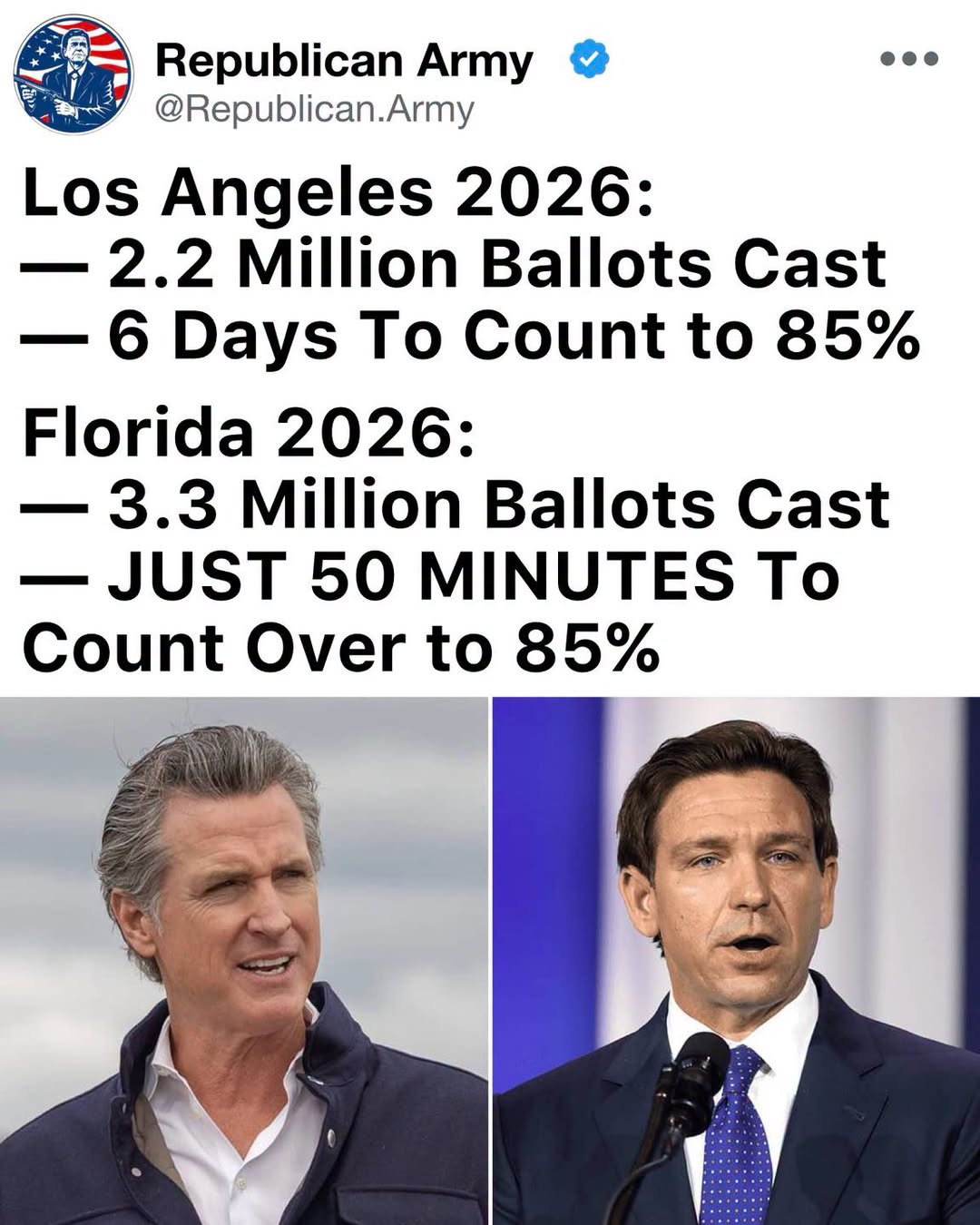
Meanwhile, across the country in Los Angeles County, an entirely different narrative unfolded as officials struggled for days just to crawl past the 85 percent mark. Handling a significantly smaller volume of total votes, California’s largest metropolitan hub found itself once again paralyzed by administrative bottlenecks and agonizing delays.
This tale of two election systems is not an accident of geography, nor is it an unavoidable consequence of scale. It is the direct result of deliberate policy choices, administrative competence, and whether state leaders prioritize rapid accountability or tolerate endless institutional drift.
Every single American, regardless of political affiliation, deserves an election system that operates with promptness, precision, and absolute transparency. When outcomes linger in bureaucratic purgatory for days or weeks on end, public confidence inevitably erodes, inviting doubt into a process that should be rock-solid.
To understand how we arrived at this crossroads, one only needs to look at the masterclass in logistical execution delivered by the Sunshine State. With sixty-seven diverse counties spanning two time zones, Florida operates one of the most robust, high-volume voting environments in the entire nation.
Yet, like clockwork, the moment the final precincts closed in the western Panhandle, county supervisors published massive, comprehensive datasets in real time. Within hours, citizens knew precisely who won, who lost, and where their communities stood on critical ballot initiatives.
Contrast that crisp, professional operation with the sluggish scene playing out in Southern California. Days after the polls officially closed, election workers were still sorting through massive piles of uncounted mail-in envelopes in a scene that has become all too familiar to frustrated residents.
The numbers tell a damning story of administrative paralysis that defies modern logistical capability. Los Angeles County, despite boasting thousands of municipal employees and millions in public funding, simply could not keep pace with an entire state that processed twice as many votes in a fraction of the time.
The root cause of these chronic West Coast delays lies in a labyrinth of self-imposed procedural roadblocks. California’s heavy dependence on universal mail-in voting is compounded by convoluted signature verification requirements and extraordinarily lengthy ballot-curing windows.
Under current California statutes, ballots postmarked by Election Day can arrive up to a week later and still be counted, dragging out tallies indefinitely. Rather than treating Election Day as a firm deadline, the system treats it as a mere suggestion, creating an administrative hangover that paralyzes local government.
Florida, on the other hand, made a conscious decision decades ago to completely overhaul its broken electoral infrastructure. Following the chaotic recount of 2000, state lawmakers systematically rebuilt the system from the ground up, demanding both uncompromising security and maximum efficiency.
Florida statutes authorize county canvassing boards to begin processing, verifying signatures on, and tabulating mail-in ballots weeks before Election Day arrives. By the time 7:00 PM strikes on election night, millions of early and mail-in votes are fully scanned, securely stored, and ready to be reported with the push of a button.
The Blueprint for Election Day Competence
Crucially, Florida achieved this rapid-fire reporting without sacrificing a single shred of ballot security or legal scrutiny. Every single mail-in ballot still undergoes strict signature verification, and every vote is backed by an auditable, voter-verified physical paper trail.
The difference is that Florida conducts its verification work on the front end, ensuring that the heavy lifting is completed before the clock runs out. When election night arrives, canvassing boards are not drowning in untouched mailbags; they are simply finalizing in-person tallies and closing the books.
“Efficient systems that prioritize speed and accountability strengthen public trust, while prolonged counting only fuels doubt about whether the process is truly secure.”
BREAKING NEWS!!>>
Twist in case of Kentucky teen Elijah Mayes accused of murdering 11-month-old baby Grayson Walton
The Height of Hubris: Why Equating Modern Political Radicalism to Jesus Christ Is a Wake-Up Call for Voters
Bizarre offer made by Fresno man Justin Deger after girlfriend allegedly attacked ex’s car with crowbar
In stark contrast, California’s open-ended timelines force county registrars into an exhausting, weeks-long marathon of manual triage. Election workers must continuously reopen batches, verify signatures against ancient state records, and dispatch outreach letters to voters whose signatures do not match.
While voter enfranchisement is an essential democratic goal, dragging out routine vote tabulation across multiple weeks accomplishes the exact opposite. It breeds widespread cynicism, paralyses candidate transitions, and leaves entire legislative bodies in a state of suspended animation.
When voters wake up three mornings after casting their ballots and see key local races still sitting at 70 percent counted, they rightfully ask simple questions. In an era where modern global commerce moves billions of dollars and millions of packages instantly, why does a government ballot count move like molasses?
The psychological damage of prolonged counting cannot be overstated in a modern republic. In the absence of swift, definitive facts, the vacuum is instantly filled with suspicion, hyper-partisan speculation, and legitimate public frustration.
Accountability is not merely about arriving at the right number eventually; it is about delivering transparent results when the public demands and expects them. A democracy cannot thrive when its most fundamental civic exercise is plagued by avoidable logistical failures.
Voters across the nation are watching these contrasting models and demanding that their own state representatives take immediate notes. Community leaders, legal scholars, and grassroots citizens are increasingly unified in their call for streamlined, common-sense election reform across all fifty states.
Other states have already proven that Florida’s success is fully replicable if the political will exists. Jurisdictions across the country have modernized their processing equipment, updated pre-canvassing statutes, and eliminated bureaucratic red tape without disenfranchising a single eligible voter.
If an enormous state of nearly twenty-three million residents can deliver clean, indisputable election results within two hours of poll closing, no single county can claim it is impossible. Administrative excuses fall flat when neighboring states and peer jurisdictions execute the exact same task with flawless efficiency.
Restoring Faith in the American Democratic Machine
There is a persistent, thoroughly debunked myth that election officials must choose between counting fast and counting accurately. Florida’s rigorous post-election audits and paper-ballot safeguards prove conclusively that high speed and high accuracy naturally reinforce one another.
When counting is swift and orderly, chains of custody remain tight, administrative staff stay sharp, and physical security is easy to maintain. It is during drawn-out, multi-week operations that physical security becomes complicated, staff fatigue sets in, and human error rates predictably climb.
Modern democracy demands administrative excellence, not bureaucratic excuses or ideological complacency. The American people deserve election administrators who respect their time, honor their civic participation, and manage public resources with relentless competence.
State legislatures that continue to cling to sluggish, outdated election laws must be held accountable by the voters they serve. Reforming ballot processing deadlines, establishing strict arrival cutoffs, and investing in high-speed scanning infrastructure are non-partisan imperatives that benefit everyone.
America was built on the premise that self-governance requires active participation, public faith, and institutional integrity. When our election systems run smoothly and transparently, the entire constitutional framework is invigorated, giving citizens unshakeable confidence in the leaders they elect.
The contrast between Florida’s dynamic, modern election system and Los Angeles County’s sluggish bureaucracy is a wake-up call for the entire nation. It is undeniable proof that competent governance is possible when leaders refuse to accept excuses and demand results.
It is time for every jurisdiction in the country to raise its standards, cast aside failed administrative habits, and adopt the gold standard of election administration. The strength of our republic depends on timely clarity, unquestioned integrity, and an unyielding commitment to getting the job done right on Election Day.
No Comments yet!