Modern politics has witnessed its fair share of staggering arrogance, but every once in a while, a statement crosses the line into complete absurdity. Abdul El-Sayed has openly compared himself to Jesus Christ, boldly proclaiming that both he and the central figure of Christianity represent the exact same kind of radical. It is a breathtaking display of unearned political hubris.
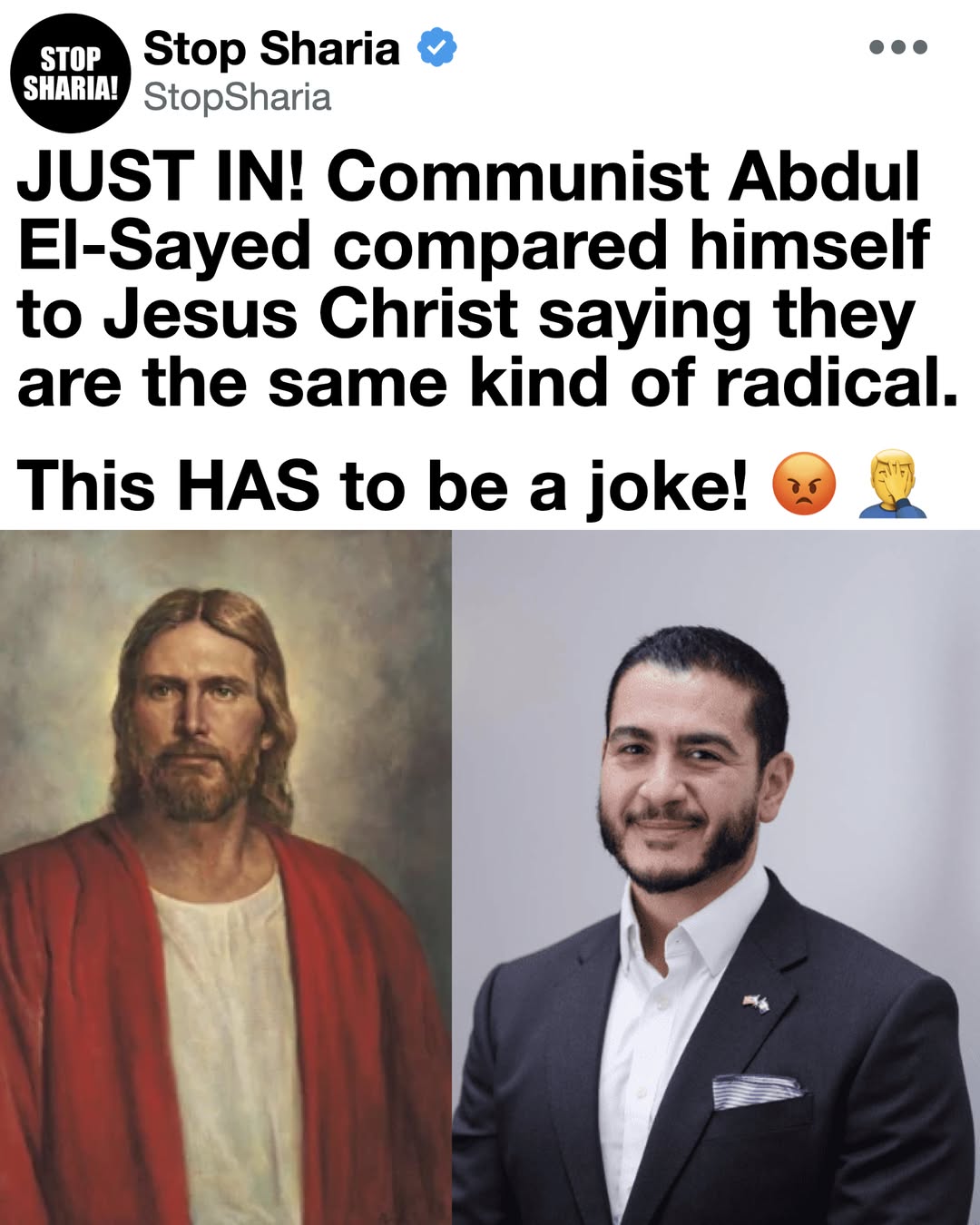
Equating a contemporary political activist with the foundational figure of the Christian faith reveals an astonishing level of self-regard. Serious public figures build their credibility on tangible accomplishments, sound principles, and genuine service to their communities. Placing oneself in the exact same category as a sacred religious icon merely to burnish progressive credentials exposes an ego entirely detached from reality.
For millions of faithful citizens across the nation, this self-serving rhetoric does not simply fall flat; it deeply trivializes faith and politics alike. Serious leaders understand the profound boundary between sacred religious devotion and the contentious arena of modern electoral ambition. Crossing that line to position oneself alongside divine history reveals a severe lack of perspective and basic reverence.
When a candidate attempts to legitimize their partisan agenda by claiming spiritual kinship with Christ, they reveal far more about their vanity than any righteous cause. The life and teachings of Jesus Christ transformed human history through spiritual redemption, moral clarity, and profound sacrifice. Reducing that sacred legacy to a mere talking point for modern political activism degrades both faith and public discourse.
This brand of theatrical grandstanding has become an alarming hallmark of today’s radical political movement. Rather than convincing the electorate through practical solutions and reasoned debate, activists increasingly seek to cloak their partisan platforms in the mantle of holy crusades. It is an unsettling tactic designed to deflect legitimate scrutiny by pretending a political agenda carries sacred authority.
The reality is that radical economic and social proposals seeking to expand massive government control bear no meaningful resemblance whatsoever to the gospel. Demanding that the state confiscate and redistribute private resources is not an act of spiritual charity; it is an exercise in compulsory bureaucratic power. Conflating the two fundamentally misunderstands the core nature of genuine Christian teachings.
Spiritual teachings emphasize voluntary generosity, personal moral responsibility, and the transformation of the human heart from within. In sharp contrast, modern progressive activism relies on top-down state coercion, administrative mandates, and the forced restructuring of everyday society. Attempting to bridge that ideological chasm with rhetorical hyperbole only highlights the sheer emptiness of the claim.
What makes this spectacle so jarring is the undeniable gap between soaring personal rhetoric and the grounded reality of the policies being pushed. Observers have pointed out that repackaging aggressive government-centered policies as spiritual enlightenment is an insult to the intelligence of everyday voters. Citizens can easily see through the thin veneer of self-righteous political theater.
When public figures inflate their own importance to such astronomical heights, they inevitably reveal their fundamental disconnection from the people they seek to lead. Everyday Americans do not want self-anointed political figures lecturing them on morality while pushing state-driven agendas. They want grounded leaders who respect the boundaries of public office and honor the intelligence of the electorate.
 The Retail Fortress Crisis: Why Locking Up Everyday Items Signals a Total Failure of Law and Order
 No Excuses for Senseless Violence: Demanding Justice for a Mother Stolen by Road Rage
 Florida man installed bedroom cameras to catch a coin thief — and caught wife Malia Nummerdor allegedly having sex with family dog
Radical economic and social proposals that expand government control and redistribute private resources bear no meaningful resemblance to the teachings or life of Christ.
A Dangerous Distortion of Faith and Governance
Throughout modern history, radical movements have routinely relied on moral grandstanding to justify economic policies that have consistently failed elsewhere. Expanding the administrative state and undermining economic freedom does not produce prosperity; it creates widespread dependence, stagnation, and public frustration. Dressing up these failed concepts in sacred garments changes nothing about their real-world consequences.
Voters have every reason to reject candidates who traffic in such grandiose self-comparisons while advancing destructive economic dogmas. When an aspiring leader demonstrates such an inflated view of their own righteousness, it offers a disturbing preview of how they would govern. True leadership is defined by practical results, accountability, and the humility to serve the public trust.
The deliberate appropriation of sacred religious imagery for partisan advantage should serve as an immediate warning sign for anyone evaluating a candidate’s fitness for office. It demonstrates a reckless disregard for the core convictions of millions of believers who hold their faith sacred. Treating foundational spiritual figures as promotional tools reveals a profound lack of respect for religious tradition.
In a healthy republic, political figures are expected to stand before the public on the merits of their ideas and the strength of their character. Attempting to bypass that accountability by claiming a unique moral kinship with Jesus Christ is as absurd as it is revealing. It reflects a desperate bid for moral authority from a political movement increasingly unmoored from practical reality.
Everyday working families are dealing with the harsh realities of rising costs, overreaching regulations, and economic uncertainty. They do not have patience for the bloated egos and theatrical delusions of political activists seeking self-glorification. What communities need are practical solutions, lower burdens, and genuine respect for individual freedom.
Humility is not merely an admirable personal virtue; it is an indispensable prerequisite for sound governance and responsible leadership. A leader who cannot accurately measure their own place in the world cannot be trusted with the vast powers of the state. Inflating one’s personal importance to the level of divinity demonstrates a glaring failure of temperament and basic judgment.
The public is increasingly pushing back against the arrogant posturing of political activists who mistake their own partisan ambitions for sacred righteousness. Citizens are demanding public figures who understand their proper role and possess the decency to leave sacred faith out of their political games. Empty posturing will never substitute for proven competence, humility, and measurable achievement.
Ultimately, this audacious comparison stands as an unmistakable warning about judgment, priorities, and character. When an activist tells the public that they walk in the footsteps of Christ as a radical political figure, voters should see it for what it is: pure self-aggrandizement. Practical results and genuine humility will always matter far more than theatrical claims of sacred kinship.
No Comments yet!