“Lawyer,” he mouthed. “Not family.”
My pen never touched the paper.
I straightened up slowly, the folio still open in front of me, and I did the only thing I could think to do that wouldn’t tip my hand. I smiled at Vaughn Pryce, the attorney, and I said, “I’d like to read it properly first. All of it. Do you mind?”
His practiced smile held, but something behind it cooled. “Of course,” he said. “Though it’s really just the standard consolidation we discussed. Power of attorney, unified estate management. Formalities.” He slid the folio a careful inch closer. “Your husband’s condition makes his affairs difficult. This simply lets the family act on his behalf.”
The family. Marguerite shifted her weight behind him, and I understood, with Julian’s eyes still burning into the side of my face, that “the family” in that sentence meant her.
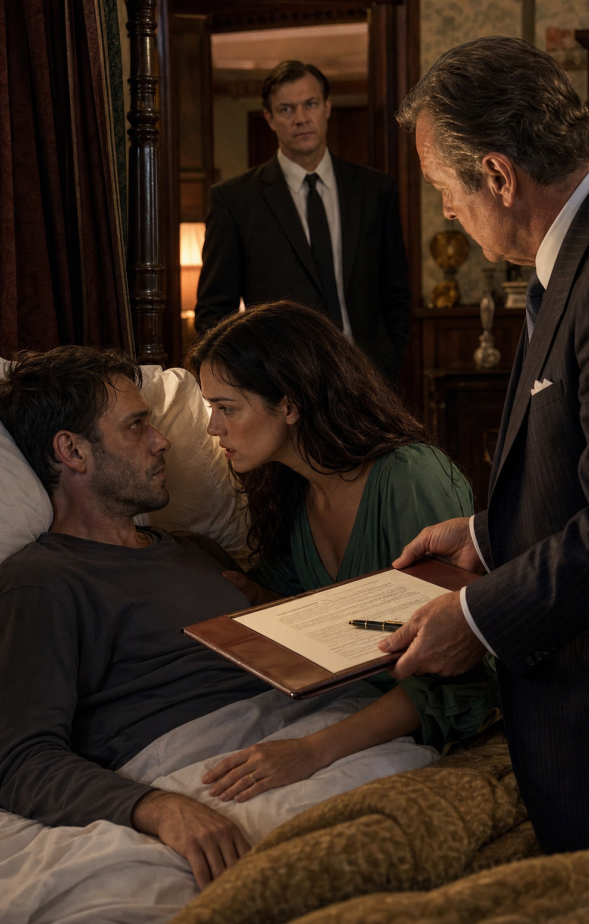
I made myself flip pages. I’m not a lawyer. But I read, and I know how to look calm while my pulse is climbing, and buried in the dense paragraphs — past the “consolidation” and the “unified management” — I found it. A clause that named Marguerite Ware as sole trustee with full discretion over Julian’s assets in the event that he was declared permanently incapacitated. And a second document, tabbed and waiting, that was exactly that declaration. All it needed was my signature as the spouse, affirming that my husband was beyond recovery.
They didn’t want me to manage anything. They wanted me to certify that the man watching me from the bed was already gone.
“This one,” I said, keeping my voice light, tapping the incapacity affidavit. “This says Julian can’t recover. But I’m not his doctor. How can I sign that?”
“It’s a legal standard, not a medical one,” Pryce said smoothly. “Your observation as his wife is sufficient. And, forgive me — you’ve seen him. He hasn’t responded in months.”
Julian’s hand was flat on the sheet now, deliberately still, but his eyes moved between me and the lawyer, lucid and desperate and asking me to be smarter than they thought I was.
“I have seen him,” I agreed. “Let me just sit with it tonight. It’s a big thing to put my name to.” I closed the folio. “I’ll sign in the morning.”
The temperature in the room dropped ten degrees. Marguerite’s stillness turned brittle. Pryce’s smile finally, briefly, slipped. “Tomorrow, then,” he said, and there was a warning in it. They gathered their things and left, and the second the door clicked shut I was back at Julian’s side.
“Can you hear me?” I whispered. “Blink if you can hear me.”
He blinked. Once, hard, on purpose.
I got the doctors — real ones, ones the family hadn’t hand-picked. It turned out Julian had been surfacing for weeks: aware, trapped, able to hear every conversation held over his bed by people who assumed the room was empty of him. He’d heard Marguerite and Pryce plan the whole thing. He’d heard them talk about me as the disposable signature that would finish it. And he’d been waiting, powerless, for me to come close enough that he could warn me with the only two words he could form.
He chose to save the woman who’d married him for money. That’s the part I still can’t get past.
The affidavit I almost signed would have declared him permanently incapacitated and handed his entire estate to the cousin who was, at that moment, arranging for his care to quietly wind down. Once she was trustee, there’d have been no one with standing to ask questions. I’d have been paid my little arranged payout and sent on my way, and Julian Ware would have disappeared inside his own life while a lawyer and a cousin divided it.
Instead, I refused to sign.
The independent neurologists documented his responsiveness. A new attorney — one Julian chose by squeezing my hand at names I read aloud from a bar directory — filed to remove Marguerite as proposed trustee and to investigate the “care” she’d been directing. Pryce, it emerged, had been on her payroll for a year. The consolidation documents had been drafted in his office, not for Julian’s benefit, but against it.
Marguerite didn’t get the estate. She got a fraud inquiry and a very expensive silence.
And Julian recovered. Slowly, then steadily — speech, then movement, then the dry, sharp humor that the family had apparently found so inconvenient they’d been happy to bury it.
People ask me if it’s strange, staying married to a man I was set up to use. The truth is I don’t feel like the same woman who leaned over that bed to whisper a guilty apology. I came into that room thinking nobody was really getting hurt. I was wrong about that. Someone was getting hurt, deliberately and quietly, and I was the pen they intended to do it with.
Julian gave me one word to stop it. “Lawyer.” And then, so I couldn’t misread him: “Not family.”
He was right on both counts. The lawyer wasn’t ours. And the family — the real one, the kind worth the name — turned out to be the two of us, built out of the one afternoon I finally decided to actually listen to the man everyone told me couldn’t speak.
Comments are closed.