The woman in the front row wore black better than grief allows.
I stood at the back of the courthouse memorial hall in my old charcoal coat, the one I’d had cleaned twice for the occasion, and I watched a stranger accept my husband’s memory like a gift addressed to her.
Her name, I would learn, was Celeste. She sat where a widow sits. She dabbed at eyes that stayed dry. When the county officials came to offer condolences — Harold had served this town for thirty years, there were a lot of them — she took their hands in both of hers and thanked them for honoring “her husband.” She had the veil, the posture, the small brave smile. She had, I would learn, a very good lawyer and a very specific plan.
What she didn’t have was thirty-four years of marriage to the man in the photograph.
I did.
I tried to speak when I first arrived. I went to the woman with the clipboard, the one organizing the speakers, and I said, quietly, that there had been a mistake, that I was Harold’s wife. She looked at me the way you look at a confused old woman who’s wandered into the wrong room. She said the family had asked for privacy. She nodded toward Celeste. “That’s his wife,” she said, gently, like she was doing me a kindness.
You have to understand how fast it happens. How quickly a room decides who belongs and who’s an embarrassment. I felt every eye that touched me deciding I was the problem. I was seventy-eight percent sure of my own name and one bad moment from being escorted out, and I stood there gripping my handbag and thinking, Harold, what did you leave me in the middle of.
Because that was the thing. Harold had died suddenly. And in the weeks before, distracted, tired, he’d mentioned a woman helping him with “some paperwork,” an estate matter, and I hadn’t asked, because after thirty-four years you don’t ask about every appointment.
Celeste had been that woman. She’d inserted herself into his affairs in his last month, and when he died she moved fast — before the obituary, before the will could be read, before anyone thought to check — to establish herself, publicly and legally, as the grieving spouse. If enough people saw her in that seat, deferred to her, called her his widow, the story would set like concrete. And the estate, the house, the pension, thirty-four years of a shared life, would flow toward whoever the world believed the wife to be.
She’d counted on me being exactly what I looked like that morning. Old. Uncertain. Easy to wave off.
She had not counted on Judge Alan Pruitt.
Harold and Alan had been friends for forty years. They’d fished together, argued politics together, stood up at each other’s weddings. Alan had signed our marriage certificate as a witness in 1990, a young lawyer in a borrowed tie. And when he arrived that morning to say a few words about his oldest friend and saw a woman he had never met in his life sitting in the widow’s chair — and saw me, Ruth, standing at the back like a stranger — he did not need anything explained to him.
He walked to the front. He did not go to the podium.
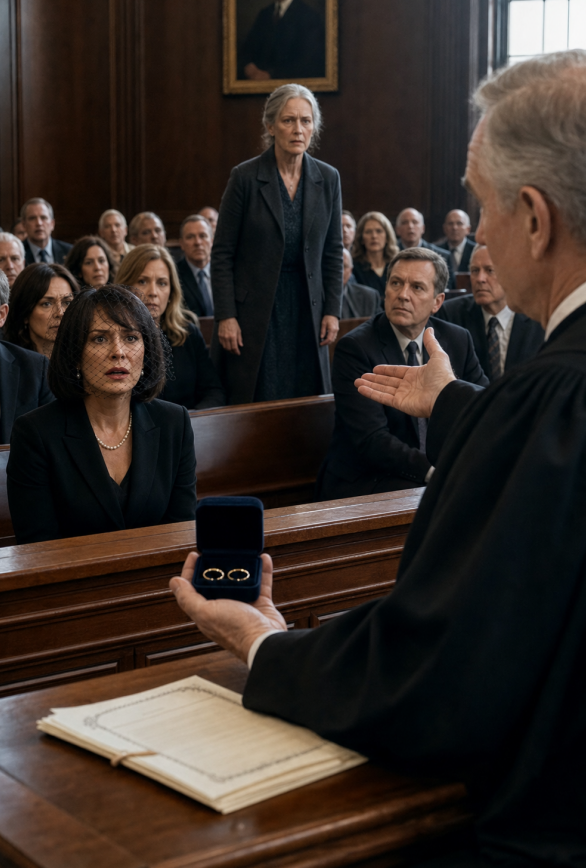
He went to his coat, folded over a chair, and from the inside pocket he took a small velvet ring box. I found out later he’d brought it to give to me after the service — Harold’s wedding band, which the funeral home had returned to Alan as the family friend handling arrangements, to pass to the widow.
He opened it. Inside were two rings. Harold’s band, and beside it, mine — the one I’d taken off and given to Alan the day before, asking him to have it placed with Harold’s, because I couldn’t bear for them to be apart even in this.
Two matched bands. Worn thin in the same places by the same thirty-four years.
Alan held the box open and looked out at the room. And then, in a voice that had quieted courtrooms for three decades, he said, “Will Ruth Merrick please come forward.”
Not Celeste. Ruth.
I felt the whole room turn. I walked up that aisle on legs I didn’t entirely trust, past Celeste, whose composed face was coming apart at the edges, and I stood beside my husband’s oldest friend.
Alan reached back into his coat and drew out a folded document. Our marriage certificate. He read it into the record — my name, Harold’s name, the date, his own signature as witness at the bottom. Then he looked at Celeste and asked, very politely, for hers.
She didn’t have one. Of course she didn’t. There had never been a marriage; there had barely been an acquaintance. She’d built a widow out of a veil and other people’s assumptions, and it took one honest man with a ring box to pull the whole thing down.
Two court officers walked her out. She went quietly. At the door she looked back once, and I have thought about that look many times since — not remorse, just recalculation, a con artist already turning the page to the next town, the next fresh grief.
They gave me the chair then. The one in the front row. And I sat where I’d sat beside Harold in church for thirty-four years, and I finally, finally got to grieve my own husband.
Alan sat beside me the whole service. Afterward he put the velvet box in my hands and closed my fingers around it.
I wear Harold’s ring on a chain now, next to mine. Two bands, worn in the same places, together — which is the only thing either of us ever really wanted.
Comments are closed.