I brought his hat to the dinner. That was the only rebellion I allowed myself.
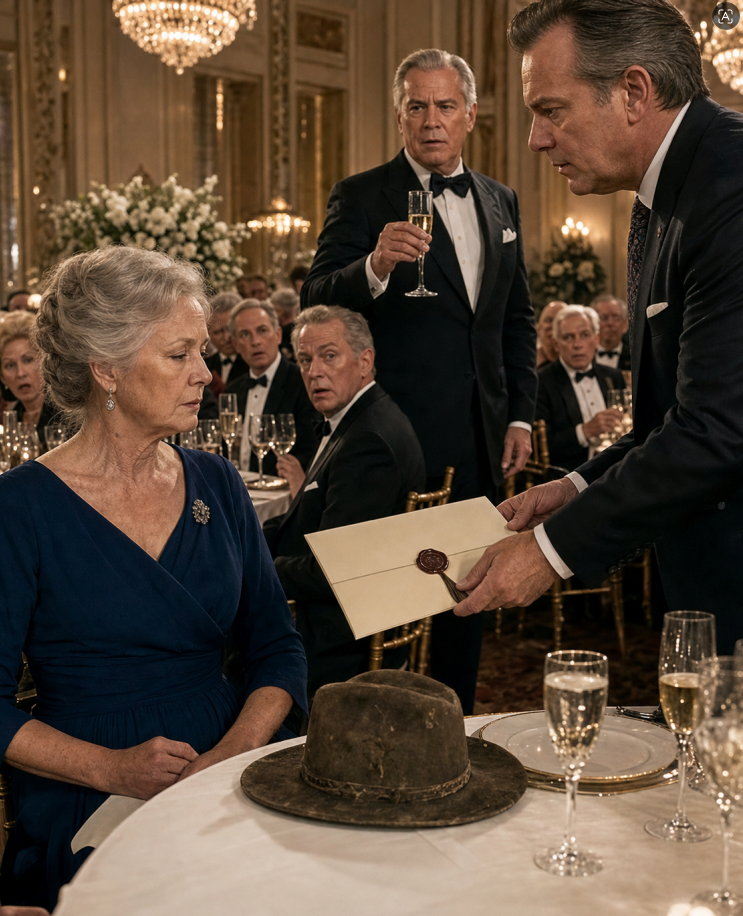
Old Walt’s felt hat, sweat-stained and shapeless, sitting on the white tablecloth beside the crystal like a stone in a jewelry box. Nobody at the table knew whose it was. They thought I was the eccentric widow who couldn’t be trusted to dress the part. Let them think it. Walt had worn that hat every Sunday for eleven years while I sat with him in the county home, and I wasn’t going to walk into that ballroom without a piece of him.
They seated me by the kitchen doors on purpose. Preston arranged the whole evening — the head table with its view of the city, the lesser tables radiating outward by importance, and me at the very edge where the waiters swung through with their trays. My late husband founded that company with his own two hands and a second mortgage, and his board had decided the founder’s widow belonged near the busboys.
I understood the message. I just didn’t accept it.
The expansion announcement came between the salad and the entrée. Preston stood, tapped his glass, and unveiled the renderings on the big screens — a sprawling new facility, projected revenues, the kind of numbers that make tuxedoed men lean forward and smell their own futures. He thanked the visionaries. He thanked the investors. And then, because cruelty is a kind of appetizer for men like him, he raised his glass toward my end of the table.
“And of course,” he said, “to Eleanor. Who reminds us that some people contribute to a company simply by being cared for.”
The laughter was soft and knowing. Not cruel enough to be called cruel. Just enough to make sure I heard it.
I did hear it. I heard all of it. I heard it the way you hear a clock in an empty house — every tick separate and enormous.
Here is what none of them knew.
Walt Krieger was not a drifter. He was a prospector, the last of a vanishing kind, and sixty years ago he’d walked every ridge and dry wash of the land this company was now standing on. When the firm bought that acreage decades back, they bought the surface. The paperwork was sloppy the way old land deals always are, and nobody in that room had ever checked what lay underneath. The mineral rights had never conveyed. They’d sat unclaimed, forgotten, under boots that never thought to look down.
Walt knew. Walt always knew. And in the last clear afternoon of his life, with me holding a cup of water to his lips, he’d signed a will leaving those rights to the only person who’d bothered to sit with him.
The attorney arrived at the dessert course.
I’d asked him to come at exactly that hour, and he crossed the ballroom in a plain dark suit that made every tuxedo look like a costume. He didn’t hurry. He stopped at my chair, and in the sudden lull he set a sealed cream folder on the tablecloth beside Walt’s hat.
Preston’s toast simply stopped. You could see him trying to place the attorney, trying to understand why a stranger was delivering documents to the woman he’d just made a punchline.
“Mrs. Halloran,” the attorney said, loud enough to carry. “The recording completed this afternoon. It’s official.”
I opened the folder slowly, because I’d earned the slowness. Inside was the deed, and the survey, and the legal description of a mineral estate that ran directly beneath the parcel glowing on Preston’s projection screens.
I didn’t stand. I didn’t raise my voice. I slid the top page toward the center of the table and let the nearest board member read it, and I watched the understanding travel around that ballroom like a draft under a door.
You cannot break ground on land whose minerals belong to someone else. You cannot dig, drill, or build a foundation without negotiating with the owner of what lies beneath. Their entire expansion — the renderings, the projections, the futures they’d smelled — every bit of it now had to pass through the woman at the table by the kitchen doors.
Preston sat down. He didn’t decide to; his body simply did it.
“That’s not possible,” he said. “We own that land.”
“You own the top of it,” I said. “Walt owned the rest. And now I do.”
I wish I could tell you I savored it. Part of me did. I’m human, and there is a particular music in watching a room full of people who dismissed you realize they need you. But the music didn’t last, because I looked down at that battered felt hat and understood the whole shape of the thing.
Walt died on a Tuesday in a narrow bed with a view of a parking lot. No board members came. No renderings glowed at his bedside. The richest asset any of them would ever chase had belonged to a man they’d have stepped over on the sidewalk, and he spent his last years grateful that one person brought him butterscotch candies and listened to his stories about the ridges.
He never got to see this. That’s the part that sits in my chest. He willed me a fortune and never once mentioned it, because to Walt it wasn’t the gift. The Sundays were the gift. He gave those back to me by giving me the rights, and he did it without ever making me feel like I was owed.
The board’s lawyers called my attorney within the week. Then they called every day. The expansion is frozen until we come to terms, and we will come to terms, because I’m not a cruel woman and Walt wouldn’t have wanted a monument to spite. But they will come to my table now. They will sit where I tell them to sit.
I kept the hat. It’s on my mantel, shaped exactly to a head that isn’t here anymore.
At the dinner, after the folder, after the silence, Preston tried one last time to find his footing. He lifted his glass with a shaking hand and asked, almost pleading, what it would take.
I picked up Walt’s hat and stood.
“You could have started,” I said, “by remembering his name.”
Then I walked out through the front doors, the ones they hadn’t wanted me near, and I let the kitchen doors swing shut behind me for the last time.
Comments are closed.