I didn’t decide to do it so much as my body decided for me.
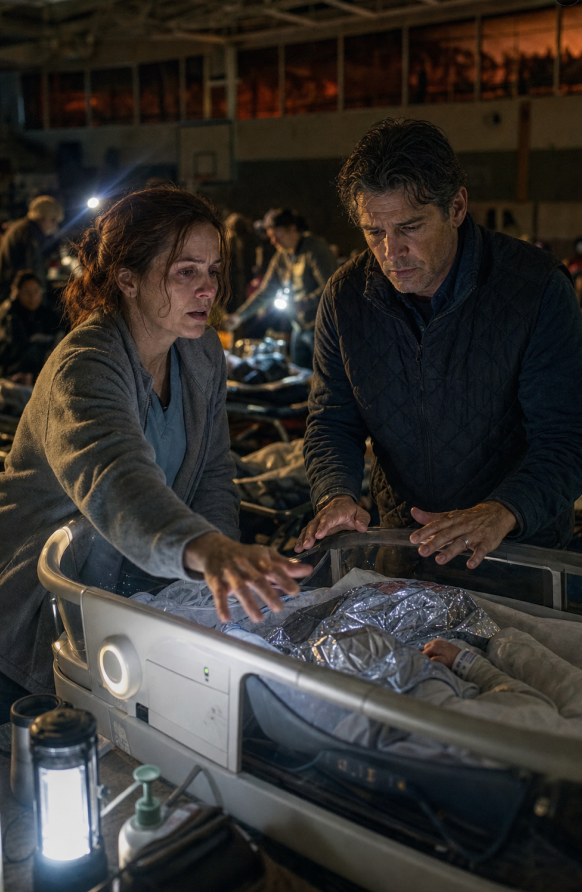
The incubator’s little green light had been the only steady thing in that gym for hours — proof, somehow, that the machines still worked, that help was a concept that still applied to us. When it blinked out, a woman two cots down started to cry, and Elliot, the baby’s father, made a sound I have never forgotten. Not a word. Just air leaving a man who has run out of things to buy his way through.
He had money. You could tell from a hundred small things even under all that soot — the watch, the way the volunteers deferred to him, the phone he kept trying even though there was no signal and no power to charge it. And none of it could warm his daughter.
I unzipped my fleece, and then I unbuttoned the shirt under it, and I lifted that tiny cold body out of the dead incubator and put her against my bare chest and wrapped my coat around us both.
I need to explain something I didn’t explain in the first part, because it’s the part that matters.
Three weeks before that fire, I had a son. He lived for four days. My milk came in the morning after we buried him, which is a cruelty I still don’t have language for — a body preparing to feed a child who is already gone. I hadn’t told anyone I was still producing. I hadn’t told anyone anything. I’d gone to my sister’s town to be somewhere that wasn’t my apartment, and then the sky turned orange and they put me on a bus to that gym.
So when I held Elliot’s daughter against my skin, my body understood the assignment before my mind caught up. I was warm in the exact place a newborn needs warmth. And when she rooted, weak and desperate, I let her nurse, because she was starving and there was no formula and no power to warm it if there had been, and because some animal part of me that had had nowhere to put four days of grief finally, finally had somewhere to put it.
She pinked up around two in the morning. I felt it happen — the cold weight of her going from limp to alive, her little hand opening and closing against my collarbone. Elliot sat on the floor beside my cot with his back against the wall and watched us and did not say one word the entire night. Every so often his shoulders would shake. He thought I couldn’t see in the dark. I could.
By dawn the roads opened and the paramedics came and took her, and Elliot went with her, and I honestly thought that was the end of it. A thing that happened in a gym in a fire. I went back to my sister’s. I didn’t tell anyone about that night either.
Three weeks later he found me.
He’d tracked me down through the shelter’s intake logs, which he was not supposed to have access to, which is a thing men like him can arrange. He came to my sister’s door in a plain gray sweater and he looked like he hadn’t slept, and he asked if he could sit down.
And then he told me the thing I still can’t say out loud without stopping.
That cot — the one right beside the incubator, the one I’d thought I got by luck of the draw when the volunteers pointed me to it — hadn’t been random. In the chaos of intake, Elliot had seen my wristband. The hospital hadn’t discharged me cleanly; my paperwork still flagged me as postpartum, and there was a grief-services referral clipped to my file that a volunteer had left visible on the clipboard. He’d seen it. He’d understood, in a way, what it meant. And when they were assigning cots, he had quietly asked — arranged, the way he arranges things — for the woman with that file to be placed near his daughter.
“I don’t know why I did it,” he said. “I think part of me thought — she’ll understand. She’ll know how to be near something that fragile without falling apart. Everyone else in that room was afraid of my daughter. You were the only one who wasn’t afraid of losing her, because —” and he stopped, and he couldn’t finish it, and he didn’t have to.
Because I already had. Because you can’t be afraid of the worst thing happening when it already happened to you three weeks ago.
He wasn’t proud of it. He kept saying that. That he’d used something private and terrible about a stranger to protect his own child, and that he’d understand if I never wanted to see him again. He’d come, he said, mostly to tell me the truth of it, because he couldn’t stand carrying it and letting me think it was chance.
I’ve thought about being angry. People tell me I’m allowed to be. He looked at the worst night of my life on a clipboard and made a calculation with it.
But here is what I keep landing on. That baby is alive. My milk, which my own body made for a son I couldn’t save, kept a stranger’s daughter breathing until the roads opened. Elliot’s terrible, presumptuous calculation put her exactly where she needed to be. And in the doing of it, something that had been frozen solid in me since a four-day life ended started, very slowly, to move again.
His daughter is nine months old now. She grabs my hair with both fists and shrieks with delight when I come through the door. Elliot and I are — I don’t have a clean word for what we are. Careful with each other. Grateful in a way that’s almost unbearable.
I lost a son and three weeks later, in the dark, in the smoke, a stranger who’d read my grief off a clipboard set a dying baby in my arms. I will spend the rest of my life not knowing whether to call that a wound or a mercy.
I’ve decided it can be both.
Comments are closed.