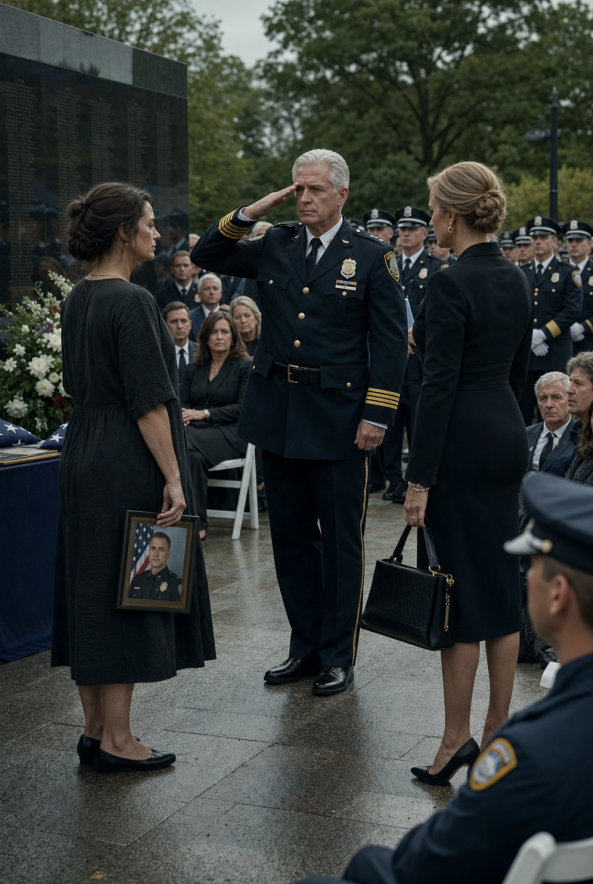
The chief’s salute held for three full seconds. Long enough that I could hear the woman in the front row — the one they’d seated, flagged, and photographed as Detective Raymond Cole’s widow — make a small, sharp sound, like the air had been knocked out of her.
I didn’t move. I couldn’t. My husband’s memorial had just tilted on its axis, and I was standing at the back in a coat older than our marriage, being saluted by the highest-ranking officer in the department.
“Mrs. Cole,” the chief said again, lowering his hand. He looked out over two thousand uniforms and civilians and cameras, and he did the thing no one in that department had been willing to do for eight months. He told the truth in public.
Ray had been undercover.
Not the desk-and-warrant kind. The deep kind — the kind where the department builds you a second life and then pretends the first one doesn’t exist, for your safety and for the case. He’d spent the last three years of his life inside an organization the city had been trying to break for a decade. The “wife” in the front row, the beautiful composed woman with the folded flag, was not his wife. She was a person of interest in the very case that got him killed. She had inserted herself into his funeral the way she’d inserted herself into his cover life — because a grieving widow is above suspicion, and a grieving widow gets access to everything the dead man left behind.
Including his files.
That was what she was really there for. Not the flag. The flag was theater. She wanted the funeral to certify her as next of kin so she could get her hands on whatever Ray had been building against her people.
And the department, terrified of blowing the last shreds of an operation that had already cost a man his life, had let her sit there. Had let the story stand. Had let me — the actual, legal, courthouse-married wife — be quietly relabeled a “complication” and pushed to the back of the room.
The chief had decided he was done letting that happen.
“Detective Cole married Anna Reyes in a private civil ceremony two years ago,” he said, and every head in that plaza turned toward me. “At his request, and for reasons of operational security, that marriage was not made public. Those reasons no longer apply. She is his widow. She has always been his widow. And this department owes her an apology it will spend a long time trying to pay.”
The woman in the front row stood up. She tried to walk toward the aisle, calm, like she was simply leaving early.
Two officers were already there.
They didn’t make a scene. Cops who are good at this never do. They simply appeared at either side of her, spoke quietly, and walked her out a side exit while the flag she’d been holding sat abandoned on an empty chair. I learned later that Ray’s last case file — the one she’d come to inherit — was the exact thing that put her in a federal courtroom within the year. He got her from the grave. He’d built it so carefully that even dead, even erased, even replaced at his own funeral, he still closed his case.
But I didn’t know any of that yet, standing at the back.
What I knew was that a young officer named Delgado came down the rows, holding the folded flag that had been taken off that empty chair and refolded, corners crisp, and he stopped in front of me with his eyes wet.
“He talked about you,” Delgado said, so only I could hear. “He wasn’t allowed to. But he did anyway. He said, if anything ever happened, we were supposed to find the woman in the gray coat and tell her he was sorry it had to be a secret, and that the secret was never because he was ashamed. It was because he was scared they’d figure out what he loved and use it.”
He put the flag in my hands. It was heavier than I expected. Everything about that day was heavier than I expected.
I have the flag on a shelf now, next to our courthouse photo — the one where we’re both laughing because the clerk mispronounced his name and Ray decided to legally keep the wrong pronunciation as a joke. For eight months I let strangers tell me I wasn’t really his wife. I let them fold me into the background of my own grief because they told me it was safer, quieter, easier.
The chief was right about one thing. It took them a long time to pay what they owed. There were letters. There was a formal correction. There was a plaque, eventually, with my name on it as next of kin.
But the thing I keep isn’t the plaque or the letters.
It’s a folded flag on a shelf, and the memory of two thousand people turning, all at once, to look at the woman they’d been told didn’t count.
Comments are closed.