I didn’t say anything in the gallery. Not yet.
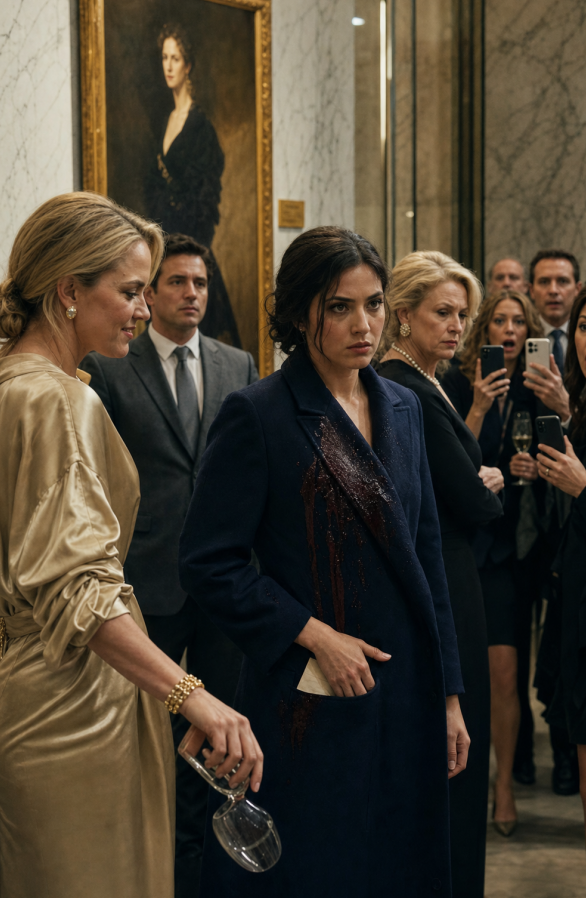
I excused myself to the restroom, wine still soaking into my skin, and I stood at the marble sink and breathed until my hands stopped shaking.
Then I called the one person at the firm who would still be awake. My supervisor, Renata. She’d flagged the Whitcomb file herself.
“The signature,” I said. “On the appraisal loan for the Whitcomb Collection. It’s my name. I never signed it.”
There was a long pause.
“You’re sure?”
“I’ve never appraised a private collection in my life. I started this job in April.”
Renata went quiet in the way people go quiet when they realize the ground just moved under them. “Then someone used your credentials to certify a loan value. That’s not a mistake. That’s fraud. Do not go back out there and accuse anyone. Come in tomorrow. Bring the coat.”
I laughed, half hysterical. “The coat?”
“The stain’s got a timestamp. Forty witnesses. If this goes where I think it goes, you want a record of exactly where you stood tonight and how they treated you.”
I went back out.
Vivian was holding court by the largest painting, a smug oil portrait the family called their crown jewel. She saw me and rolled her eyes at her friends.
“Back for round two?”
Daniel finally crossed the room. He touched my elbow, lowered his voice. “Can you just let it go? For one night? Mom’s already upset.”
Six years. And that was the sentence he chose.
“Your mother’s upset,” I repeated.
“You know how Viv is.”
“I do,” I said. “I know exactly how Viv is.”
I looked past him to the portrait. To the little brass placard beside it that read ON LOAN — WHITCOMB FAMILY TRUST.
On loan. Not owned. Financed against an appraisal that carried my forged signature.
That’s when the older man in the corner stepped forward. I hadn’t noticed him before. Gray suit, quiet eyes, a leather folder under his arm. He’d been standing near the placard the entire time.
“Excuse me,” he said, and the room turned. “I’m looking for the family’s counsel. I represent the note holder on the Whitcomb appraisal loan.”
Vivian’s smile flickered. “This is a private event.”
“It is,” he agreed. “Which is why I’d hoped to do this quietly. The loan certification appears to carry a forged appraiser’s signature. That makes the note callable. Immediately.” He looked around the gallery, at the paintings on every wall. “As of this filing, the collection secures a defaulted debt. Nothing here can be sold, moved, or transferred pending review.”
The champagne glasses stopped moving.
Daniel’s mother stood up. “That’s absurd. Our appraiser signed everything.”
“Did he?” the man said. He opened his folder. “The signature belongs to a junior analyst who never met your family and never saw this collection.” He glanced at me. Just once. “She reported it herself. Tonight.”
Every head in that gallery turned toward me. The woman with the wine stain. The one who didn’t know how to carry herself.
Vivian’s face drained white. “You,” she breathed.
“I didn’t sign it,” I said. My voice didn’t shake anymore. “Someone in this family used my name to inflate this collection and borrow against it. I found out two weeks ago. I reported it two weeks ago. Tonight was just the first time I was in the same room as the paintings.”
“You’re lying,” Vivian snapped. “You’re nobody. You review parking tickets.”
“I review distressed tax filings,” I said. “Yours crossed my desk in June.”
The lawyer cleared his throat. “The family will need to identify who submitted the certification under her credentials. That person is looking at federal fraud charges. The collection is frozen either way.”
Daniel’s mother sat back down, slowly, like her knees had given out. And I watched her look at Vivian. Not confused. Not shocked.
Guilty.
Because Vivian handled the family’s paperwork. Vivian had access to the firm’s portal through an old client login. Vivian, who couldn’t stand that I’d gotten a real job, had needed a credentialed name to sign off on a value the family couldn’t actually justify.
She’d picked mine. The nobody. The safe target.
“Viv,” Daniel said quietly. “What did you do?”
She didn’t answer. She just set her wine glass down on the marble ledge, very carefully, the way you set something down when your hands have stopped working.
I pulled the folded envelope from my ruined coat pocket and handed it to the lawyer. The lien notice. The one I’d carried in all night against my ribs.
“I think this is yours now,” I said.
Then I took off the wine-stained coat, folded it over my arm, and walked toward the door across those marble floors, past forty people who had spent six years deciding what I was worth.
At the threshold I stopped and looked back at the crown-jewel portrait, at the little brass placard that said ON LOAN.
The gallery lights were still warm and gold on every frame.
And not one of those paintings belonged to them anymore.
Comments are closed.