I married a man who couldn’t say yes.
I want to be honest about that from the start, because I’ve had a long time to stop pretending it was anything noble. My sister owed the Voss family money — the kind of debt that doesn’t get forgiven, only collected, in one currency or another. And the currency they wanted was me. A wife for Adrian. The heir who’d been in a coma for fourteen months, the one the doctors had quietly given up on, the one the family needed married before a trust clause locked his fortune away from them forever.
Sign here, they said. Wear the ring. It’s a formality. He’ll never know, and neither will anyone else, and your sister’s debt disappears.
So I signed. And I told myself I’d never have to look at him.
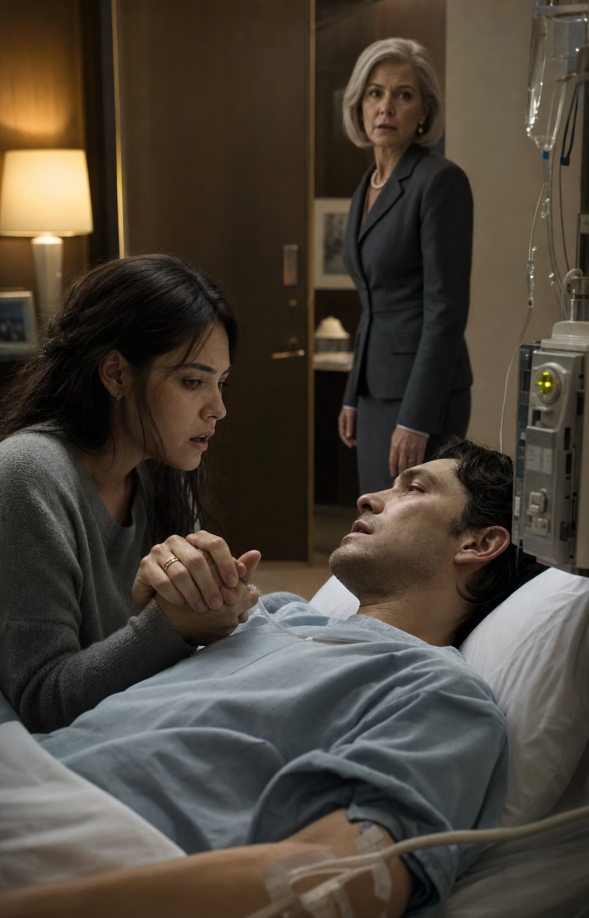
For six months I kept that promise. The checks cleared, my sister was safe, and I stayed away from the private hospital suite where my husband breathed through a machine and a beautiful silver-haired woman named Vivian ran his empire in his name. Vivian was his aunt. She was also, everyone understood without saying it, the reason nobody fought too hard for Adrian to wake up. A conscious heir is a problem. A sleeping one is a signature you get to forge.
I only went back because the guilt got too heavy to carry. I thought if I said it out loud — the whole ugly truth, to a man who couldn’t hear me — maybe I could set it down.
The suite was cold and white and full of the sounds of things keeping a person technically alive. He looked smaller than his photographs. Gaunt, pale, dark hair against the pillow, an IV in one arm and, taped beside it, a small pump I didn’t think much of at the time. I sat down by the rail and I took his hand, which was warm, which somehow made it worse.
And I told him everything. That I’d married him for money. That I’d never meant to come. That I was sorry he was a chess piece to the people who were supposed to love him, and that I was one too, and that between the two of us he was the only one who hadn’t chosen it.
I said, “I only married you to save my sister. You deserved better than to be someone’s transaction. I’m so sorry.”
And his fingers tightened on mine.
I froze. I told myself it was a reflex. Nurses had warned me about that, involuntary movements, nothing more. But then his lips moved. Dry, cracked, barely there. I leaned down until my ear was almost against his mouth, my heart slamming.
He breathed one word.
“Vivian.”
Not a groan. Not a random sound. A name. Said with something underneath it that I felt in my spine before I understood it — not longing. Fear.
I looked up. And Vivian was standing in the doorway.
She’d come to check on her investment, I suppose. Composed, tailored, pearls. But when she saw me bent over him, when she saw his hand gripping mine, something crossed her face that I will never forget, because it was the exact opposite of what an aunt should feel seeing her nephew stir after fourteen months. It wasn’t joy. It was calculation. And then it was alarm.
“He’s having a spasm,” she said smoothly, already crossing the room. “It happens. I’ll call the nurse to adjust his medication.”
His medication. My eyes went to the little pump taped by the IV. And Adrian’s hand squeezed mine again, harder, and his eyes — his eyes opened, just slits, and they went straight to that pump and then to me. Begging.
I did the only thing I could think of. I stood up between Vivian and the bed and I said, too loud, that I wanted the doctor. Not the nurse. The doctor. Now. And when she told me I was overwrought and should leave, I said I was his wife, legally, and I wasn’t going anywhere, and if anyone touched that pump before a physician looked at it I would call the police from this room.
That stopped her. The word police. The one thing people like Vivian cannot survive is a written record.
The doctor came. A real one, from another floor, one Vivian didn’t own. He looked at the pump. He looked at the chart. And his face changed.
The dosage running into my husband’s arm was a sedative. A heavy one. It had been ordered “to manage agitation” — except Adrian, per every scan, had no brain activity that should produce agitation. Someone had been keeping him under. Chemically. For months. Every time he drifted up toward the surface, the pump pushed him back down.
He wasn’t hopeless. He was being held.
Vivian was gone by the time hospital security understood what they were looking at. She had a car waiting, the way people like her always do. But you can outrun a building. You can’t outrun a toxicology report and a nephew who wakes up.
Adrian surfaced over the next eleven days. Slowly, terribly, beautifully. Muscles that had forgotten themselves, a voice that came back in pieces. The first full sentence he ever said to me, once he could, was, “You came back and told me the truth. Everyone else just told me to sleep.”
I tried to give him an out. I told him the marriage was a fraud, that he owed me nothing, that I’d disappear and he could annul the whole thing and pretend the woman who married him for money had never existed.
He said no.
He said the only honest person in his entire life had walked into his room to confess the worst thing she’d ever done, and it woke him up. Literally. He said he’d take that over a hundred people who loved his fortune and let him drown to keep it.
Vivian’s fight over the trust is still crawling through the courts, but it’s a losing one, because the heir she declared hopeless is very much awake and very much signing his own name now. My sister’s debt is gone. And the man I married for all the wrong reasons is, against every single thing I planned, the person I’d marry again for the right ones.
It turns out the word that saved his life was a name. And the word that saved mine was the truth I only said because I thought no one was listening.
Comments are closed.