The two men who drove me up the mountain didn’t say a word the entire way.
The truck was a big black thing with tires meant for terrain that no longer existed under all that water. I sat in the back with my bag on my knees and told myself, over and over, that I was a doctor and this was what doctors do. We go when we’re called. I just hadn’t expected the call to come from him.
Everyone in the valley knew about the house on the ridge and the family that lived in it. You didn’t say the name out loud at the diner. You didn’t ask what happened to the people who’d crossed them. You kept your head down and you were grateful they left the town mostly alone, the way you’re grateful a storm passes to the north.
And now their patriarch had called my emergency line at two in the morning and said the word every doctor is helpless against. “He’s dying. Please.”
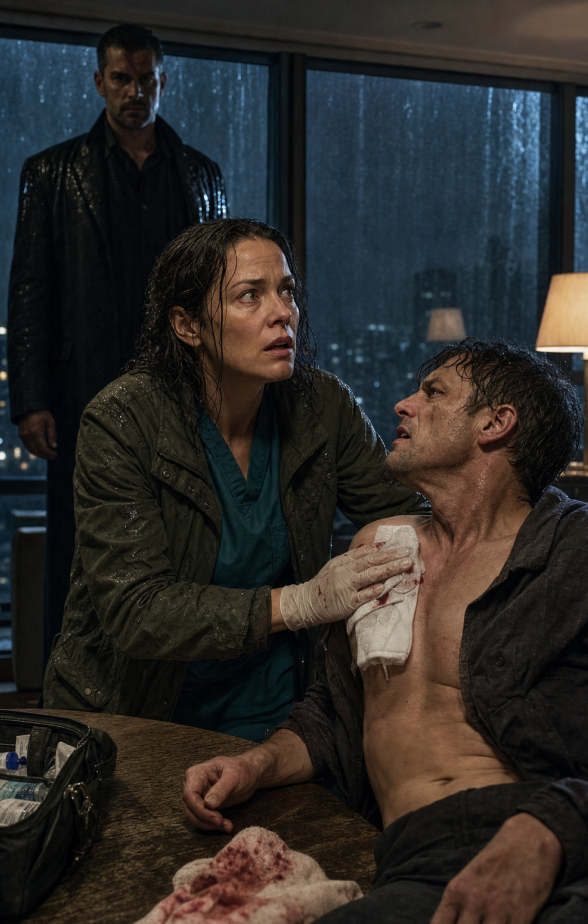
The house, when we finally reached it, was exactly the fortress the rumors promised — stone and dark glass, a helipad no helicopter could use in that wind, men in rain gear with rifles slung standing under the eaves like they’d grown there. Nobody frisked me. That surprised me later, when I had room to be surprised by anything. They just took my bag, looked through it fast and professional, and walked me up a wide staircase to a room at the end of a hall.
There was a lot of blood, though someone had tried to pack the wound before I got there. A man lay on the bed, shirtless, gray-faced, breathing in the shallow way that makes the back of your neck go cold. And I knew, the moment I saw the entry wound below his collarbone, exactly why they’d sent two silent men down a flooded mountain for a small-town doctor instead of calling an ambulance. Gunshot wounds get reported. An ambulance means a chart, and a chart means the sheriff, and the sheriff means questions this family did not intend to answer.
I pulled back the blanket to get a better look at the wound. And then I looked up at his face.
And the room tilted.
I knew that face. I had known it my whole life, in a different shape, softer and younger and unmarked by whatever the last eleven years had carved into it. I had cried at what I was told was that face’s funeral. I had helped my mother pick out the casket. I had stood at a graveside in a cheap black dress and thrown a handful of dirt on a box I now understood had never held my brother at all.
Danny. My little brother, who had gone off the rails at nineteen, who had fallen in with people my parents wouldn’t name, who had “died” in a car fire so complete there’d been nothing to see — right up until this exact moment when he was bleeding on a bed in the most feared house in the county and I had my hands inside the wound.
I did not fall apart. There wasn’t room. I did what I know how to do — I found the bleeder, I clamped it, I got a line in him, I worked. The old man, the patriarch, stood in the corner the whole time and watched me with eyes that didn’t miss anything, and at some point he said, quietly, “You know him.”
It wasn’t a question. I didn’t answer it. I just kept working, because the only leverage I had in that house was the fact that their boy was dying and I was the only person in thirty miles who could stop it.
I stopped it. Somewhere around four in the morning Danny’s breathing evened out and his color came back and the bleeding was controlled and I knew, with the cautious knowing of my profession, that he was going to live if infection didn’t take him. I sat back on my heels, soaked in my brother’s blood, and I finally let myself look at his face the way a sister looks, and not the way a surgeon looks.
That’s when the old man told me the truth, or as much of it as he wanted me to have. Danny hadn’t died in that fire eleven years ago. He’d owed the wrong people, and the choice they’d given a scared nineteen-year-old was to disappear into their world or bring ruin down on the family he’d borrowed against. So he’d let a fire tell his family he was gone, and he’d been theirs ever since. The funeral I’d grieved at was a mercy and a leash all at once.
And now, the old man said, there was a choice for me too. Keep my mouth shut and let Danny recover quietly in that house — or report the wound, the way the law required, and set in motion a chain of events that would not end well for anyone in that room, my brother included.
I want to tell you I agonized over it for hours. I didn’t. I looked at Danny’s face, alive, breathing, real, after eleven years of a grave, and I understood that the law had already failed him once and I was not going to be the thing that finished the job.
I told the old man I’d stay until Danny was stable enough to be left, and then I’d go home, and I’d forget the wound. But I set a condition of my own, and it surprised him, and it’s the reason I can live with what I chose.
I told him I wanted to see my brother. Not once. Regularly. That if I was going to carry their secret, then Danny was going to be my brother again — that I’d drive up that mountain with antibiotics and follow-up care and, God help me, our mother’s stubbornness, and that they were going to let me. The old man studied me for a long time. Then he almost smiled, and he said, “He always said his sister was the tough one.”
That was eight months ago. I’ve been up the mountain eleven times since. Danny is healed. We don’t talk about the years we lost, not yet. Mostly we just sit, and sometimes he tells me small true things about who he’s become, and it’s still the best hour of my month.
I know what I did. I’m a doctor and I broke the law and I’d do it again without a heartbeat’s pause. Some nights I wonder what it makes me, keeping that family’s secret. Then I remember the eleven years I spent believing my brother was in the ground, and I think: I got him back. Whatever it cost, I got him back. And there is no oath in the world that outweighs that.
Comments are closed.