I stood there with the recorder burning in my closed fist, and Elias Crane held my gaze, and for the first time since a lawyer had introduced us, I understood I had never actually met this man.
He raised one finger to his lips. Not a shush. A plea. Wait.
Then he took my other hand and led me to the far corner of the room, away from the door, away from the mirror, away from the ornate air vent I hadn’t thought twice about. He turned the recorder over in my palm and pressed a small button on its side.
His uncle’s voice filled the space between us.
Low. Amused. Unmistakable. Harold Crane, the man who had shaken my father’s hand and called me “dear” at the rehearsal dinner.
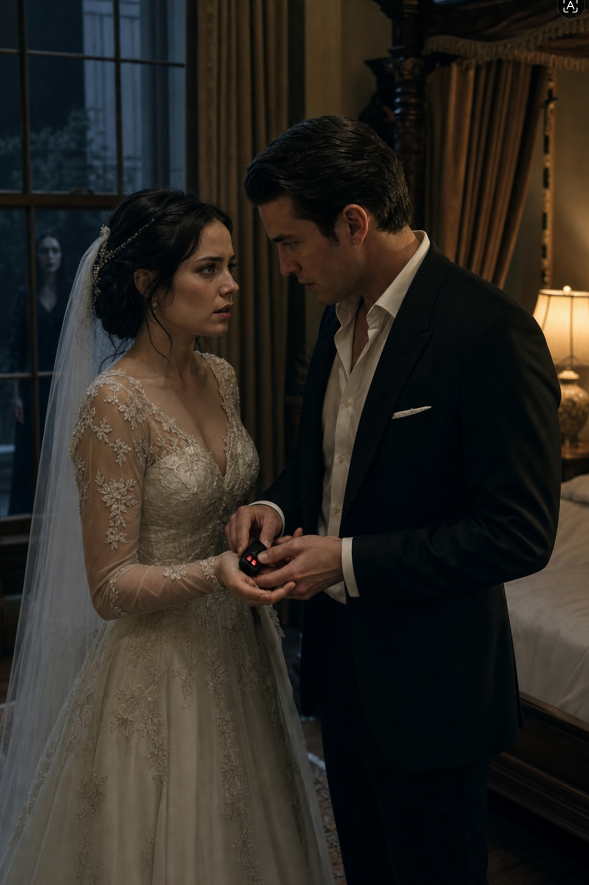
“The beauty of it,” the recording said, “is that the boy can’t contradict a word. Twenty years I’ve told the board he’s mute. Twenty years I’ve signed in his name, voted his shares, moved his money. A fever.” A dry laugh. “There was never any fever. I put him in a room at nine years old and told him that if he ever spoke, if he ever made a single sound in front of anyone, I’d finish what I started with his mother.”
I felt the floor tilt.
Elias watched my face as I listened. He wasn’t mute. He had never been mute. He had been silenced, by a man who needed a voiceless heir to loot an estate for two decades.
The recording kept going. Harold, talking to someone, a lawyer maybe, or one of his people. Bragging. Men like Harold can’t help it; the not-talking was never his problem.
“The marriage seals it,” his voice went on. “Once he’s wed and the shipping merger clears, the trust converts. He’ll have signed away control to me for good and he’ll never know, because he can’t read a contract out loud to ask a question. The girl’s just set dressing. Her father’s too buried in debt to make noise.”
The red light blinked. Eleven days of this. Elias had been wearing the recorder in his cuff for eleven days, gathering the rope.
He took a small pad and a pen from the nightstand. His handwriting was fast and sharp, a man who’d done all his talking on paper his whole life.
I can hear. I can speak. I chose not to, in front of them. It’s the only weapon I had.
I wrote back, my hand shaking: Why give this to me?
He read it. Looked at me for a long moment. Then wrote:
Because you told me the truth tonight when you had no reason to. Everyone in this house lies to me because they think I can’t answer. You didn’t lie. You said you were leverage. So am I. I thought maybe two pieces of leverage could stop being used.
I read it three times.
Then, so quietly I almost missed it, Elias Crane spoke. The first words I ever heard from him, rough and unused, like a door opening on a room no one had entered in years.
“The merger clears at nine tomorrow morning,” he said. “Harold thinks I’ll sign in front of the board and say nothing, like always. He’s arranged the whole thing for silence.” He swallowed. “But you’re my wife now. Which means you can speak for me. And I can hand you eleven days of him confessing to everything.”
I understood then what the wedding had actually done. Harold had married me to Elias to seal his control.
Instead, he’d handed Elias the one thing a silent man had never had. A voice with legal standing in the room. A wife who could stand up at that table and play the recording out loud.
We didn’t sleep. We planned.
At eight the next morning I walked into the Crane boardroom in a gray suit instead of a veil, Elias at my side, his hand steady in mine. Harold smiled his warm smile and slid the merger documents across the table and said, “Whenever you’re ready, my boy.”
“He’s ready,” I said. “But before he signs, there’s something the board should hear. A statement from Elias, since he can’t give it himself.”
Harold’s smile didn’t move, but his eyes did.
I set the recorder on the polished wood and pressed play.
His own voice filled the room. The fever that never was. The mother. The twenty years of forged signatures. Eleven days of it, playing to a table of directors who had believed every word he’d ever told them.
Halfway through, Harold lunged for the recorder. Elias caught his wrist. And then Elias Crane, the silent heir, spoke for the first time in front of his family, in front of the board, in a voice that shook but did not stop.
“Sit down, uncle,” he said. “You told me that if I ever made a sound, you’d finish it.” He didn’t let go of Harold’s wrist. “I’m making a sound now. Finish nothing.”
The room was very quiet after that, the way a room gets when everyone in it realizes the ground they were standing on was never real.
The board called their own lawyers before Harold could call his.
That was two years ago. The merger went through, but under Elias’s name and his signature and his voice. Harold is in a courtroom now, working through the first of many charges, and the tapes are entered into evidence, all eleven days of them.
Elias talks now. Not much, and not to everyone. Twenty years of silence doesn’t leave a person all at once. Some mornings he still writes me notes instead, out of habit, and I keep every one of them in a drawer.
But last week he stood at that same bedroom window where I once told him I was only leverage, and he said my name out loud, just to hear it in the room, and I realized neither of us had been the paper anyone signed.
We were the thing that tore the contract up.
Comments are closed.