The governor’s hand closed around mine and the whole hall seemed to hold its breath.
I had rehearsed nothing, because I had expected nothing. I had come to the ceremony the way I came to everything that year — quietly, near the back, in the plain dark dress, carrying the little framed commendation they had mailed me in an envelope with a cellophane window. I had learned to make myself small in rooms that were supposedly about my husband, because a woman named Sloane Prescott had decided, somewhere in the first raw weeks, that the grieving was hers to organize, and the town had agreed with her the way towns agree with the person who is easiest to photograph.
Sloane had known Cade for a total of about three months. She had run the neighborhood watch he liaised with. When he died, she wept beautifully at the vigil she planned, gave the quote to the paper, and set up the memorial fund with her own name as treasurer. I let her. I was too gutted to fight, and some cowardly part of me was grateful that someone else would stand in the lights.
So when the governor took the podium that night and Sloane rose from the front row in her navy dress with her hand already lifting, I did what I always did. I sat still and waited to clap.
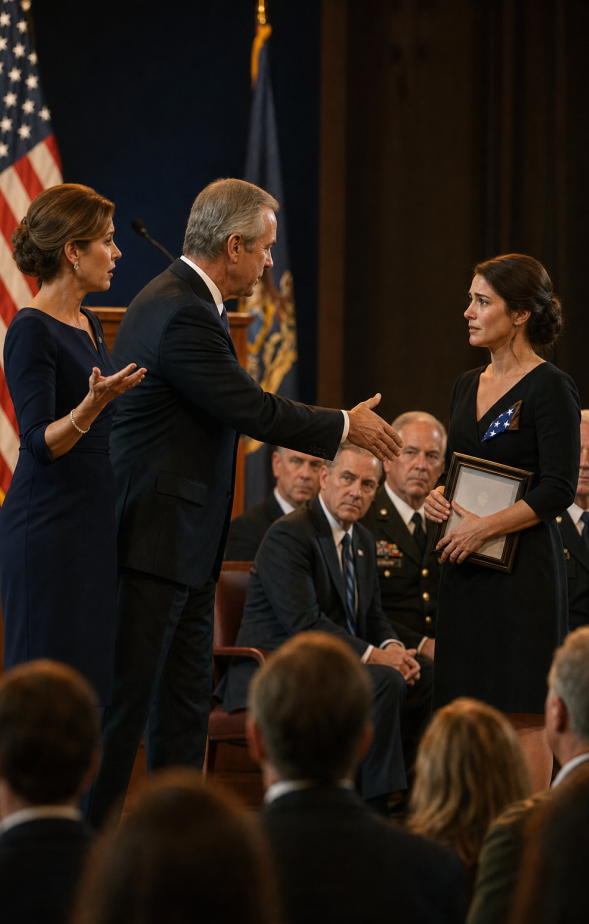
He did not shake her hand.
He came down off the step. He walked past her outstretched fingers as though they were not there, and he crossed the floor to the third row, and he stopped in front of me. Up close he was older than the posters, kind around the eyes, and very deliberate. He said my name — my real name, the one that was on the marriage certificate and none of the press releases. Then he leaned down so that only I could hear the first of it.
He told me that my husband had not died the way the story said.
Cade had not been a trooper who wandered into the wrong traffic stop. He had spent the last fourteen months of his life working an assignment so quiet that even I had not known its shape, only its cost — the late nights, the flinching, the way he had started sleeping with his back to the wall. He had been placed inside a trafficking and protection ring that reached further up the county than anyone had wanted to admit, and he had died because he got close enough to the center to matter.
And the ring he had been sent to break had a public face, a respectable one, a fundraiser and a volunteer and a woman who was very good at standing next to grief and being photographed.
He did not have to say her name. I felt it go through me like cold water. Every vigil. Every quote. Every dollar routed through a fund she controlled, in the name of the man who had died trying to expose what she was part of. She had not been mourning Cade. She had been managing the story of his death from the inside, keeping herself close to it, making sure the widow stayed small and quiet at the back where she could not ask inconvenient questions.
I stood up. My legs did it before I decided to. The governor straightened, still holding my hand, and now he spoke to the room, and he said the parts that could be said — that Sergeant Cade Rhodes had died in the line of a duty most of them would never know the details of, that the state honored his widow, and that certain matters connected to his work were, as of that week, in the hands of people whose job it was to pursue them.
He was careful. He named nothing. He did not have to. I watched it travel across the hall, the understanding, seat by seat, the same way it had traveled through me. And I watched Sloane Prescott, still standing, her hand finally dropping to her side, her lovely composed face doing the arithmetic of a woman who has just realized which way the light has turned.
She left before the reception. Within the month there were investigators, and subpoenas for the memorial fund’s records, and a story in the same paper that had run her tearful quotes, this time with her name in a different kind of sentence. I did not gloat. I was too busy learning who my husband had actually been in his last year, which was braver and lonelier than the man I thought I had failed to comfort.
I had spent a year believing my grief was too quiet to count. That I was the widow who couldn’t perform the part. The governor’s hand around mine, in front of everyone, said the opposite: that the quiet one was the real one, and that the woman who knew how to hold a room had been holding it for reasons that had nothing to do with love.
I keep the commendation on the mantel now, out of its cellophane envelope, in a proper frame. Underneath it I keep the folded flag. And when people ask me about Cade, I tell them the truth I was finally allowed to tell — that he died doing something most people never knew about, and that the woman who tried to own his memory is the exact thing he gave his life to stop.
I stand at the front now. It took a governor reaching past a prettier hand to teach me I was allowed to.
Comments are closed.