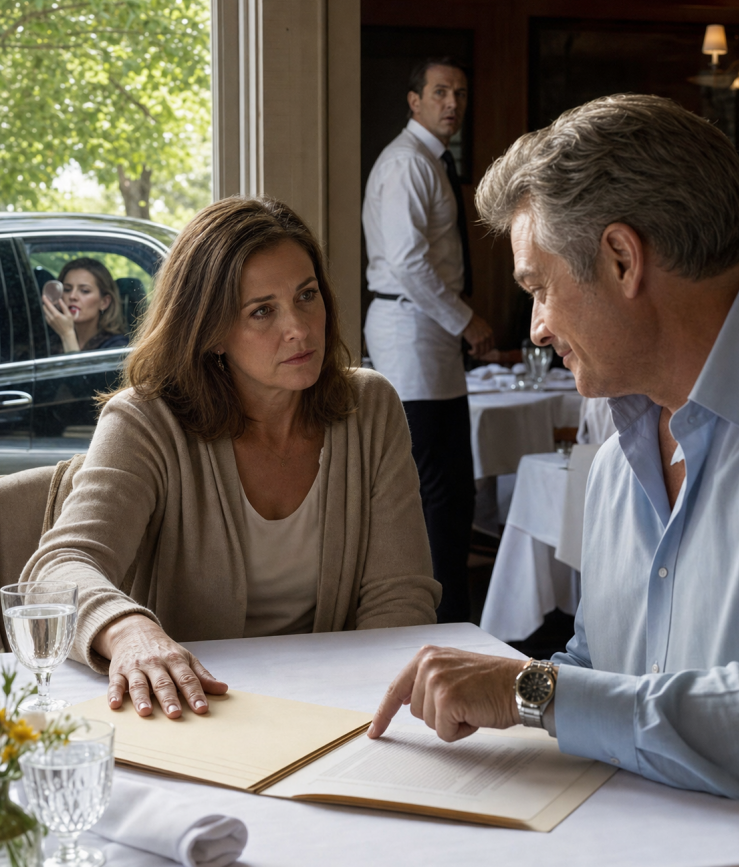
He did not read it at the table. Men like David never check their own math. He just laughed, the soft laugh he uses on waiters and women he underestimates, and told me to enjoy my little mystery.
So I let him keep the folder. I had a copy of the one that mattered at home in a shoebox, next to a birthday card in Ruth’s shaking handwriting.
Here is what David never bothered to learn about his own family, because learning it would have meant sitting with an old woman he found boring.
The house on Linden Street was built by his great-grandfather. When the old man died, he did not leave it to David’s grandmother, the way the family always told the story at dinner. He left it to his two daughters together, equally. David’s grandmother, and her younger sister. Ruth.
Ruth married, moved two towns over, and never pressed her claim. The family let the story quietly rewrite itself, the way families do. By the time David inherited, everyone simply assumed the whole house had come down his grandmother’s line.
But assuming is not the same as recording. And Ruth, forgotten Ruth, had kept every yellowed paper her father ever signed.
She showed me the day I brought her soup during her first hospital scare. She was propped up on two pillows and she said, in that dry way of hers, You are the only one who comes, so you may as well know where the bodies are buried.
Then she told me she still legally held half of the house David lived in. Her half had never been sold, never been signed away, just buried under sixty years of nobody looking.
I told her it was not my business. I told her I did not come for anything. That was the truth, and she knew it, which I think is exactly why she decided what she decided.
Ruth passed in March. Quietly, in her sleep, with me holding her hand because no one else showed up in time. David sent a wreath and skipped the service for a golf tournament.
Her lawyer called me two weeks before the divorce lunch. Ruth had made a new will eighteen months earlier, witnessed, notarized, airtight. She left her half of the Linden Street house to me. To the girl who came, she wrote. Do something loud with it.
So when David slid that folder across the tablecloth and told me I had always been a guest, I already owned half the floor under his feet. He just did not know it yet.
He found out four days later, when his own lawyer called him, voice tight, asking who Ruth Delaney was and why her estate had filed a partition claim on the family home.
He called me that night. The soft laugh was gone.
You cannot do this, he said. That house is my family.
I let the silence sit the way Ruth taught me to. Then I said, Ruth was your family too. You just never noticed her. I did. And she noticed me back.
A partition claim means the house cannot simply be his. Half of it is mine, legally, permanently, and there is nothing his shiny lawyer can do but negotiate. He can buy me out at fair market value, or we sell and split, or he keeps living there and pays me for the privilege.
He wanted to know what I wanted. What my number was. Men like David always think there is a number.
Here is what I wanted. I wanted him to understand that the woman he called a guest for nineteen years, the woman he tried to hand a suitcase and a story, had been the only person in his whole family to earn a place in that house through love instead of assuming one through blood.
So I did the loud thing Ruth asked for.
I did not take the money and vanish. I kept my half. I let David and his new girlfriend go right on living on Linden Street, in the house with the garden I planted, under the roof I now legally hold half of. Every month he writes me a check for my share, and every month he has to address the envelope to me by name.
He hates it. His girlfriend hates it more. The neighbors, who all adored Ruth, love it most of all.
I bought a small place across town with the rent, near a hospital where I volunteer three days a week now, sitting with old people whose families have gotten too busy to visit. There is always a Ruth in every ward, sharp and funny and waiting for someone to ask a real question.
Sometimes I drive past the house on Linden Street. The garden is overgrown because David never learned which things were weeds. The porch light Ruth’s father installed still comes on at dusk, all on its own, the way it has for ninety years.
I keep the birthday card in the shoebox on my nightstand. Do something loud with it, she wrote.
I did, Ruth. I promise you did.
Comments are closed.