Dr. Reyes didn’t raise his voice. He walked the length of that emergency room, past the man in the camel coat, and stopped just close enough to be heard.
“Mr. Calloway,” he said. “I need to ask you something about a car accident three years ago.”
I was still in the trauma bay with my hands inside a fight to keep a woman and her unborn child alive, but I heard the whole room change temperature. The woman on Calloway’s arm — young, glossy, bored until that exact second — took a half-step away from him without seeming to decide to.
Calloway laughed the way powerful men laugh when they’re buying time. “I don’t know what you think you’re—”
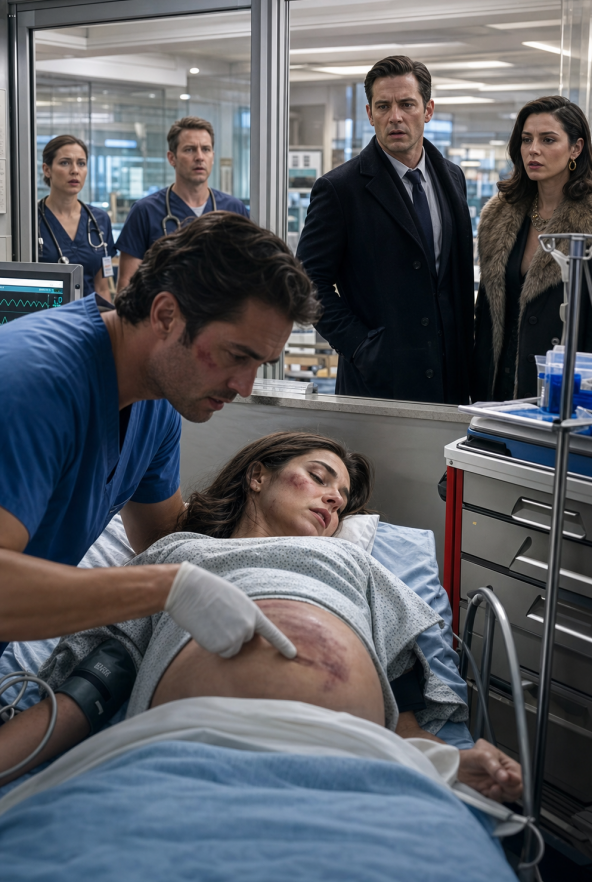
“The woman in that bay has a splenic repair scar,” Reyes said. “I did that repair. Three years ago, on a Jane Doe brought in after a single-vehicle crash off Route 9. She left against medical advice before we could get a name, and I never saw her again.” He paused. “The car was registered to you. It was in the report. You said she’d taken it without permission.”
I remember the exact moment the monitor over my patient’s head steadied — the moment she stopped actively dying and started merely being critical — because it lined up with the moment Calloway stopped pretending.
Her name, we learned once she was stable enough to have one, was Dana. She was thirty-four. She had been in a relationship with Nathaniel Calloway that he had spent three years insisting never happened. The crash off Route 9 hadn’t been an accident she caused. It had been the night she tried to leave him, and the version of events that made it into a report — the version where she was an unstable woman who took a car — had been written by lawyers who worked for a man whose family name was on the wing we were standing in.
And she was pregnant. Late second trimester. The dates, when the OB laid them against the last time anyone could place Dana and Calloway in the same city, pointed exactly one direction.
He’d walked into my emergency room to give a speech to the board about the generosity of his family. He had walked in six feet from the woman he’d spent three years erasing, and he hadn’t even looked.
Here is what I have learned in fifteen years of trauma nursing: the powerful are not protected by their money so much as by everyone else’s assumption that the story they tell is the real one. Dana had been the unstable ex. The woman who took the car. The problem that went away. Nobody with a badge or a title had ever had a reason to look at her chart and Calloway’s story side by side.
Dr. Reyes had a reason. It was a scar he’d sewn with his own hands, and he was not a man who forgot his own work.
Calloway’s lawyers arrived within the hour — that’s how fast money moves — and they tried, first, the gentle version. A misunderstanding. A tragic coincidence. A generous offer to “make sure Dana had the best care,” delivered to me, of all people, at the nurses’ station, as if I were the loose thread.
I told them what I tell everyone who tries to manage me in my own department. “I document what I see. I saw a coding patient with a repair scar, a chart, and a set of dates. That’s already in the record. It’s not mine to un-see.”
Dana survived. So did the baby — a girl, born six weeks later, small and furious and alive. Dr. Reyes’s identification of the scar became the thread that unraveled the tidy three-year-old report, because once someone credible said out loud that the “unstable woman who took the car” had actually been fleeing, other people came forward. A neighbor. A coworker Dana had confided in. A paramedic who’d never been comfortable with how quickly that scene got cleaned up.
Nathaniel Calloway did not go to prison for the crash — the evidence was old, and men like him have very good lawyers. But the paternity was not something a lawyer could talk away, and neither was the pattern that came out once people stopped assuming his story was the true one. His name came off the wing. His board seat evaporated in the quiet way those things do. And Dana, who had spent three years being the discredited ex, walked out of my hospital with a daughter and, eventually, a settlement large enough that she will never have to explain herself to anyone again.
I saw her once more, months later. She came back to thank the staff, the baby on her hip, and she found me at the same station where Calloway’s lawyers had tried to make me the loose thread.
“You didn’t look away,” she said. “Everybody always looked away.”
I told her the truth. “I had a coding patient. Looking away wasn’t an option.”
But that’s only half of it. The other half is Dr. Reyes, who remembered a scar for three years, and a coldness in the man who owned half the building that finally, on the day he ignored the wrong trauma bay, turned around and found nothing there to protect him.
Comments are closed.