The maitre d’ pulled out my chair, and I watched my husband’s whole face come apart.
Grant had rehearsed a lot of expressions for me over the years. The tired-but-loving one when he came home late. The wounded one when I asked a question he didn’t like. The patient one, the one that said I was being difficult. I knew them all. I’d catalogued them the way you learn the creaks of a house you no longer trust.
I had never seen this one. This was the face of a man who has just realized the floor he’s standing on is painted on air.
“Sophia,” he said. “What—what are you doing here?”
“Eating,” I said, and sat down. “I own the place. Where else would I be?”
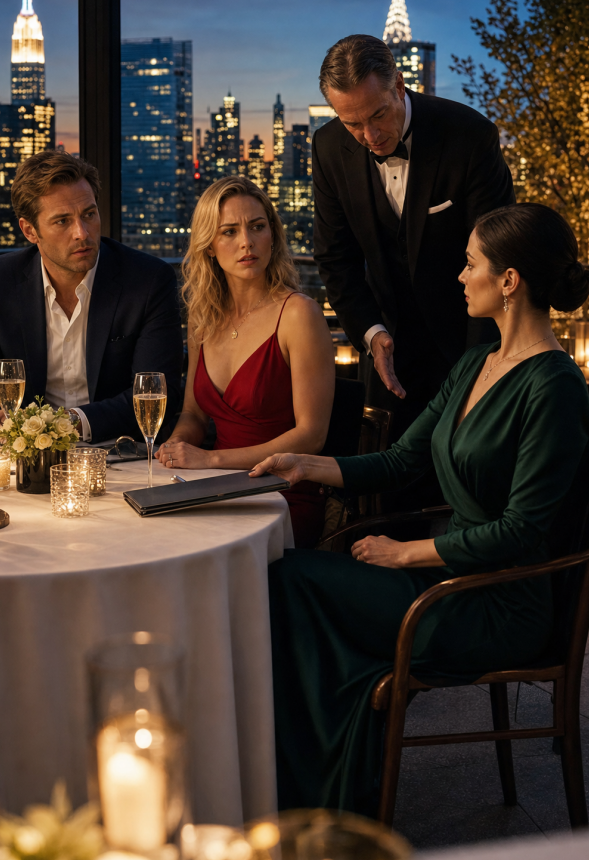
Let me back up, because the rooftop was the end, not the beginning.
I bought into the restaurant two years ago, quietly, through the holding company my grandmother left me. It started as an investment and became something more personal when the head chef, a woman named Renata who’d been burned by three bad partners, asked me to come on as the majority owner so she could stop being afraid. I said yes. I never told Grant. Not because I was hiding money from him the way he was hiding money from me, but because it was the one thing in my life that was mine, that he couldn’t manage or minimize or fold into his plans. A woman is allowed one room of her own.
I found out about the affair the boring way. Not lipstick, not a text. A recurring transfer on a joint account, small at first, then not small, moving into an account I didn’t recognize. I’m good with numbers. I’ve always been good with numbers, which is a thing Grant found charming when we were young and inconvenient once he had things to hide.
So I hired a forensic accountant. And I waited.
When Grant told me he had a “client dinner” downtown on Thursday, I almost laughed, because I knew before I checked that the reservation for the chef’s table — the best seat in my own restaurant — had been booked under his name that morning. He’d booked his affair into my house. He’d have laughed himself if he understood the shape of it.
I called Renata. I told her not to change a thing. Seat them, serve them, treat them like royalty. And when the moment was right, I’d arrive.
The woman across from him was younger than me and nervous in the way of someone who half-suspects she’s a bad decision. When I sat down she looked at Grant, then at me, then at the maitre d’ still hovering with the deference he showed only to the owner, and I watched the math happen behind her eyes. She set down her wine.
“You must be the client,” I said pleasantly. “Grant talks about his clients constantly. Well. He talks about one client constantly.”
Grant found his voice. “Sophia, this is completely inappropriate—”
“You’re right,” I said. “It is. Which is why I brought paperwork instead of a scene.”
I slid the folder across the linen. It was bound, tabbed, professional. My accountant does beautiful work.
“Page four,” I said. “That’s the account you opened in her name. Page six is where the money came from — our account, the joint one, the one you told me we had to be careful with because things were tight. Forty-one thousand dollars, Grant. Careful indeed.”
The woman — her name was Chloe, I learned later, and honestly I don’t hold much against her; she thought he was single — stood up so fast her chair scraped. She looked at the folder, at her own name printed on a bank record she’d never seen, and she understood that whatever this was, it was not a love story. It was a liability.
“You told me you were divorced,” she said to him.
“Separated,” Grant tried.
“We had breakfast together this morning,” I said.
She left. She didn’t storm out; she just gathered her coat with the quiet efficiency of someone removing herself from a crime scene. Smart woman.
That left Grant and me and the folder and the city glittering behind us like it didn’t care, which it didn’t.
“You’ve been planning this,” he said, and he had the nerve to sound betrayed.
“I’ve been noticing this,” I corrected. “There’s a difference. You did the planning. I just kept the receipts.”
Here is the part I didn’t put online, because it’s the part that mattered.
He didn’t apologize. Not once, that whole night. He argued about the account, said it was a business thing, said I wouldn’t understand the structure, tried three separate times to make me the unreasonable one for reading my own bank statements. And somewhere in the middle of watching him do it, over the candlelight, in the restaurant I’d built as my one safe room, I stopped being angry. Anger needs a little hope in it — hope that the person will finally see you. I was out of that.
I signed the divorce filing the following Tuesday. The forensic audit did most of the talking; the hidden transfers made the settlement very simple and very much in my favor. He kept expecting a fight, kept bracing for the scene, and never got one, because I was done performing for him too.
Renata catered nothing that night. She just came out at the end, after he’d gone, and sat down in Chloe’s abandoned chair with two glasses and a bottle of the good Barolo we don’t put on the menu.
“On the house,” she said.
“I own the house,” I reminded her.
“Then on me,” she said, and poured.
We sat there until the kitchen closed, two women who’d both been underestimated by men who mistook quiet for weakness. Below us the city kept its lights on. Around us my restaurant hummed, mine, every table of it.
I go back most Thursdays now. I sit at the chef’s table alone, or with Renata, or with friends who make me laugh. Same seat he booked for her.
Best seat in the house. I should know. I picked it.
Comments are closed.