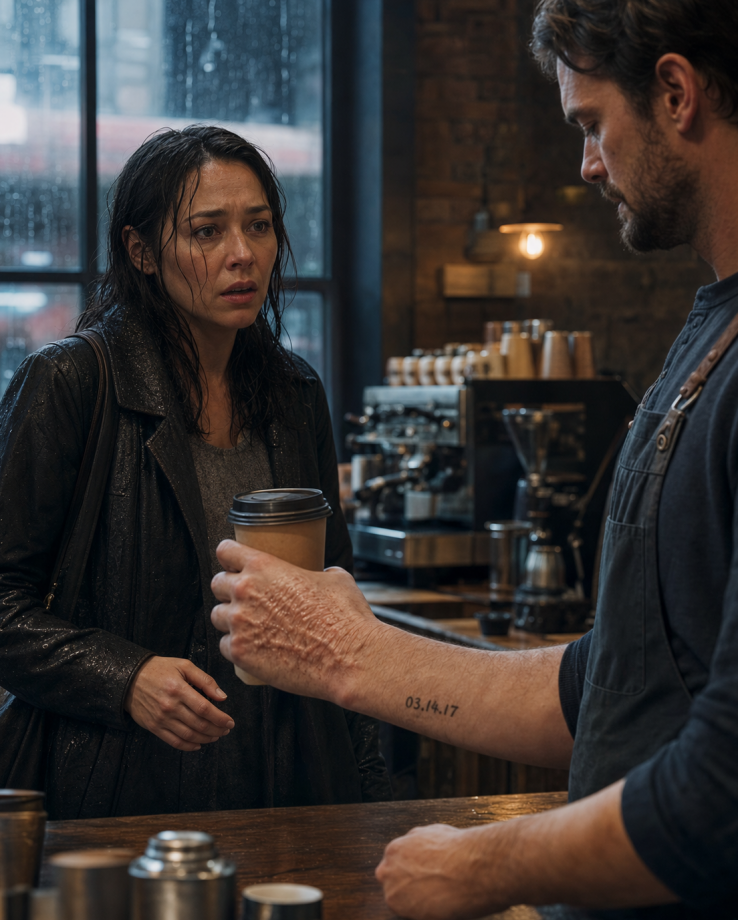
I didn’t scream. I think everyone expects that when the dead come back — some cinematic gasp, a dropped cup, a scene. What actually happened was much quieter. I stood at that pickup counter with my cold latte and I said, “Marcus. Look at me.”
And after two years of being a ghost, he did.
He came around the end of the counter. He told the other barista he was taking his fifteen, and he walked me out into the rain to a bench under the awning where the espresso machine couldn’t drown out what he had to say. His hands were shaking now — the scarred one and the other — and the steady voice I’d heard him fake for a stranger’s coffee order was gone completely.
“I wanted to tell you a thousand times,” he said. “Every single day.”
Here is the truth he’d been carrying alone, the truth that took me the rest of that rainy afternoon and half the night to pull out of him in pieces.
Three years ago, before the boat, Marcus had done something he never told me about. He’d borrowed money. Not from a bank — from a man who ran cash through the marina, a man who lent easy and collected hard. We were drowning after the fire. The rebuild, our daughter’s smoke-damaged lungs, the months he couldn’t work with his burned hand. He took the loan to keep our house, and he told himself he’d pay it back before I ever noticed.
He couldn’t. The interest ate him alive. And when he tried to walk away, the man made it very clear what happened to families whose fathers didn’t pay. He described our daughter’s school. He described the route I drove to work. He knew our lives down to the hour.
“He told me the only way you and Emma were ever safe,” Marcus said, “was if I stopped existing. If I was worth more gone than alive. There was an insurance policy. If I drowned, it would clear the debt and leave you something. If I ran and he found me, he’d take it out of you.”
So he staged it. He went out on the water in a storm he’d checked three times, he capsized the boat where the current would carry everything away, and he swam to a stretch of shore he’d picked in advance. He watched his own memorial from a distance through a borrowed phone. He watched me fold the flag they gave me. He watched Emma cry.
“The insurance cleared the loan,” he said. “You were safe. He had no reason to touch you anymore. That was the whole point. If I came back, the debt came back with me, and so did he.”
I sat with that for a long time. The rain kept coming. Part of me wanted to hate him — for the empty casket, for the nights I’d held Emma while she asked why her daddy didn’t float, for the insurance money that had felt like blood in my hands. And part of me understood that the man beside me had chosen to be dead so that we could be alive, and had paid for it with two years of watching us from across the water.
“Does he still —” I couldn’t finish it.
“He died last spring,” Marcus said. “Heart attack. It was in the paper. That’s the only reason I stopped running. That’s why I’m here, forty minutes from you, and not four states away. I’ve been trying to figure out how to come back from the dead without wrecking the life you built without me.”
I told him about the life we’d built. The place I set for him at dinner that Emma still insisted on. The way she’d stopped saying “drowned” and started saying “before.” I told him that a girl who lost her father to the sea and got him back from a coffee shop was not going to accept “it’s complicated” as an answer.
We didn’t fix everything on that bench. You don’t undo two years of grief in one rainy afternoon, and there were hard, ugly conversations still ahead — about the money, about the lie, about whether I could ever again trust a man who’d let me bury him. But Emma is nine now. She deserved to know her father chose her, even in the worst possible way.
I brought her to the coffee shop the following Saturday. I didn’t tell her why. I just ordered her hot chocolate and let the man behind the counter come around and kneel down to her height and say her name.
She looked at his hand. At the scar. She has heard the story of that scar her whole life — the night her daddy reached through fire for her. She looked at the scar, and then up at his face, and she said, very quietly, “You have the fire hand.”
And my dead husband, on his knees on a coffee-shop floor, finally got to cry in front of his daughter.
Comments are closed.