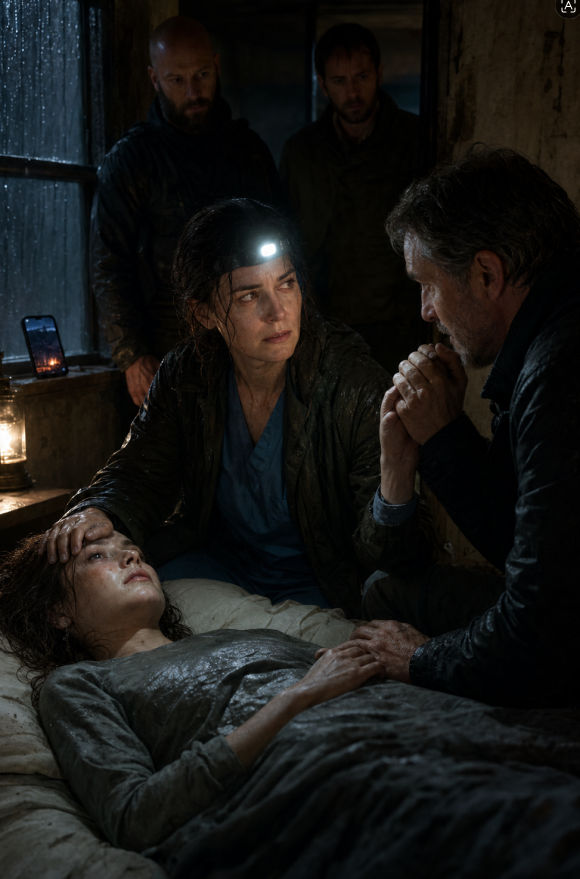
I kept my hand exactly where it was, pressed to his forehead, because I was afraid of what my body would do if I pulled it away too fast.
His name was Marcus Vale. I didn’t need anyone to tell me. The county whispered that name the way you whisper about weather that kills. And Dana, the woman breathing softly on the mattress now, was his little sister.
He stood up slowly. He was still holding my hand, and now the grip meant something different.
“You recognized me,” he said. Not a question.
I didn’t answer. There’s a moment in medicine where you learn that lying with your face is a skill, and I was already exhausted, and the storm was still hammering the roof.
“I saw the way you looked at me,” he said. “Just now. You know.”
“I know your sister is alive,” I said. “That’s all I know.”
He let go of my hand and walked to the small window. Rain ran down the glass in ropes. On the sill sat a burner phone, screen up, and even from across the room I could see the frozen frame of a video paused on it. A building at night. Orange light. My clinic.
He’d been watching it. Over and over, maybe. The way people replay the worst thing they ever did, not out of guilt, but to remember they’re capable of it.
“That fire wasn’t supposed to hurt anyone,” he said. “It was a message. Your partner was treating men I needed to stay sick. I told my people to make it look like an accident.”
“You burned down the only clinic in forty miles,” I said. My voice came out steadier than I felt. “People drive two hours now to see a doctor. A kid died in the back of a car in March because we weren’t there.”
He flinched. I saw it. And I filed it away, because a man who flinches still has something in him you can push against.
“And now,” he said quietly, turning back to me, “you’ve saved the one person on this earth I would burn the whole county down to protect. So we have a problem, doctor.”
“We don’t have a problem,” I said. “I’m going to leave, and you’re going to let me, and your sister is going to live.”
“You could tell people,” he said. “About the fire. My face on that recording. You could ruin me.”
And there it was. The test in disguise. He wasn’t thanking me anymore. He was measuring me, deciding how much of a threat the woman who saved his sister had just become.
Two of his men had drifted into the doorway. I hadn’t heard them come. The vial was empty in my pocket. My leverage, the thing that had made me useful, was spent.
I did the only thing I knew how to do. I told the truth.
“Mr. Vale,” I said, “I’ve had your sister’s life in my hands for three hours. If I wanted to hurt you, I had the easiest chance in the world, and I didn’t take it, because that’s not what I do. I don’t trade in what I know. I trade in whether people breathe.”
Dana stirred on the mattress. Her voice was a thread. “Marcus.”
We both turned.
“He’s not lying,” she whispered. “I heard everything. She stayed. She counted my breaths. Don’t you dare.”
Something broke in his face. Not the mask, the thing under it.
He crossed to the bed and knelt, and for a long moment the only sound was the rain and his sister’s breathing, and I understood that whatever he decided in the next ten seconds was the whole rest of my life.
“Take the phone,” he said finally, without looking at me.
“What?”
“The recording. My face. Take it. Do what you want with it.” He set it in my hand. His fingers were shaking. “You gave me back the only thing I couldn’t buy. I won’t beg you for your silence. I’m giving you the reason to keep it, or the proof to end me. That’s yours now.”
I looked down at the phone. My clinic, frozen in orange.
I could have walked out and gone straight to the county sheriff. I thought about the kid in the car in March. I thought about it hard.
But I also thought about a man kneeling by his sister’s bed, handing a stranger the noose for his own neck, because she’d asked him not to be who he’d always been.
By morning the water had dropped enough to cross. Two of his men carried Dana down the trail on a board, gentle as if she were made of glass.
At the bottom, where my truck waited half-sunk in mud, Marcus Vale stopped me.
“The clinic,” he said. “It’ll be rebuilt. Bigger. No name on the check. You’ll never see where it came from.”
I didn’t say thank you. I don’t thank people for putting out fires they started.
I got in my truck. The phone sat on the passenger seat the whole drive down, screen dark now, my clinic sleeping inside it.
Three months later, a new clinic opened on the old lot. Brick, not wood this time. A generator that could outlast any storm. Nobody knew who paid.
The phone is still in my desk drawer, in an evidence bag I’ve never sealed.
Some nights I take it out and look at that orange frame, and I still haven’t decided.
But every morning I unlock a door that shouldn’t exist, on a lot that burned, and I see the line of people already waiting, and I go to work.
Comments are closed.