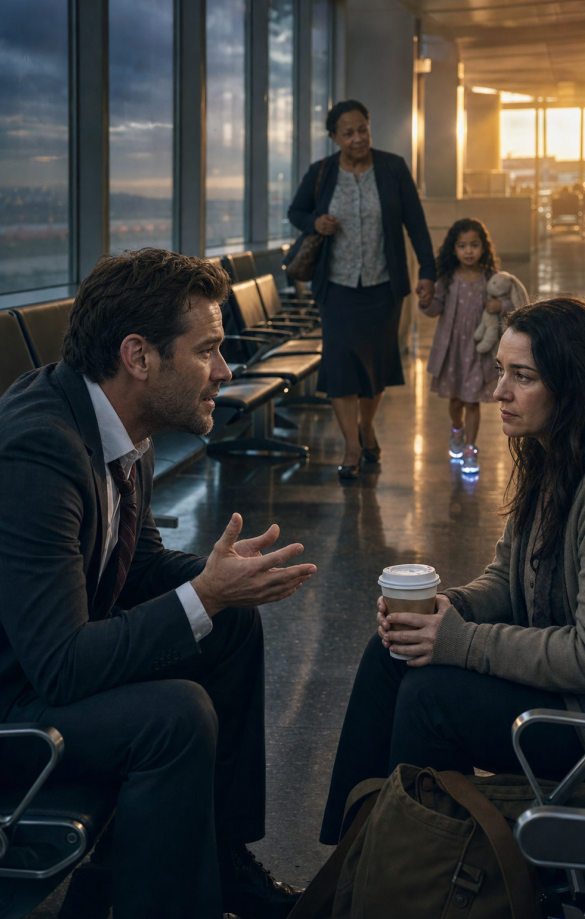
The sun was just starting to burn the storm off the far windows when the nanny came around the corner of the empty concourse, and I stopped hearing a single word Daniel was saying.
Let me go back to the night before, because you can’t understand the sunrise without the dark.
Our flight had been cancelled at eleven at night — some cascade of weather and crew hours that stranded a whole terminal of strangers on those hard steel benches. I’d found a corner to myself, or thought I had, until a familiar voice said my name like it was a joke he’d been saving for years.
Daniel. Older, softer around the jaw, but the same. The man I’d been with for three years in my twenties. The man who left me in the ugliest way a person can leave — not with distance, but with an accusation.
He’d called my phone one afternoon, back then, and I hadn’t picked up because I was in a meeting. When I called back forty minutes later, he was already gone — coat, toothbrush, the framed photo off the dresser. He’d seen an outgoing call on my phone bill to a number he didn’t know and decided, in the span of one afternoon, that I was having an affair. The number was a misdial. A wrong digit on a call to my own doctor’s office. I had the records. I begged him to look at them.
He never did. He wanted to be betrayed more than he wanted to be right, because being betrayed let him leave without being the villain.
What he didn’t know — what he couldn’t have known, because he blocked my number and moved and told our friends I’d “cheated” — was that three weeks after he walked out, I found out I was pregnant.
I had our daughter alone. I named her Lila. I raised her on double shifts and secondhand everything and a stubbornness I didn’t know I had. And I stopped, eventually, trying to find him, because a man who won’t read the phone records isn’t going to read a birth certificate.
So there we were. Stranded overnight. And Daniel, being Daniel, spent those hours in the dark telling me about my life.
“You had so much potential, Nora,” he said, leaning forward with that half-smile. “I always felt bad about it. You could’ve done something. Instead you’re — what, still scraping by? Alone?” He shook his head like my whole life was a tragedy he’d narrowly escaped. “I just think it’s sad. You wasted it.”
I let him talk. I held my cold coffee and I let him build his little monument to how much better he’d done, how right he’d been to get out. Because I knew something he didn’t.
Lila had been on a delayed flight too — coming back from a week with my sister, flown as an unaccompanied minor with a family friend, Ms. Okonjo, escorting her. Their connection had been rerouted through this same terminal. I’d gotten the text at 4 a.m.: same airport, arriving at dawn, meet at the gate.
I hadn’t told Daniel any of it. Why would I? He didn’t even know she existed.
So when the sky went from black to that thin blue and then to gold, and I saw Ms. Okonjo come around the corner holding the hand of a small girl with dark curls and a stuffed rabbit under her arm, I just stood up. Mid-sentence. Right in the middle of Daniel explaining how I’d thrown my potential away.
Lila saw me and her whole face opened up. “Mommy!”
She ran the last stretch and hit me at the knees, and I picked her up, and over her shoulder I watched Daniel’s face.
He was looking at her the way you look at a mirror that’s showing you something impossible. Because Lila has his eyes. Not similar. His. The exact shape, the exact color, the little downturn at the outer corners that I used to trace with my thumb.
“Nora,” he said. His voice had gone strange. “Who — how old is she?”
“Five,” I said.
I watched him do the math. I watched five years land on him all at once — the afternoon he didn’t wait, the phone records he wouldn’t read, the door he closed so he could be the one who was wronged. I watched him understand that the “wasted potential” he’d been mourning for me was a woman who had raised his daughter alone while he told the story of my failure at dinner parties.
“You never told me,” he whispered.
“I tried,” I said. “You blocked the number. You moved. You told everyone I cheated.” I settled Lila on my hip. She was studying him with open five-year-old curiosity, this stranger who had her eyes. “I stopped trying because you taught me you’d rather have the story than the truth.”
He reached out — toward her, I think, some instinct — and Lila leaned into my neck, shy, and he let his hand drop.
“Can I—” he started.
“Not tonight,” I said. Not cruelly. Just true. “She doesn’t know you. And you don’t get to walk into her life at an airport gate because you finally did the math.” I picked up my bag. “If you want to know her, you’ll do it the slow way. Lawyers, letters, supervised time, all of it. The way you should have done everything the first time, instead of leaving.”
Ms. Okonjo gathered our things. Lila waved at the man with her eyes, the way kids wave at anyone, and we walked toward the exit as the whole terminal went gold.
Behind me, Daniel didn’t say a word. For the first time in the whole long night, he had nothing to explain.
The potential he thought I’d wasted had a name, and a stuffed rabbit, and his exact eyes — and she’d just walked across a sunrise to reach the only parent who ever stayed.
Comments are closed.