Three languages. English, then Gujarati, then Portuguese — because the port her last three shipments cleared through was in Brazil, and I wanted her to understand that I knew the whole route, end to end.
Celeste Ashford’s champagne never made it to her mouth. She set it down on the display case very slowly, the way you move when some animal part of your brain has understood a threat before the rest of you catches up.
“I’m sorry,” she said, and the bright cruel laugh was gone, replaced by something thinner. “Who are you?”
I reached under my apron and took out the leather folder I’d carried in with the catering trays, and beside it, my credentials.
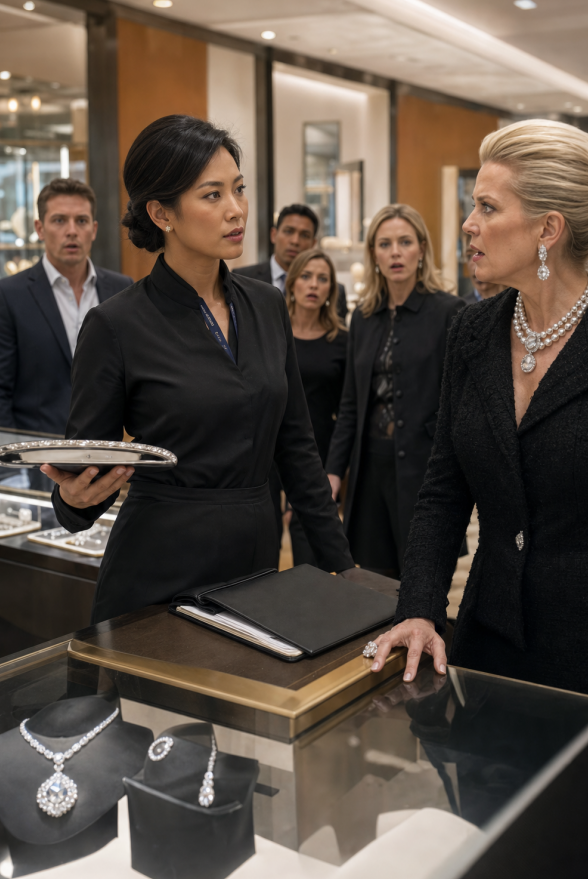
“Priya Nair,” I said. “U.S. Customs and Border Protection, financial crimes liaison. I’ve been the extra server at four of your events this year, Ms. Ashford. You really should look at the people you humiliate. Sometimes they’re the ones taking notes.”
I have to tell you, the room did something I’ll remember for the rest of my career. Those buyers — the ones who’d laughed politely at her joke about the illiterate help — they took one collective step back from her, like she’d become contagious. That’s what her kind of power is really made of. It evaporates the second it stops being useful to the people standing near it.
Here’s what the boutique crowd didn’t know, the thing I’d spent fourteen months assembling.
The Ashford brand sells conflict-free diamonds. That’s the whole story they tell — ethically sourced, fully traceable, certified. It’s why their stones command the prices they do. And it was a lie built on doctored paperwork. Celeste’s operation was buying undocumented stones through a chain of shell shippers, running them through that Brazilian port, and marrying them to the paper trail of legitimate certified goods. The invoices I’d recited from memory were the doctored ones — the ones where the carat weights coming in never quite matched the carat weights going out, with the difference laundered into “certified” inventory.
She thought the discrepancies were invisible. They were, to anyone who only glanced. But I don’t glance. I’d been reading her paperwork for over a year, and I’d memorized the pattern the way you memorize a song you can’t get out of your head.
The shipment that mattered most was already flagged. That was the part I saved for last, and I said it quietly, just to her, while my colleagues came in through the boutique’s front doors — no sirens, no theatrics, just a handful of very calm people with a warrant.
“The container you have coming through on the fourteenth,” I told her. “It’s already been pulled for secondary inspection. We knew what was in it before it left the dock. We just wanted you here, in front of these people, when it landed.”
She looked at me then with something almost like understanding. Not remorse — women like Celeste Ashford don’t do remorse. But understanding. The understanding that the “illiterate waitress” she’d chosen as her evening’s entertainment had been the most dangerous person in the room the whole time, and that her instinct to perform her cruelty in public had just handed me the perfect stage to end her on.
The case took another eight months to bring fully. These things always do — the courtroom part is slow and unglamorous and full of forensic accountants explaining supply chains to juries. But the boutique moment was the hinge. Two of her buyers became cooperating witnesses within a week; nobody wants to go down with a brand that’s about to be a headline. The shell shippers unraveled once we had leverage. And the “conflict-free” certification that had been the whole foundation of the Ashford name became the thing that buried it, because fraud about ethics reads even worse in the press than fraud about money.
I didn’t stay for the arrest formalities that night. That’s not really my part. I handed off, I signed my report, and I went home and took the low knot out of my hair and sat on my kitchen floor for a while, the way I do after the long ones.
People assume the satisfying part was the badge. The reveal. Watching that laugh die on her face. And I won’t pretend that wasn’t something.
But the part I actually think about is smaller. It’s every event before that one, every night I cleared glasses and poured champagne and smiled while people talked about me as though I couldn’t understand them. All those people so certain that a woman with a tray and an apron couldn’t possibly be reading them right down to the decimal.
Celeste Ashford told a room full of people I couldn’t read a word.
I read her the whole time. I read her better than anyone in her life ever had. And when I finally read her out loud, in three languages, in front of every person she’d been trying to impress, she finally understood the one thing she’d never bothered to learn.
The quiet ones at the edge of the room are usually the only ones actually paying attention.
Comments are closed.