The paramedic’s name was Ray, and I’d known him for eleven years before I knew what he’d give me that night.
Let me back up. My husband, Danny, drove an ambulance for this city for most of his adult life. He loved it in the plain, unglamorous way people love work that matters. So when the department decided to hold a memorial for the crew lost in the warehouse collapse, and Danny’s name was on the list of the fallen, it should have been simple. Grief is never simple, but the shape of that night should have been.
It wasn’t, because a woman I had never met was sitting in the front row in black, accepting condolences as Danny’s widow.
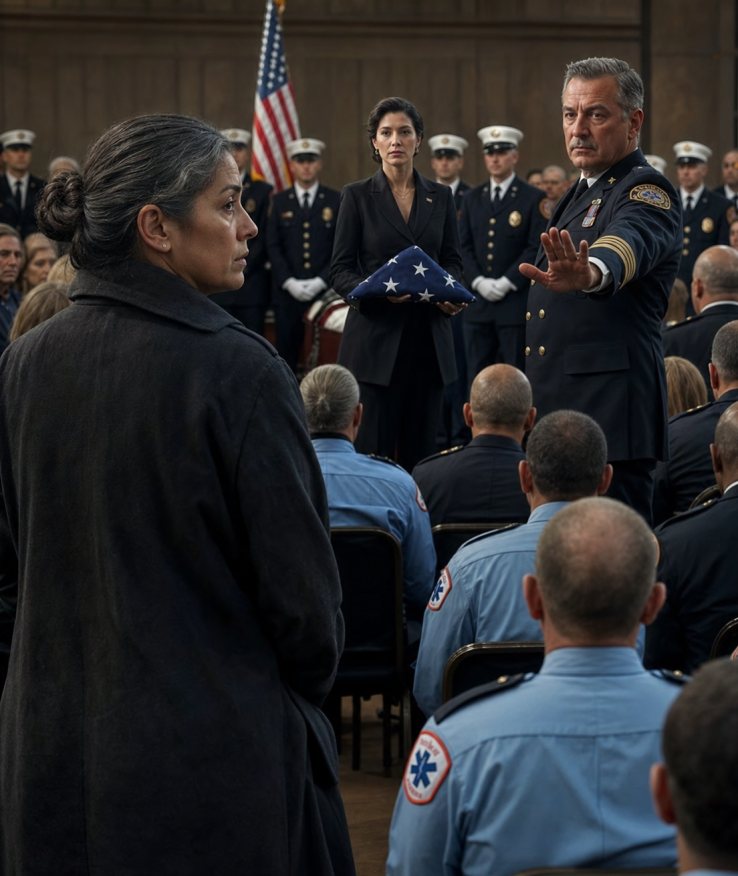
Her name, I would learn, was Charlene. She had a folder of documents, a practiced tremble, and a story about a private marriage the department had no reason to doubt. By the time I arrived — late, because grief makes you slow, because I’d sat in my car for twenty minutes unable to walk in — she had already been escorted to the family seats. When I gave my name at the door, a young officer with a clipboard told me gently that the widow was already seated, and asked if I was “a friend of the family.”
I stood in that doorway and felt the floor tilt. Everything Danny and I had built, thirty-one years of it, was being quietly handed to a stranger with better paperwork.
I don’t know what I would have done. Made a scene, maybe. Been escorted out as the confused older woman who wandered in. That’s how these things usually go for the person telling the truth.
But Ray was working the door.
Ray had ridden with Danny for years. Ray had eaten dinner at our table. Ray had carried our groceries up the stairs the winter I broke my hip. And when Ray heard the officer with the clipboard call me “a friend of the family,” he stopped moving. He looked at me, and then he looked at the woman in the front row, and something in his weathered face went very hard and very calm.
He came out from behind the door. In front of everyone, he brought his hand up in a slow, deliberate salute — to me.
“That’s Danny’s wife,” he said. Not loud. He didn’t need to be loud; a man like Ray only has to say a thing once. “That’s Eleanor. I’ve been to their house a hundred times. Whoever that is in the front row, it isn’t her.”
The room turned. The officer with the clipboard looked down at Charlene’s folder like it had caught fire in his hands.
Here is what I found out later, once the department pulled the thread Ray had handed them. Charlene had done this before. She read obituaries and incident reports and looked for the recently, publicly dead — men whose service meant a folded flag, a pension, a death benefit, sometimes a settlement. She built a paper marriage out of forged certificates and confident grief, and she moved fast, before the real family surfaced, because she’d learned that institutions trust the person who arrives first and cries best.
She had not counted on a paramedic who knew my face.
They walked her out before the ceremony started. Quietly, the way you remove a problem you don’t want to become the story. And then the crew chief, an old bear of a man named Halloran, came and found me in the corridor where I was shaking, and he took my hand in both of his, and he said, “Mrs. Doyle. We are so sorry. Let’s start this again, the right way.”
They sat me in the front row. They read Danny’s name with the others. They gave me the flag, folded into that tight triangle, and Ray was one of the two who held it, and when he passed it to me his hands were steady even though his eyes weren’t.
I want to tell you the part that has stayed with me most, though, because it isn’t the fraud. Frauds are everywhere; that’s just weather. What has stayed with me is that in the worst hour of my life, when a stranger with a folder had a better claim on my own husband than I did, the thing that saved me wasn’t a document. I didn’t have the right document. I fumbled at the door like exactly the kind of person these schemes prey on.
What saved me was that Danny had spent his life being the sort of man whose partner would cross a crowded room to salute his wife.
He built that. Every ride-along, every dinner, every time he carried somebody’s groceries. He built a man who would stand up for me when I couldn’t stand up for myself. And on the night they almost honored the wrong widow, that man was working the door.
Comments are closed.