The email froze the note at 6:02 the next morning, but I need to back up and tell you how I ended up standing behind a velvet rope on a runway, because the how is the whole point.
I met Marcus two years ago at an industry mixer — ironically, a finance event, the kind of room where I’m entirely at home and he was entirely lost. He was charming and a little helpless and I found the helplessness endearing before I understood it was a permanent condition. Marcus Wexler had never in his life solved a problem his family’s money couldn’t solve for him. I didn’t hold it against him at first. I do a specific, unglamorous job — I structure aircraft leases, I read the fine print nobody reads, I know exactly how the rich borrow money and pretend they own things — and I liked that Marcus seemed impressed by competence he didn’t have.
His mother, Diane, never liked me. From the first dinner she treated me like the help who’d wandered into the family photo. “And what is it you do again, dear?” she’d ask every single time, as though a woman with a real career was a concept she couldn’t hold onto. Aircraft finance. Leasing. Structured notes. It went in one ear and out the other, because Diane had decided what I was the moment she saw my off-the-rack dress, and nothing I actually did could dislodge it.
I should have walked away. I know. But Marcus, for all his softness, seemed to genuinely love me, and I kept thinking the family would come around. They didn’t. They got worse. And then came the jet.
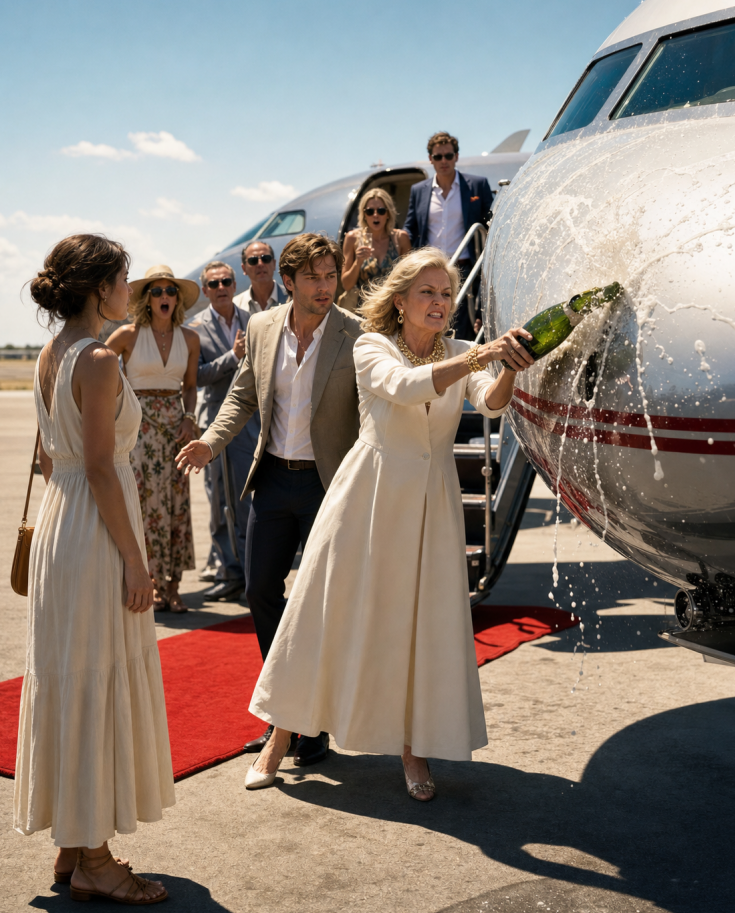
The Wexlers financed a private jet six months ago. It was going to be the family’s crown jewel, and Marcus — desperate to be taken seriously by his own mother — wanted to be the one who “made it happen.” The problem was that Marcus had no independent standing to co-sign an aircraft lease. He needed a co-signer with real standing in the aviation-finance world.
I have that standing. I have it in spades.
But nobody asked me. Somebody in that family — I later confirmed it was Diane’s assistant, acting on Diane’s instruction — took my name, my credentials, and forged my signature onto the co-signer line of a floating-rate lease agreement. They needed the competence they sneered at, so they simply took it, forged it, and never told me, because in Diane’s mind I was an asset to be used, not a person to be asked.
I found out three weeks before the christening. A colleague at the lessor’s office called me, half-laughing, and said, “Didn’t know you co-signed the Wexler bird. Small world.” My blood went cold. I pulled the documents. There was my signature — a decent forgery, but a forgery — on a lease for an aircraft I’d never agreed to touch.
I had every right to blow it up immediately. Fraud. Forgery. I could have called lawyers that afternoon.
Instead I waited. Not because I’m patient by nature, but because I wanted to understand exactly how much leverage I was holding, and because some quiet, wounded part of me wanted to see whether Marcus — if given one clear chance — would choose me over his mother’s approval.
The christening was that chance. Diane put me behind a rope on the tarmac and told a crowd of investors I was a “guest” who understood this “wasn’t really the place.” And Marcus, standing two feet away, studied his shoes and said nothing. He watched his mother wave the woman he claimed to love off a runway, and he chose silence.
That was my answer.
So at 6:02 the next morning, I sent the email I’d drafted and held. As the forged co-signer of record — the industry professional whose name and standing had made the whole deal possible — I had specific, documented authority over the note. The floating rate had reset three days earlier and spiked their monthly obligation into a number that would strangle them. My email placed a compliance hold and formally disputed my own signature as fraudulent, which under the lease terms triggered an immediate freeze pending investigation. The jet couldn’t fly. The financing couldn’t close. And the fraud investigation would land on Diane’s assistant, and by extension Diane, with my full cooperation.
Marcus called me at 6:47. His voice was shaking. “Mom’s lawyer says the jet’s grounded. They’re saying your name’s on it and you filed something. What did you do?”
“What did I do?” I said. “Marcus. Somebody forged my signature onto a multimillion-dollar lease. I reported a crime. The question isn’t what I did. The question is why you’re calling to ask me that instead of asking your mother why my name was on a document I never signed.”
Silence. Long enough that I heard him breathing.
“You could fix it,” he finally said. “You could withdraw the dispute. For me.”
And there it was. Even at the very end, his instinct was to ask me to make his family’s problem disappear. Not once did he say I’m sorry. Not once did he say my mother had no right.
“No,” I said. “I don’t think I will.”
The fallout took months. The forgery was real and provable, and the Wexlers’ lawyers spent a great deal of money making sure Diane’s assistant took the fall alone and Diane’s name stayed clean. The jet eventually flew — refinanced at a punishing rate, with a co-signer they had to pay a premium to secure, because it turns out the “dog lady” of aircraft finance was the only reason the good terms had ever existed. Diane never apologized. People like Diane don’t. But she paid, quietly and repeatedly, in every basis point of that worse deal, for years.
Marcus and I were finished. His last text just said, “I didn’t know she forged it. I swear.” And maybe he didn’t. But he knew, on that tarmac, exactly what she was doing to me in plain sight, and he watched his shoes.
I still structure leases. And every time I sign my name now — my real name, on my own terms — I think about how the Wexlers spent all that time deciding I was nothing, right up until the morning they discovered I was the one thing their shining toy depended on.
Comments are closed.