The flight director’s name was Colonel Ford, and when he stepped away from the folded flag and walked toward me through the crowd, the whole memorial went silent in a way I’ll never forget.
I need to back up, because the version most people saw on the news is the version the agency wanted them to see.
My husband, Daniel, was a mission specialist. Fourteen months ago the capsule he was aboard was declared lost during re-entry — a catastrophic failure, no survivors, no recovery. That was the story. That was what they told me, standing in my own kitchen with their hats in their hands. I believed it because why wouldn’t I. You don’t argue with men who build spacecraft when they tell you the sky took your husband.
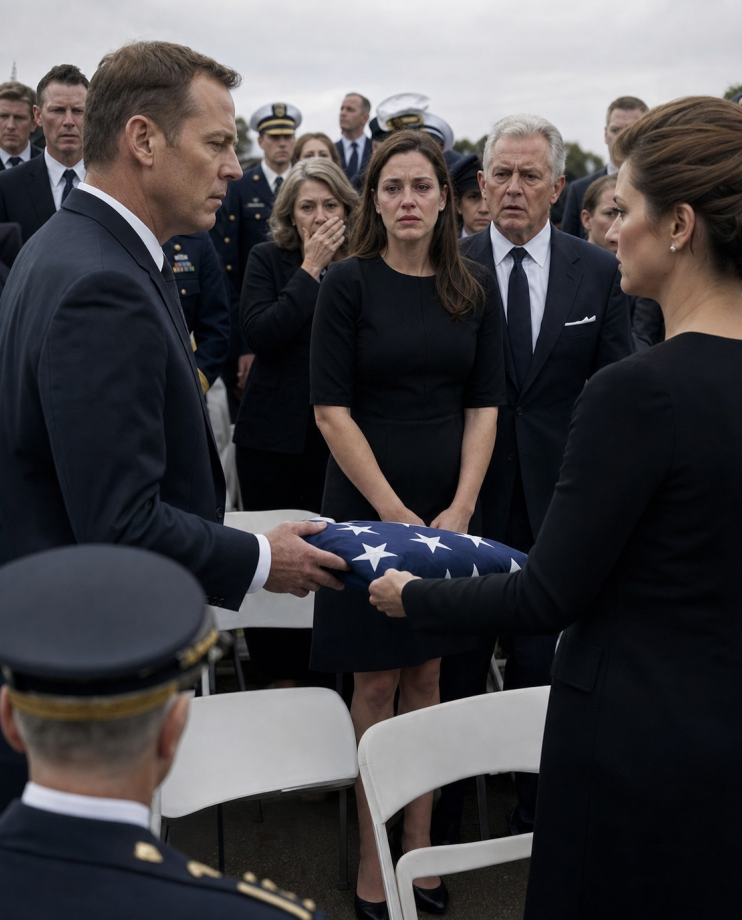
What I didn’t know was that Daniel’s family had spent the months before that memorial quietly dismantling my place in his life. His mother had never accepted me. We’d married fast, at a courthouse, while Daniel was between rotations, and to her that meant it didn’t count. So when the agency began arranging the memorial, she put forward another woman — a former girlfriend of Daniel’s, poised and photogenic and exactly the widow they wanted for the cameras. She produced old photos. She questioned the timeline of our marriage. And because grief makes people tired and paperwork moves slowly, the agency took the path of least resistance.
They introduced her as the widow. They folded the flag into her hands.
And I stood in the third row, in a black dress I’d bought for the occasion, watching a stranger accept the last honor my husband would ever receive, while his mother dabbed her eyes beside her and did not once look at me.
I want to tell you I made a scene. I didn’t. I couldn’t. Shame is a strange paralytic — when a room full of important people has decided you don’t belong, some part of you starts to believe them. I just stood there and let it happen.
Then Colonel Ford walked to the podium.
He was supposed to say a few closing words. Instead he stopped, looked at the folded flag in the other woman’s hands, and set down his notes. He asked, quietly, for a moment. Then he came down off the platform, crossed the grass, and stopped in front of me.
“Mrs. Vance,” he said. Daniel’s name. My name. “Forgive us. We got this wrong.”
He turned to the assembled crowd, and in a steady voice he told them what almost no one in that field was cleared to know: that the mission failure had not been what the public was told. That the capsule loss had been staged — a controlled cover for a contingency the program did not want broadcast. And that the crew, including my husband, had survived, and had spent the past fourteen months in medical quarantine and debrief under a classification so tight that not even next of kin had been notified.
Daniel was alive.
I don’t remember sitting down. People tell me my knees went and the woman next to me caught my arm. What I remember is Colonel Ford lifting the flag out of the other woman’s hands — gently, but without asking — and turning to face me, and saluting, and placing it in mine.
“This was never hers to hold,” he said.
The quarantine was real. The reasons were real, and most of them I still can’t repeat. But the marriage his mother had spent a year trying to erase was on file with the agency the whole time, in Daniel’s own emergency contact forms, in his benefits designation, in a sealed letter he’d left that named me and only me. The problem had never been the truth. The problem had been that the people arranging the memorial hadn’t bothered to read the paperwork that contradicted the prettier story.
I saw Daniel eleven days later, thinner and grayer and with a tremor in his left hand that the doctors say may never fully leave. He held onto me in that quarantine visiting room like a man who’d been told for over a year that he’d probably never be allowed to. He knew about the memorial. He knew what his mother had tried to do. He’d found out while he was still in isolation, and he told me it was the closest he ever came, in all of it, to falling apart.
His mother has not spoken to me since. She has, however, spoken to a great many other people about how the “confusion” was understandable and how she only ever wanted what was best for her son. I let her talk. Colonel Ford’s account is in the record now, and the flag is in a case on our mantel, and I don’t need anyone’s permission anymore to know who I was to Daniel.
Sometimes people ask me if I’m angry. At the agency, at his family, at the machinery that erased me and then, on live cameras, had to un-erase me in front of everyone.
Mostly I’m just tired, and mostly I’m just grateful.
But I’ll admit there’s one small thing I keep. The memory of a colonel setting down his notes because he couldn’t stand to let a lie be the last thing said over a man he respected. He didn’t have to come down off that platform. He could have finished his remarks and let the paperwork sort itself out later, quietly, the way institutions prefer.
Instead he crossed the grass, and he saluted the right woman, and he told five hundred people the truth.
That’s the part I hold onto. Not the betrayal. The one man who refused to let it stand.
Comments are closed.