Halvorsen’s question hung in the air of that gallery like smoke: “Didn’t you rent from her?”
Portia recovered the way she always does, with a laugh and a deflection. “Let’s not talk business at a party,” she said brightly, and tried to steer him toward the champagne. But the wave had already moved through the room. People were looking at me now — really looking, the way you look at a person whose story has just been rewritten in front of you.
I set down the coat I was holding. I want to describe what I felt in that moment, because it wasn’t the hot flush of revenge I’d half-expected. It was calm. Fifteen years of standing quietly in rooms full of loud people had taught me that the person who doesn’t need to raise her voice already holds the room.
I walked to the center of the gallery. Portia’s smile was doing that brittle thing again.
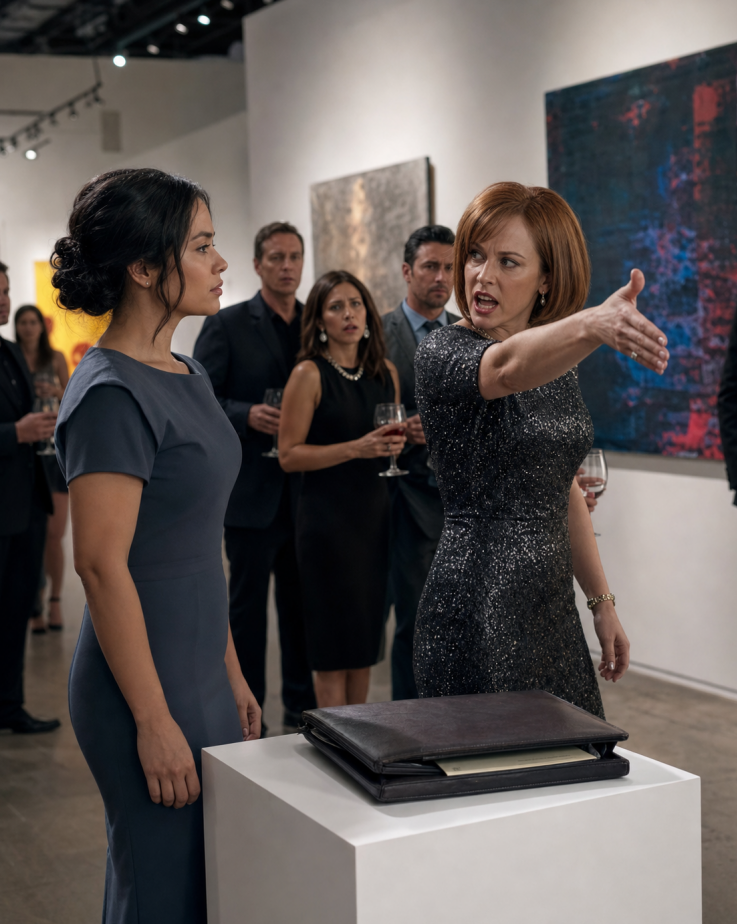
“It’s a beautiful show,” I said, and I meant it, because the work was beautiful — it just wasn’t hers. “But since we’re among people who love art, I think the artists deserve their proper stories.” And then I did the thing Portia had spent the whole evening trying to prevent: I gave the room the truth, piece by piece.
I told them the Corveau on the north wall came from a widow in Portland who’d held it for thirty years and only parted with it because she trusted the buyer. I’d brokered that sale. I told them the two Ibarras were placed by me with the Halvorsen collection a decade ago, when Ibarra was unknown and unfashionable and I believed in her anyway. I went down the wall, canvas by canvas, and for eleven of the fourteen works I could name the collector, the year, the story. Because I’d been the one who moved them.
I never once said the word “Portia.” I didn’t have to. Every sentence I spoke about the real history of those paintings was a sentence that erased the fiction she’d built about “discovering” them.
When I finished, the applause was for the artists. But everyone in that room understood what had just happened.
Portia found me twenty minutes later, in the back hallway, where the caterers were stacking trays. The performance was gone from her face. What was left underneath was something I’d never seen: fear.
“You’ve embarrassed me,” she said.
“No,” I told her. “You did that when you asked me to take coats. I just told the truth about some paintings.”
Here is the part that matters, though, and it’s why I don’t think of that night as a victory so much as a reckoning that was eight years overdue. Portia’s lease on that gallery was up for renewal in the spring. She’d been counting on it — she’d told the family the space was “practically hers,” the way she says everything is practically hers. And it was mine to renew or not.
I renewed it.
I know that surprises people when I tell the story. They want the ending where I lock her out, where I repossess the walls, where the woman who treated me like furniture gets tossed onto the curb. I understand the appeal. I felt the pull of it myself, standing in that hallway with all the power finally, visibly on my side.
But I’ve spent my whole career learning the difference between owning a thing and being owned by your feelings about it. Throwing Portia out would have felt wonderful for about a week, and then I’d have been exactly what she always accused me of being — small, grasping, obsessed with a status I had to prove. I didn’t need to prove anything anymore. Everyone in that room already knew.
So I renewed her lease, at market rate, with one change written into the new terms: the building’s ownership would be disclosed on the gallery’s own materials. No more pretending the space had materialized from her own importance. She would operate her gallery, publicly, in a building everyone now knew belonged to me. Every day she unlocked those doors, she’d be unlocking mine.
She signed it. Her hand shook, the way people’s hands shake when they finally understand the shape of a thing they misjudged for years.
My husband asked me, later, why I didn’t just end her. Julian loves his sister but he’s not blind to her, and I think part of him wanted the clean dramatic finish too.
I told him the truth. His sister spent eight years deciding I was invisible, and the cruelest thing I could do wasn’t to remove myself from her world. It was to remain in it, permanently, as the landlord of her ambitions — kind, unbothered, and impossible to erase.
Portia is polite to me now. Painfully, carefully polite. She introduces me at family gatherings with my full history, because she learned the hard way what happens when she doesn’t.
And the coat rack she stationed me at? It’s still by the gallery door. Every time I visit, I hang my own coat on it myself, and I think about how the woman who told me I was good at invisible work never once asked what I’d been so good at, for so long, that I could afford to be invisible on purpose.
Comments are closed.