Her name was Dara.
There. I said it. For seven years I trained my mouth not to make that shape, and now I can’t stop. Dara Lindqvist. The pharmacist tech who worked two counters down from me back when I had one store and a head full of ambition and a temper I mistook for standards.
We were together three years. I was going to marry her. And then a man I trusted — a supplier, someone I’ve since learned had his own reasons — told me she’d been skimming from the register and laughing about it with somebody else. I didn’t check. That’s the part I can never take back. I didn’t pull the tapes, didn’t look at the counts, didn’t ask her a single question. I just decided I was too smart to be made a fool of, and I told her to get out and never come back.
She tried to tell me something that last night. She was crying, and she kept saying “Elliot, there’s something you need to know,” and I talked over her. I told her whatever it was, I didn’t want to hear it.
I know now what she was trying to say.
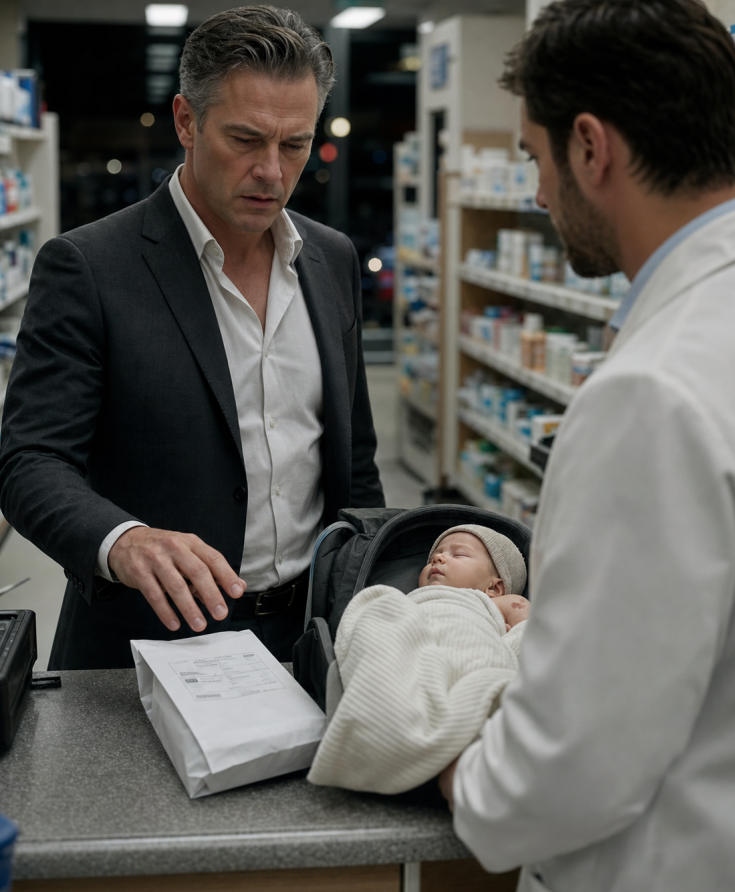
I stood over that car seat under the fluorescent lights with the prescription slip shaking in my hand, and I did the math no man wants to do. The birth date on the ankle band. The date on the last argument I replay in my head at two in the morning. Nine months, near enough to the day.
The birthmark on his shoulder settled it before any test could. A pale comma of a mark, low on the left shoulder blade. My mother had it. I have it. And now this sleeping newborn had it too.
Priya was still standing there. “There’s more,” she said quietly. “The prescription — it’s a standard postpartum medication. But the pharmacy that transferred it flagged the patient. She’s not picking it up because she can’t.” She hesitated. “The transfer came from the clinic attached to the Fuller Street shelter.”
I know Fuller Street. Everyone in this business knows Fuller Street. It’s where people go when there’s nowhere lower to go.
I left Priya with the baby and I drove there in the dark with my hands finally, fully steady, because grief does that — it burns off the shaking and leaves you cold and clear.
The shelter’s night manager met me at the door. When I said Dara’s name, her face did the thing faces do when they’re about to hand you something heavy. She’d been living there four months, the manager said. She’d had the baby at County. She’d been trying to get back on her feet, and she’d listed a next-of-kin contact and a pharmacy — mine — because, the manager said, “she told us the father owned it. She said if anything happened, the baby should go there. That you were a good man underneath it. She was real sure about that part.”
Was. The manager said “was.”
Dara had gone into cardiac arrest two nights earlier. An overdose, though the manager was gentle about the word — a body worn thin, a heart that quit under the strain. She’d left the baby with a volunteer she trusted, along with the prescription slip and a folded note, and made that volunteer promise that if she didn’t come back from the hospital, the child would be brought to my counter after closing, when I’d be alone. She didn’t want a scene. She didn’t want my staff to see. She wanted me to have the chance to choose, in private, the way I’d never given her the chance to explain.
The volunteer had done exactly what she promised. That was the woman my staff never saw slip in and out.
They gave me the note at the shelter. I’ve read it maybe four hundred times. It’s short. She wrote that she was sorry for the way things ended, which undid me completely, because she had nothing to be sorry for. She wrote that she’d named him Samuel, after my father, whose name I’d told her once in a good moment and forgotten I’d ever shared. And she wrote the line I’ll carry to my own grave: “I never told you because I didn’t want him to grow up feeling like an accusation. I wanted him to be wanted, not owed.”
She waited seven years for me to become the man she believed I was underneath. And I became him about thirty-six hours too late to tell her.
Samuel is mine now. The tests confirmed what the birthmark already told me, and I didn’t fight a second of the process — I ran toward it. He’s asleep down the hall as I write this, in a room I painted myself, badly, because I wanted to be the one to do it.
I kept the store. I kept all twenty-two of them. But I closed early the day of Dara’s small service and I stood at the back the way she must have imagined I would, and I’ve since put her name on a fund at the Fuller Street clinic, a real one, that pays for exactly the kind of support I didn’t send when it would have mattered.
People tell me I’ve done a good thing, taking him in. They don’t understand. He took me in. He’s the second chance she left on my counter when she had every right to leave me nothing at all.
Every morning I see that little comma of a birthmark when I change him, and I think the same thing. Dara knew. She knew what I was underneath before I did. I just wish being right about me hadn’t cost her everything.
Comments are closed.