The rock was the size of a plum, painted a muddy river-gray, with a lopsided red heart smeared across the middle and a clear coat of drugstore nail polish over the top so it shined. Mateo held it up to me with both hands, the way you’d offer someone a bird you’d found.
“It’s so you have something to hold when you’re scared,” he said. “Mama says everybody gets scared, even grown-ups. Even you.”
I want to tell you I said something kind. I didn’t. I took the rock because a child was holding it out and you take what a child hands you, and then I sat there in my expensive chair in my expensive house and could not make my throat work.
You have to understand who I was that afternoon. My name is Harlan Voss. I built my life on a single principle: everyone wants something, so find out what before they find out yours. I tested everyone. I’d hired Rosa three weeks earlier and I’d spent those weeks being cold to her on purpose, leaving impossible messes, giving contradictory orders, watching to see when the warmth would curdle into resentment the way it always did. That morning I’d already drafted the message to the agency. She was “getting too comfortable.” I was going to let her go by Friday.
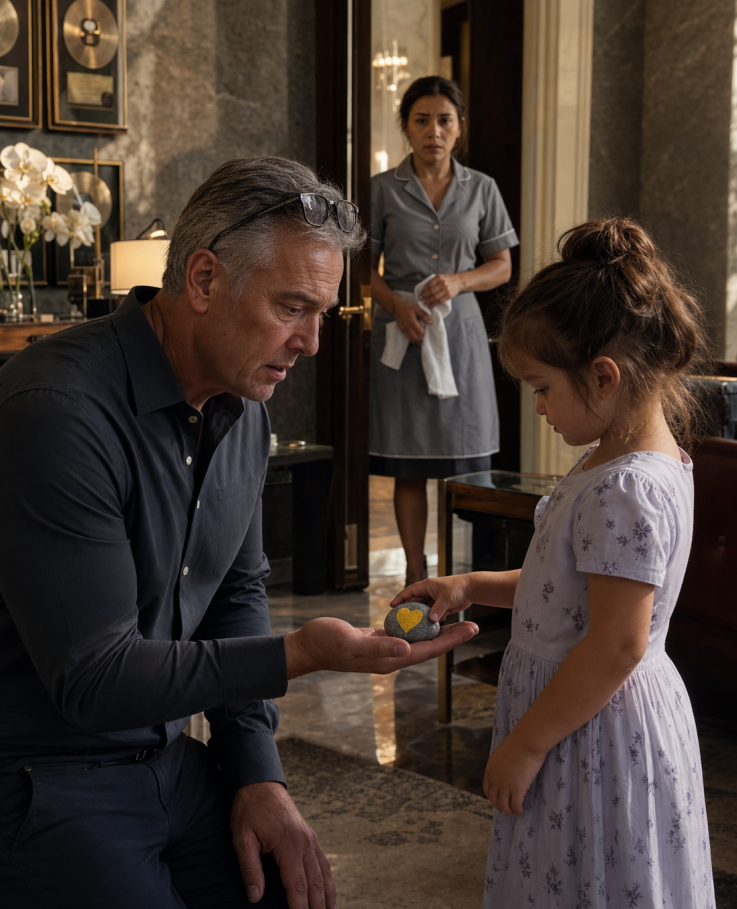
I had not accounted for the boy. He wasn’t part of the test. He was just a six-year-old who wandered into my study while his mother worked, saw a man sitting alone in a gray room full of gray light, and decided I looked sad.
Sad. No one had called me anything close to that in twenty years. Feared, yes. Respected, sometimes. Difficult, behind my back. But this child looked at the most guarded man he’d ever meet and saw straight through to the one true thing.
I asked him, stupidly, why he thought I was scared.
He shrugged. “You have your mad face on all the time. My cousin had his mad face on all the time and it was because he was scared of the dark. So I gave him a nightlight.” He pointed at the rock in my hand. “That’s your nightlight. But a rock. So you can put it in your pocket.”
Rosa appeared in the doorway then, and I watched the blood drain out of her face. She thought her son had done something wrong. She started apologizing, reaching for him, that particular terror of a woman who cannot afford to lose a job. “Mr. Voss, I’m so sorry, he knows he’s not supposed to come in here—”
“He’s not in trouble,” I heard myself say. My voice came out strange. “He gave me a gift.”
I kept the rock. That’s the part I still can’t fully explain. I, who had thrown out gifts from senators, who had a drawer of unopened watches from people trying to buy my favor, put a painted rock from a housekeeper’s son in my breast pocket and carried it into a nine-figure negotiation the following Tuesday.
And in the middle of that negotiation, when the other side pushed and I felt the old cold thing rise up in me, the instinct to win at any cost, my hand went to my pocket and closed around that rock, and I heard a six-year-old say even you.
I didn’t crush them the way I’d planned. I made a fair deal. My own lawyers thought I’d gone soft. Maybe I had. Maybe soft is just the word hard people use for healing.
I never sent the message to the agency. Instead I sat with Rosa at my kitchen table, the same table where her son ate his cereal every morning, and I did something I hadn’t done since my wife died: I asked a question because I wanted to know the answer, not because I wanted leverage. I asked about Mateo’s father. I asked how she’d ended up cleaning houses. I asked what she wanted for her boy.
She told me. And somewhere in the telling, the house stopped feeling like a mausoleum I was haunting and started feeling like a place where people lived.
Mateo is seven now. The rock sits on my desk beside the awards that never once warmed me. He’s added two more since, a painted turtle and something he swears is a dragon but looks like a potato. I keep them all. Rosa runs the household now, salaried, with the guest wing for the two of them, because when she tried to give notice last spring to take a “more stable” job, I discovered that the thought of that silence coming back was the only thing left that actually scared me.
I used to test everyone to find out what they wanted from me. It took a six-year-old with a painted rock to show me the thing I’d been starving for was the one thing you can’t extract from anybody: to be seen, and stayed with, and loved on purpose.
He gave me a rock to hold when I’m scared. What he actually gave me was a reason not to be.
Comments are closed.