Preston Vane read the name on my clipboard, and the room changed.
I didn’t understand it at first. I was a hospice nurse doing what hospice nurses do — turning down a blanket, watching a monitor, keeping a dying man comfortable. The nephew by the window had gone the color of the bedsheets, and Arthur, in the bed, was smiling like a man who’d finally reached the end of a very long errand.
“Read it to him, Della,” Arthur whispered. “Read it out loud. He needs to hear it in your voice.”
I thought he was slipping. “Read what, Mr. Vane?”
“Your name,” he said. “Your real one. The one on the top of that chart.”
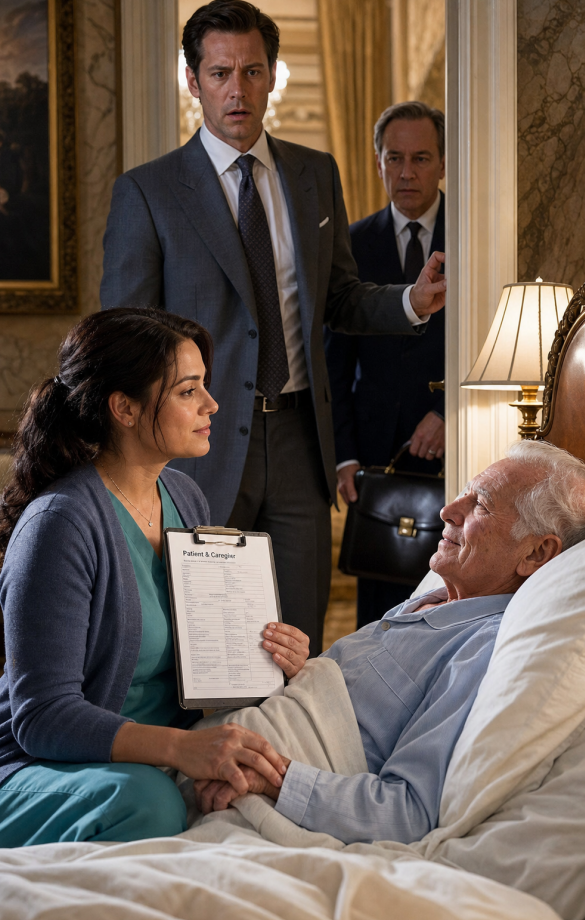
So I looked down at my own intake sheet, the one I fill out a hundred times a year without thinking, and I read the line I’d read a thousand times: my legal name, my date of birth. And then Arthur said a second name — a family name — and told me it was mine too, and the whole floor seemed to tilt.
Here is what I didn’t know when I walked into that mansion.
I was adopted. That was never a secret; my parents told me young, told me I was loved and chosen, and I never felt a hole where the story should be. They were good people. They gave me everything. I became a nurse because my mother had been one, and I never once went looking for a bloodline, because the family I had was enough.
The Vanes had spent forty years making sure I stayed exactly that incurious.
Arthur told me the rest in pieces over the next two days, his voice thin but his mind sharp at the end the way some minds are. Decades ago, his younger sister — my grandmother, it turned out — had a daughter out of wedlock in a time and a family where that was a scandal to be managed rather than a child to be loved. That daughter, my birth mother, was pushed to the edges and then out entirely. When she had me, the family made the same calculation a second time. A baby was a claim. A claim was a threat to how the Vane fortune would someday be divided. So the baby was placed quietly, the paperwork buried, and the branch of the family I came from was simply pruned off the tree and never spoken of again.
Arthur had been a young man then, outvoted and ashamed, and he’d let it happen. He told me that was the regret he’d carried longest — longer than any business failure, any lost love. “I let them erase a person to protect an estate,” he said. “I have spent a great deal of the time since trying to find that person.”
He had found me years ago. Quietly. He knew where I worked. He knew I was a nurse. And when he learned he was dying, he did something the rest of his family never saw coming: he specifically requested, through the agency, the hospice nurse by name. He arranged for me to be the one at his side. Not to make amends with money — though he did that too — but so that at the very end, the child his family had erased would be the one holding his hand, and so the truth would finally be spoken in a room where a Vane heir could hear it.
That’s why Preston couldn’t stop staring at me. He’d grown up hearing the whispered family lore — the “lost branch,” the inconvenient baby, the name never to be mentioned. And there I was, wearing it on a clipboard, changing his uncle’s sheets.
Arthur died four days later, at peace, my hand in his.
The will was where the erasing came undone. Arthur had rewritten it. Not to hand me a fortune I never asked for and didn’t need — I told him plainly I hadn’t come for money — but to do something more surgical: he restored my name to the family record, formally acknowledged the line the Vanes had cut off, and left instructions that could not be quietly ignored. A trust in my birth mother’s name. A public correction of a private lie. And a share that made me, whether Preston liked it or not, an heir the family could no longer pretend didn’t exist.
Preston fought it, at first. Of course he did. Men who grow up certain of their inheritance don’t give up a slice of it gracefully. But Arthur had been careful — the documentation, the DNA, the decades of quiet record-keeping he’d done specifically so this could not be waved away. In the end there was nothing to fight. There was only a name, restored, and a family forced to say it out loud.
I kept nursing. I didn’t want the mansion or the boardroom seat, and I said so. But I took the acknowledgment, because it wasn’t really about money — it was about a woman, my birth mother, who died believing she and her child had been thrown away by people who found them inconvenient. Arthur’s will said, in language no lawyer could soften: they were not thrown away. They belonged. Their name belongs.
Preston and I are not close. But he came to me, months later, and said the thing his uncle had spent forty years wishing someone in that family would say. “You should have been one of us all along. I’m sorry it took a dying man to make us admit it.”
The dying man made absolutely sure I was the nurse at his side. Now I understand why. He needed a witness with my name — so that when the truth was finally spoken, it would be spoken by the very person they tried to erase.
Comments are closed.