The four-star general’s name was Ellison, and I had served under him in a place that does not appear on any map my father-in-law is cleared to read.
Let me go back to the parade ground.
I married into the Harlan family the way you walk into a room you already know is going to be cold. My husband, Daniel, was gentle and decent and completely unable to stand up to his father, a brigadier general who had spent thirty years confusing rank with worth. To Harlan, I was a problem to be managed. A woman who “did something with the government” that I was maddeningly vague about, who wouldn’t produce the officer husband or the civilian meekness he expected. He decided early that I was either lying about my service or embarrassed by how minor it was. He never once considered the third option: that I couldn’t tell him.
Because my commission, my unit, and most of my career are classified. I don’t get to correct people at dinner parties. I don’t get to flash a rank to win an argument. That is the deal I signed, and I have kept it even when keeping it cost me every ounce of respect in that family.
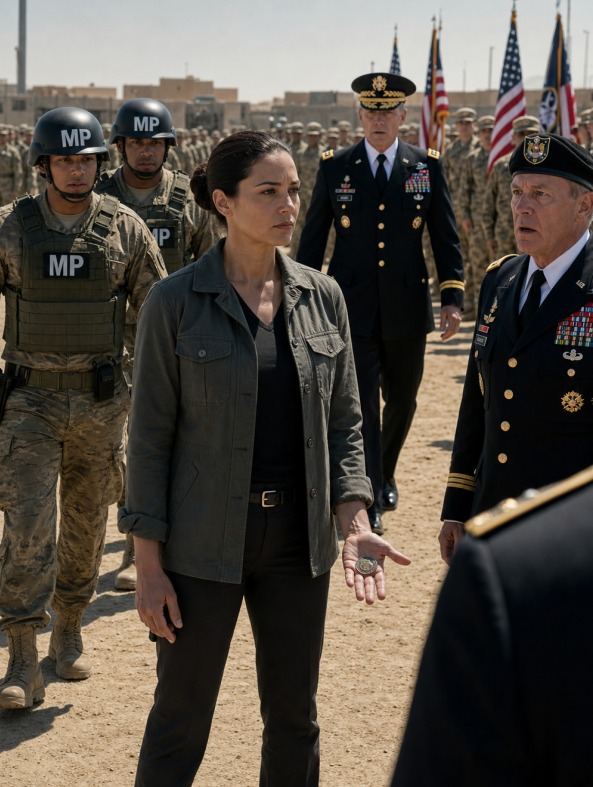
The day it broke open was supposed to be a routine base ceremony. Daniel was receiving a recognition, and I came to stand beside him. Harlan saw me in the crowd in my plain jacket and slacks — no uniform, because I was not there in an official capacity — and something in him simply decided he’d had enough of being embarrassed by me.
He called two MPs over. In front of hundreds of people, he told them I didn’t belong on the parade ground and to escort me out.
I want you to understand: I could have stopped it in one sentence. But there were people present that day whose presence meant I could finally say that sentence out loud, and I was waiting to see how far my father-in-law would go when he thought no one could contradict him.
He went all the way. He raised his voice. He told the MPs to remove “this woman” who was “impersonating something she isn’t.”
The MPs started toward me.
And then they slowed, because General Ellison had stepped out of the reviewing line.
Ellison is not a man who leaves a formation. Two thousand people watched a four-star general walk directly across the ground toward the woman a brigadier had just ordered dragged away. The MPs stopped where they were, caught between two orders and rapidly doing the math on which one would end their careers.
I opened my hand. In my palm sat a challenge coin — his coin, given to me after an operation I will never describe, the kind of coin that is not decoration but recognition, passed from a commander to someone who did something he needed done and could never publicly acknowledge.
Ellison saw it. He stopped. And he saluted me.
You could hear the parade ground change. A four-star does not salute a civilian. A four-star does not cross a field for someone beneath notice. Every soldier who understood what they were seeing came to the same conclusion at the same instant, and it moved through the crowd like a temperature drop.
“Captain Reyes,” Ellison said, loud enough to carry. “My apologies. I didn’t realize you were being received as a guest today rather than on orders.”
Captain. He said it plainly, and he tied it to a name my father-in-law had spent years sneering at.
Harlan’s face did the thing I’d waited a long time to see. Every certainty he’d built about me collapsed at once, and underneath it was the specific fear of a man who has just publicly ordered military police to lay hands on an officer decorated by someone four ranks above him.
Here is what the coin meant, and what Ellison’s salute told everyone who could read it. I did not outrank my father-in-law on paper in a way that mattered at a ceremony. But I had done work, under Ellison’s command, of a kind that a brigadier general running a garrison had never touched. The coin was the one artifact of that world I was allowed to carry, and Ellison was one of the very few people alive permitted to acknowledge what it stood for. When he saluted it, he was vouching, in front of two thousand witnesses, for everything my father-in-law had insisted I was lying about.
The MPs came to attention and stepped back. One of them apologized to me quietly. I told him he’d done nothing wrong, because he hadn’t — he’d been put in an impossible position by a man too proud to ask a single question in three years.
Harlan tried to speak to me afterward. He started with “Dana, if I’d known—” and I stopped him there, because that was the whole point. He hadn’t known because he’d never once asked. He’d decided the woman in the plain jacket wasn’t worth the question.
Daniel, to his credit, didn’t defend his father this time. He stood next to me while Harlan searched for a version of the moment where he came out intact and slowly understood there wasn’t one.
I didn’t report the incident. Ellison offered, coldly, to make it formal, and I told him the parade ground had already done more than any paperwork could. Two thousand people had watched a brigadier general order a decorated officer removed and watched a four-star cross a field to salute her instead. That story doesn’t need my signature. It travels on its own.
My father-in-law retired not long after. He tells people it was his choice. Maybe it was.
I still can’t tell anyone what I did to earn that coin. But I don’t need to anymore. The next time Harlan introduces me, he uses my rank, carefully, like a man handling something he finally understands can cut him.
Full story? This was it. The rest lives in a file neither of us will ever read.
Comments are closed.