I set the broom down against the nose gear of the jet, and I let it lean there while the last of the laughter died.
Bianca was still smiling. She thought she’d won. She thought the worst thing that could happen at that party was that the girl her son loved might cry in front of the guests.
Let me tell you how I ended up owning her family’s airplane.
My company leases business aircraft. It’s not glamorous work — it’s contracts, maintenance schedules, tail numbers, and default clauses — but I built it from one leased turboprop into a fleet, and I did it quietly, the way I do most things. I don’t wear the money. I never have. When I met Trent at a fundraiser two years ago, he had no idea what I did beyond “something in aviation,” and I liked it that way. I wanted to be liked for me, not for the balance sheet.
I should have paid attention to how much that bothered his family.
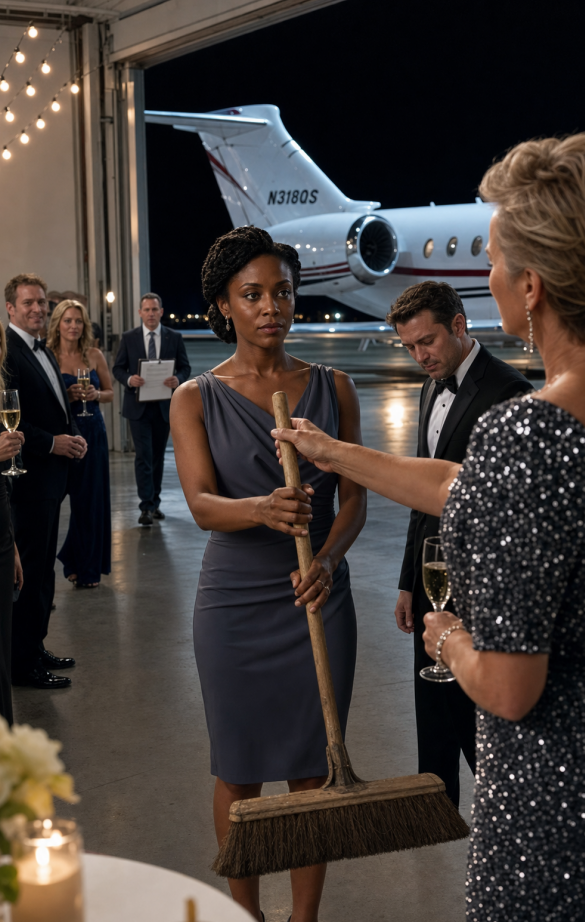
Bianca ran background on me the way some people breathe. She found out I “worked” — that I got up every morning and ran a business instead of managing a trust — and she decided that made me common. Help. A woman who’d tricked her golden son. She never said it to my face until that night, but it was in every clipped hello, every seating chart that put me at the end of the table, every “and what is it you do, exactly?”
What she never did was connect the dots. Because it never occurred to Bianca Sterling that the help might own the thing she was showing off.
The Sterlings leased that jet — the gleaming centerpiece of their party — eighteen months ago. Through a broker, on paper, from a leasing company they never bothered to look up. My company. They’d been late on payments for months. Then they missed enough of them, in a row, that the note went into default and the aircraft became repossessable.
And when my team pulled the file to start recovery, we found something worse than late payments. The co-signature on the lease extension — the guarantee that kept the jet in their hands after the first default — had been forged. In my company’s name. Someone in the Sterling family had signed a document as if they had authority they didn’t have, to keep the plane they couldn’t afford.
I didn’t know, standing there with a broom in my hand, exactly who’d forged it. I found out later it was Trent’s older brother, covering for the family’s cash problems, certain no one would ever check.
But I knew that night that I held every card. The jet was mine to take. The forgery was a crime. And Bianca had just handed me a broom in front of forty people and told me to sweep.
So I asked her, very pleasantly, if she liked the airplane.
She blinked. She said of course, it was the family’s pride, and did I even understand what a machine like that cost?
I said I understood exactly what it cost, because they’d been leasing it from me for eighteen months and hadn’t paid for six of them. I said the gentleman by the door with the clipboard worked for my recovery team, and that the aircraft she’d built her entire party around would be leaving with us tonight.
The hangar went so quiet I could hear the string lights buzzing.
Trent finally looked up from his shoes. “Grace,” he said, “what are you talking about?”
And that was the moment I understood something about the man I’d almost married. Not that his family was cool to me — I’d known that. But that when his mother handed me a broom and the room laughed, he studied his shoes. He didn’t laugh, but he didn’t stop it either. He never once, in two years, stood between me and them.
I handed him back the ring in front of everyone. I didn’t throw it. I just set it in his palm the way you return something that was never really yours to keep.
Then I nodded to my colleague by the door, and we grounded the jet.
The paperwork took weeks — repossession always does. The forged signature became a very serious problem for Trent’s brother, one that involved lawyers far less pleasant than me. The Sterlings, it turned out, had been living on leased and borrowed shine for years; the jet was just the biggest and most visible piece of it. When it rolled out of that hangar, a lot of other things started rolling out too.
Bianca called me exactly once, weeks later. Her voice had lost all its bright cruelty. She wanted to “clear up a misunderstanding.” She wanted to know if there was a way to keep the aircraft, for the family’s reputation.
I told her I’d think about it if she could produce a valid signature on the extension.
She couldn’t, of course. That was the whole point.
I don’t feel triumphant about it, honestly. I feel a little sad for Trent, who might have been a decent man if he’d ever been brave. But I don’t feel sad about the broom.
Because here’s the thing his mother never grasped: I do like to work. I love it. Work is the thing that made me a woman who could stand in a hangar full of people laughing at her and know, calmly, that she owned the floor and the plane and every ounce of her own future.
She handed me a broom to make me small.
I used it to lean against the most expensive thing she’d ever borrowed, right before I took it back.
Comments are closed.