I took the folder from Arjun’s hands because I did not know what else to do with mine. He watched my face while I opened it, and for the first time in the month I’d been married to him, I understood that the stillness I had read as coldness was him bracing to be misunderstood again.
Inside was everything.
The top page was the hospital’s master billing statement for my father’s ICU admission. Across it, in red, was a single word: PAID. Under it, clipped in order, were the admission authorization for the cardiac specialist my family had been told was “impossible to get on such short notice” — signed by Arjun at 11:52 p.m., less than an hour after my father collapsed — and a transfer confirmation moving my father to the specialist’s service before I had even finished crying in the parking lot.
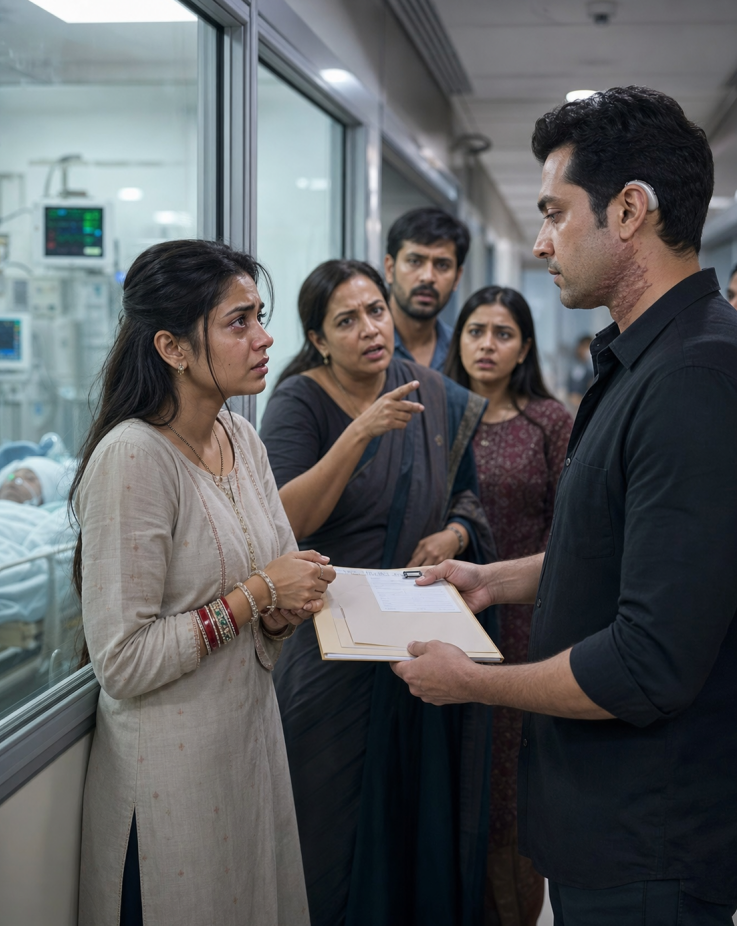
He had done all of it that first night. Silently. While my aunts stood in the corridor telling each other, and me, that this was what came of marrying “that cold man,” that his family had bought me and now his money would sit locked away while my father died.
His money had not been sitting anywhere. It had gone out the door within the hour, and he had let his own family take the credit for “graciously helping” so that no one would lose face and the fragile peace between our families — the peace I had been sold to secure — would hold.
I need to back up, because you can’t understand the folder without understanding the silence.
I was told I was marrying the Vale family’s eldest son to settle a debt between our families. I was told he was cold, that he “didn’t talk,” that I should keep my expectations low and my head down. On our wedding day he said perhaps ten words to me. In the weeks after, he communicated in notes, in gestures, in a strange watchful care I could not decode — he learned that I take my tea without sugar, he moved a lamp to my side of the room when he saw me reading at night, he never once raised his voice — and I read all of it as a rich man’s indifference dressed up as manners.
What no one told me, because his family found it shameful, was that Arjun was caught in a base fire during his service years ago. He pulled two men out. He went back for a third. The ceiling came down. He survived with burn scarring along his neck and jaw and, more than that, with most of his hearing gone and his speech damaged. He reads lips, slowly and carefully. He wears a hearing aid he keeps half-hidden because his own mother treated his injury as an embarrassment to be minimized in front of guests.
He wasn’t cold. He was a man in a house full of people who talked over him, about him, and never to him. He had simply stopped trying to be heard by people who had decided in advance that his silence meant he had nothing to say.
In the ICU corridor at three in the morning, when I finally looked up from that folder, he was signing something with his hands — I didn’t know the signs then; I’ve been learning since — and when he saw I didn’t understand, he said out loud, carefully, in the voice he hates to use in front of strangers, “He is your father. You were frightened. I could fix it, so I did. That’s all.”
That’s all.
My aunts, who had spent the night narrating my terrible marriage to anyone who would listen, went very quiet when the specialist came out and thanked “Mr. Vale for his rapid decision, which frankly saved your father’s life.” I watched the story they’d built collapse in real time. I did not enjoy it as much as I thought I would. Mostly I was ashamed of how completely I had joined them.
My father lived. He is home now, on a careful diet he complains about constantly, which is how I know he’s really better.
Arjun and I are, slowly, actually getting married — the real thing, the part that has nothing to do with the ceremony. I am learning to sign. He is learning that I will not talk over him and will wait, however long it takes, for whatever he wants to say. It turns out the quietest man I have ever met has an enormous amount to say to the one person willing to watch his hands and his face and mean it.
The folder is in a drawer in our room now. Not hidden, the way he hides things. Just kept. On the bad days, when the old habit whispers that I was sold to a stranger, I take it out and read the timestamps. 11:52 p.m. Less than an hour. Before I knew his heart at all, he had already put it entirely on my side.
Comments are closed.