Julian Mercer followed us across the ballroom, and I braced myself, because in eleven years of caregiving I’ve learned that when a rich man in a tuxedo starts moving toward you and your client, it usually means a complaint is coming.
I thought Eleanor had done something. She gets confused in loud rooms; sometimes she calls out, sometimes she reaches for strangers thinking they’re people from long ago. I had already started composing my apology when the host of the gala — the billionaire whose foundation the whole evening was built to celebrate — knelt down in front of her wheelchair, took her thin hand in both of his, and said, in a voice that cracked in half, “Grandma?”
The champagne flute he’d been holding was gone. I don’t know when he set it down. He was on one knee on the ballroom floor in a tuxedo that cost more than I make in a season, and he was crying, openly, in front of four hundred of the most powerful people in the city.
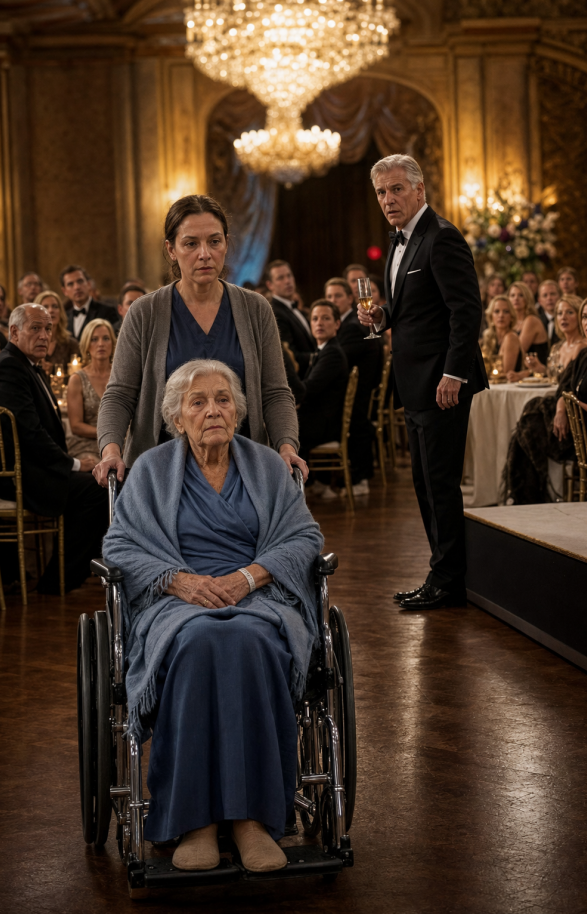
I did not understand yet. I stood there with my hands still on the wheelchair grips, and I watched Eleanor — my sweet, faraway Eleanor, who some days doesn’t remember my name — look at this man’s face for a long, floating moment. And then something surfaced in her eyes. Something reached up through all the fog.
“Julian,” she said. “You got so tall.”
He broke completely.
Here is what I learned that night, in pieces, sitting in a quiet side room while the gala went on without its host. Julian Mercer had been told, at nineteen, that his grandmother had died. His parents — his father, specifically, Eleanor’s own son — had been in the middle of a vicious fight over money and control of the family’s affairs, and Eleanor had sided against her son on a matter of conscience. Cutting her off wasn’t enough for him. He told his children she was dead. He staged a story convincing enough that a grieving nineteen-year-old never thought to question it. And then he had her placed, under a slightly altered name, in a care arrangement far from the family, and let the years do the rest.
For decades, Julian believed he’d lost her. He built a foundation in her memory — the very foundation this gala was raising money for. Her name was on the banner over the stage. He had spent a fortune keeping alive the memory of a woman who was, it turned out, still alive, being wheeled through his own party by a caregiver pulling a double shift.
What gave it away was the medical ID bracelet on Eleanor’s wrist. When she reached out — she does that, reaches for people — her sleeve slid back, and Julian saw the bracelet, and he saw the name on it, and even altered, even after all these years, he knew. A grandson knows his grandmother’s hand.
I want to tell you about the part that stays with me most, though, and it isn’t the money or the betrayal or the reunion, dramatic as all of that was.
It’s that Eleanor, who cannot always find her way back to the present, found her way back to him. For a few hours that night, in that side room, she was more present than I’d seen her in months. She told him about a boat they’d had when he was small. She remembered a dog’s name. She laughed at a joke from forty years ago. It was as if some door in her, long jammed, came open because the person on the other side of it had finally come to knock.
Julian’s father — I’ll be plain — is not a man I have any sympathy for, and the reckoning between him and his son is theirs to have, and it is happening, with lawyers and with a rewritten estate and with a silence between father and son that I don’t think will ever fully close. Some things you don’t get to undo. Some years you don’t get back.
But Eleanor got a grandson back. And Julian got the months — however many they turn out to be — that his father tried to steal from him.
He asked me to stay on as her caregiver. He offered to pay me more than I’d ever made, to hire a full team, to take every burden off my shoulders. I said yes to staying, and no to the team, mostly. Eleanor doesn’t need a team. She needs the same two hands she’s gotten used to, and now she needs to see her grandson’s face as often as he can bring it, which turns out to be nearly every day. He rearranged a life built around a foundation in her memory to spend actual afternoons with the actual woman.
The foundation’s still running. But they changed the name on the banner. It doesn’t say “In Memory Of” anymore.
It says “In Honor Of.” Present tense. Because she’s here.
I still become invisible in most rooms. It’s the nature of the work. But I think about that gala, and the billionaire who spent years mourning a woman who was alive the whole time, and I think: you never really know who you’re pushing past. The old woman in the wheelchair. The caregiver behind her. The person the whole room looks through. Sometimes she’s the one everyone in that room came to celebrate — and nobody recognized her but the man who never stopped loving her.
Comments are closed.