The father’s name was Gerald Ashford, and by the time we landed I knew far more about him than I ever wanted to. Defense contracts. A company with a name you’d recognize. The kind of wealth that buys a private cabin’s worth of first-class seats just so no one sits too close. But at 38,000 feet, holding a baby who’d gone the color of ash, none of that had been worth anything at all, and he knew it, and that knowing had cracked something open in him that money had kept sealed for years.
His son’s name was Theo. Four months old, born early, still catching up. The nasogastric tube was feeding him because he hadn’t yet learned to take a bottle well, and the night nurse the family traveled with had, for the first time in months, not made the flight. Gerald had waved her off. He could handle one flight. He was a man who handled things.
He could not, it turned out, handle a slipped feeding tube at cruising altitude with his son turning gray in his hands. Nobody could have, without training. That’s not a failure of love. It’s just not something you know how to do until someone teaches you, usually at 3 a.m. in an emergency department, over and over, until your hands can do it while your mind is somewhere else entirely.
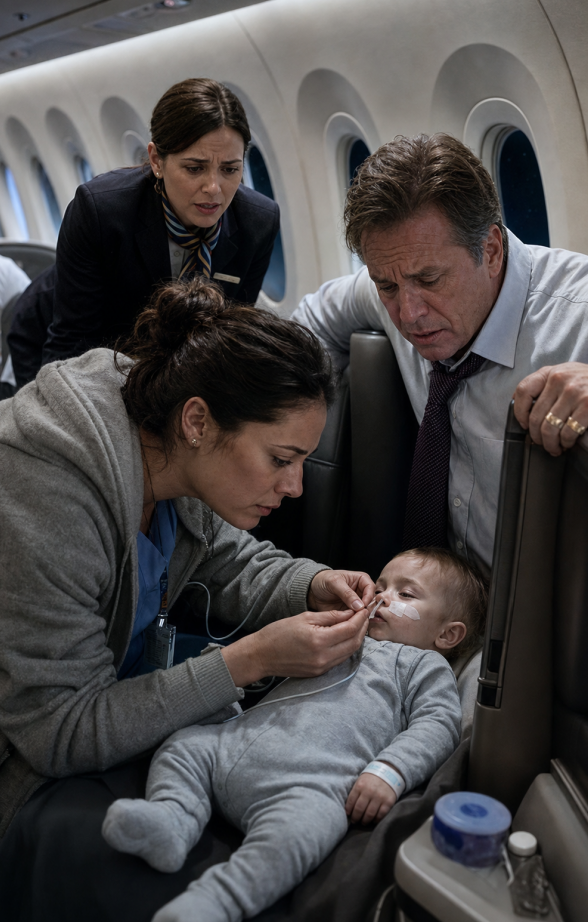
My hands could do it. That was the part he kept coming back to, after, once Theo was pink and furious and asleep against my shoulder. “You weren’t even scared,” he said, and it wasn’t quite a question. “Everyone else froze. You just — you knew.”
I didn’t tell him the truth on the plane. I told him I was an ER nurse, which was true, and that we see this kind of thing, which was also true, and I handed his son back and I went to walk to my seat in economy. He wouldn’t let me. He had the crew move me up front for the rest of the flight, and he sat across the aisle and watched his sleeping son and, every few minutes, watched me, like he was trying to solve something.
Here is what I didn’t say.
Fourteen months before that flight, I had a son of my own. His name was Micah. He was born early too, earlier than Theo, and he was so small and so fierce and he fought for eleven days in a NICU while I learned every alarm and every tube and every hold, learned them the way you learn a language when your child’s life depends on you being fluent by morning. I learned to re-seat a feeding tube on my own son at 2 a.m. with a nurse’s hand over mine, guiding me, telling me I was doing it right.
Micah didn’t come home. On the twelfth day his fight ended, and I went home with an empty car seat and a body that didn’t understand yet that there was no baby to feed. My milk came in three days after the funeral. I have never told anyone what that week was like.
I went back to work because staying home was worse. And I discovered something I hadn’t expected: that all the terrible, useless fluency I’d learned in that NICU — every alarm, every tube, every desperate calm — was suddenly the most useful thing about me. On the worst nights, when a baby came in blue and everyone else’s hands shook, mine didn’t. Because I had already lived the worst version of it. I had nothing left to be afraid of. The thing people can’t do in a crisis is stay present with a dying child. I could. I’d learned it on the child I couldn’t save.
That’s why my hands didn’t shake on that plane. Not because I’m brave. Because Micah taught me, in eleven days, everything Theo needed in that one terrible minute.
I found all of this pouring out of me a week later, in Gerald’s absurd glass office, where he’d asked me to come “discuss an arrangement.” He wanted to hire me. Private nurse for Theo, full salary, never fly commercial again, name my number. I sat across his enormous desk and I heard myself say, instead of a number, “I had a son. He didn’t make it. That’s why I could help yours.” And this powerful man, this man who handled things, put his face in his hands and cried.
I didn’t take the job. I want to be honest about that, because I think people expect the story to end with me installed in a mansion. It doesn’t. I couldn’t spend my days holding a healthy baby who lived while pretending the reason I was so good at it wasn’t sleeping in a cemetery across town. I told Gerald that, too, and to his enormous credit he didn’t argue. He listened.
What he did instead was better. He asked me what would actually help — not him, not Theo, but nurses like me, and families like the ones I saw on the worst nights. And I told him. I told him about the parents who sleep in NICU parking lots because they can’t afford a hotel near their premature babies. I told him about the ones who lose a child and get a bill and a bereavement pamphlet and nothing else. I told him what it’s like to have your milk come in with no baby to feed and no one who prepares you for it.
Gerald Ashford funded all of it. A NICU family housing program at the hospital where I work. A bereavement fund. A milk-donation and lactation-support line for parents in the exact hollow place I’d been in. He put my son’s name on none of it, at my request, and all of it in Theo’s — the Theodore Ashford Family Fund — because, he said, “Your boy saved mine. Let mine carry it forward.”
I still work the floor. I still fly economy. And every so often, on the worst nights, when a baby comes in the wrong color and everyone freezes, my hands still don’t shake. I still whisper the same low nonsense I whispered to Micah, to Theo, to all of them. And I think that’s the closest thing to a life after loss that I’ve found — not forgetting, not moving on, just this: hands that learned the worst thing so that, once in a while, at 38,000 feet or 3 a.m., they can undo it for somebody else.
Comments are closed.