I did not go to the hospital for her. I want that on the record, because for a long time it was the only thing I was sure of.
I went because my associate said there was “a situation in the ER involving a name we monitor,” and in my world you handle situations personally or they handle you. I brought Sabrina because she was on my arm that night and I hadn’t yet learned to leave the women I was performing wealth for at the door of the real parts of my life.
So we were standing in the lobby of a Chicago hospital at eleven at night, me in a suit that cost more than the annual salary of every nurse on that floor, Sabrina laughing at something on her phone, when they wheeled the gurney past.
I glanced at it the way you glance at any stranger’s worst night. Then I saw the hand.
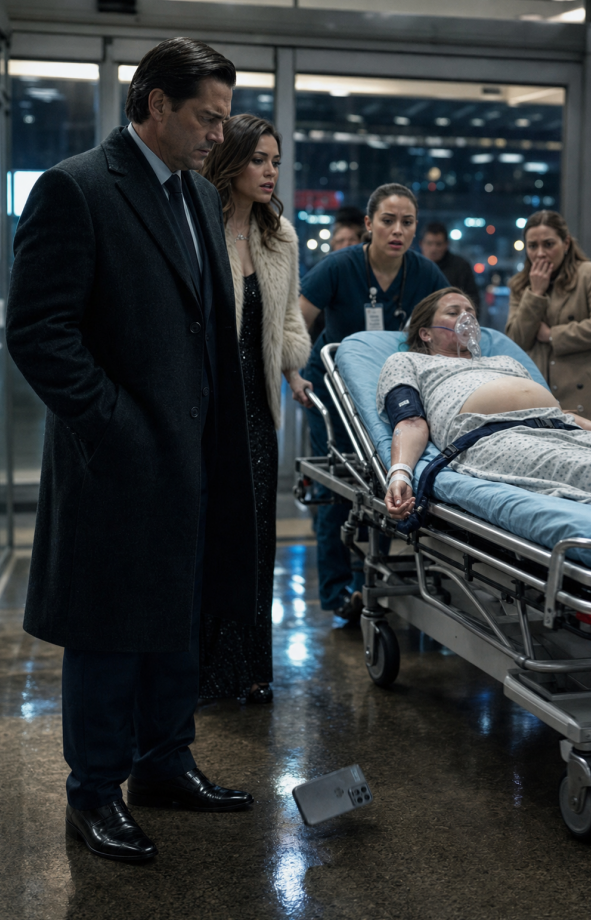
She had a titanium phone clutched against her chest — matte, custom, a thing I’d had made in a run of two. I gave one away once, years ago, to a woman I told myself I’d forgotten. And there it was, riding on a dying woman’s chest through the doors of Trauma 3, and my whole body understood before my mind would let it.
Elena.
I had not said her name out loud in three years. I’d made sure of it. When my father made his position clear — that a woman like her was a liability to a man like me, that there were things a family in our business could not be seen to tolerate — I did what the cold, efficient version of me does. I ended it. Cleanly. I told myself she’d land on her feet. I never once let myself ask what she landed carrying.
Because Elena was pregnant when I cut her loose. I know that now. I did not know it then, or I did not let myself know it, which in the ledger that matters is the same crime.
The nurse tried to stop me at the trauma bay doors. I have a face that stops people, and for once I didn’t use it to intimidate; I just said, “That’s the mother of my child,” and I did not know until the words were in the air that I believed them.
They were losing her. Blood pressure gone, the OB shouting numbers, and the fetal monitor doing the thing that empties a room of hope. They needed blood, fast, more than the bank had ready in her type — a rare type. The same rare type that has made me useless as a donor to everyone my whole life. The same type, the resident realized, staring at the chart and then at me, that the baby would carry if the father were —
“Roll up your sleeve,” she said. She didn’t ask who I was. She just knew.
I sat in a plastic chair beside the woman I’d thrown away and I gave her the one thing my money had never been able to buy her: the exact blood she and the child needed to survive the hour. Sabrina left somewhere in there. I didn’t notice her go and I’ve never spoken to her since.
Elena did not die.
That’s not a small sentence, so let me sit inside it the way I sat in that chair. She came so close that the chaplain had already been called. But the transfusion held her, and the OB got the baby out — a girl, early and furious and so small she fit in the crook of one arm — and the two of them spent eleven days in that hospital while I learned, hour by hour, exactly what my cleanliness had cost.
Elena had carried our daughter alone. When my family’s lawyers made it clear that a claim against me would be “unwise,” she stopped trying to reach me and started trying to survive. She kept the titanium phone not out of sentiment, I think, but as evidence — proof, if she ever needed it, of who the father was. She’d been working two jobs and hiding a pregnancy-related heart condition that finally collapsed her in a grocery store parking lot, which is how she ended up on that gurney on the one night I happened to be standing in that lobby.
The odds of me being there are not odds I can calculate. I’ve stopped trying.
When she was strong enough to talk, she didn’t scream at me, which was worse. She just said, “I wasn’t going to tell you. You made your choice very clear.” And I had no defense, because I had. The man who ended things with surgical cleanliness three years ago would have called this a closed matter.
I am trying to become a different man. It is slow and it is not noble and I don’t get to skip the part where I earned her distrust.
But I bought the condo two floors below her recovery suite, and I did not tell her it was so I could be close. I put my father’s lawyers on notice that the next threat sent to Elena’s door would be answered by mine. And I sit with my daughter every evening the nurses allow it, holding a girl who is alive because of a blood type I always thought was a curse.
Elena hasn’t decided what I am to her yet. She’s allowed to take as long as she wants. I broke it; I don’t get to set the timeline for the repair.
But last night, when I stood to leave, she said my name — not coldly, just tired — and told me the baby’s middle name is one I gave Elena on a night I pretended later never happened.
I sat back down. I stayed until the sun came up over the parking lot where she’d collapsed, the lot I now own, the lot I’ll keep, so that the place she nearly died becomes the place I finally stopped running.
Comments are closed.