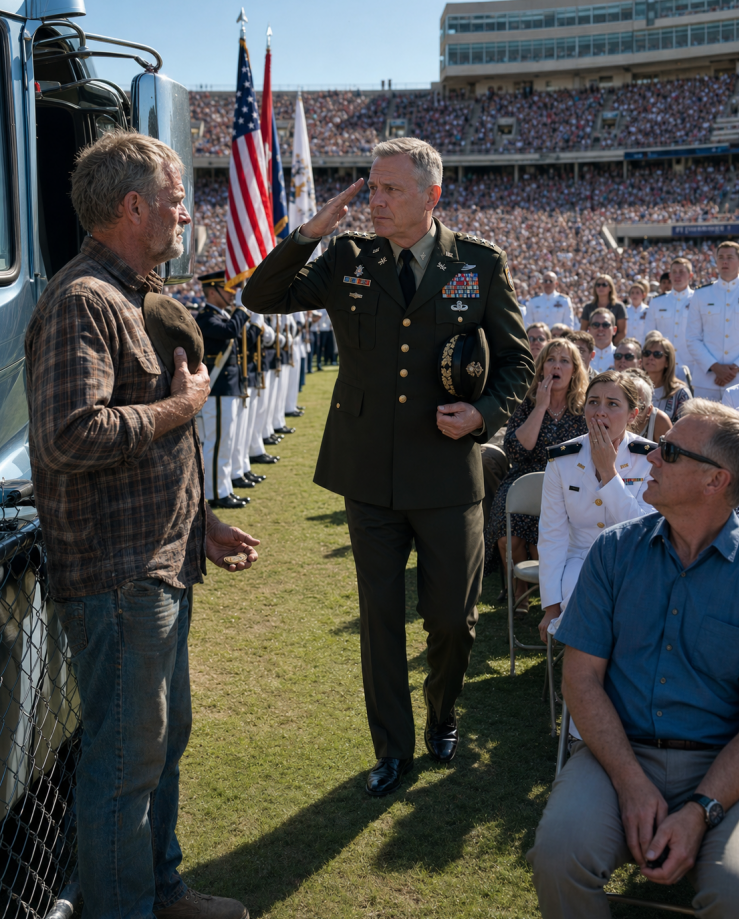
The general held that salute until I understood he wasn’t going to drop it until I returned it. So I did — the old way, the way my hands still knew after twenty years of holding nothing heavier than a gearshift. And the whole stadium made a sound like the tide going out.
Then he said, loud enough for the front rows to hear, “It’s an honor, Chief. It’s been a long time.”
Chief. Nobody had called me that in two decades.
Let me tell you the part of my life I never told my daughter.
My name is Earl Dawson. For twenty years I’ve driven a long-haul rig, and Emma grew up thinking that’s all her father was — a quiet trucker who was gone a lot and came home smelling of diesel and truck-stop coffee. It’s not that I lied to her. It’s that the truth wasn’t mine to tell, and by the time some of it could have been, too many years had gone by and I didn’t know how to start.
Before the rigs, I was a rescue swimmer and then a team chief in a part of the service that doesn’t get parades. I spent fourteen years pulling people out of water and off mountainsides and out of places I still can’t name, in weather and under fire that I still don’t talk about. I was good at exactly one thing: going into the worst moment of someone’s life and bringing them back out of it.
The night that ended my career, I brought out six men from a downed bird in water cold enough to stop a heart in minutes. I made six trips. I don’t remember the last two. The corpsmen told me later I’d been clinically hypothermic and kept going anyway, and that the last man I hauled up had no pulse when I reached him and a strong one by the time we hit the deck.
I wrecked my shoulder and my knee doing it. The body only has so many of those nights in it. They gave me a medal in a small room with no cameras, because the mission never officially happened, and then the injuries mustered me out, and I came home to a country that had no idea and a marriage that didn’t survive the man I was after. I took the only work that let me be alone with my thoughts and paid the bills. I drove.
Emma was four. She doesn’t remember any version of me but the trucker.
I told myself that was fine. I told myself she didn’t need a father with medals; she needed one who showed up, and I did, every leave, every birthday I could route a load through. She grew up strong and stubborn and decided somewhere around fourteen that she was going to serve. I didn’t push her toward it or away from it. When she got her commission, I wept in the cab of my truck in a rest area outside Kansas City where nobody could see.
Which brings me to the stadium. I’d driven eighteen hours to be there. And I truly meant to disappear into the top row, because I looked at the program and saw the review party — the flag officers on the dais — and my stomach dropped, because I knew one of those names.
Lieutenant General Harmon. Back when he was a young officer, half-drowned and gray-faced, he was the fourth man I pulled out of that water.
I didn’t think he’d remember a rescue swimmer’s face from one bad night twenty years ago. I figured I’d watch Emma get her bars, keep my cap low, and be gone before anyone connected the trucker in the bleachers to anything.
He remembered.
He told me later he never forgot. He said the last thing he saw before he lost consciousness that night was my face, and the first thing he saw when he woke up on the deck was the same face, and that he’d spent two decades wondering what happened to the chief who made six trips and then vanished. He’d looked. The records were sealed; the trail went cold. And then he glanced up from a commissioning program and saw a ghost standing at the edge of the field with a ball cap over his heart.
So he stopped a ceremony in front of thousands of people and crossed a stadium to salute a truck driver.
When the noise died down, he walked me up onto that field himself, one hand on my shoulder, and he found my daughter in the formation. He stopped in front of her. And he said, so the ranks around her could hear, “Lieutenant, did you know your father pulled me out of the water twenty years ago? That I’m alive because of him? That everyone I’ve served, everyone I’ve led, everyone I’ve brought home in my turn — all of it started with this man deciding not to quit at four bodies?”
Emma looked at me. Twenty-two years old, ramrod straight, tears cutting down her face while she tried to hold military bearing.
“No, sir,” she said. “He never told me.”
“He wouldn’t,” the general said. “That’s how you know it’s true.”
I don’t have the words for her face in that moment. Every trucker joke, every kid who’d asked what her dad did and gotten a shrug, every parent-teacher night I’d missed for a load — all of it reorganized itself, right there, into something else. Not an absent father. A quiet one.
Afterward there were photographs I didn’t want and handshakes I didn’t know what to do with. Cadets I’d never met wanted to shake the hand of the chief. Families who’d walked past me in the bleachers now wouldn’t let me leave.
But the only part I’ll keep is the walk back to the fence, after, with Emma. She had her bars on. She held my arm the way she did when she was small. And she said, “You drove eighteen hours to hide in the back.”
“Didn’t work,” I said.
“No,” she said. “It didn’t.” And she squeezed my arm. “I’m glad.”
I still drive. I’ll probably always drive; it’s in me now, same as the water used to be. But there’s a photograph taped inside my cab these days — a three-star general saluting a man in a flannel shirt, and a young lieutenant in white looking at her father like she’s seeing him for the first time.
Some nights on a long empty highway, I look at it, and I finally let myself feel like it counted.
Comments are closed.