The champagne tower came down like the whole lie was made of glass.
Two children I had never seen before — a boy and a girl, maybe seven, in little formal clothes someone had pressed with care — walked straight through my caterers, past my new wife, and stopped at the base of that seven-tier tower I’d paid a fortune to have built. The girl reached up. The tower swayed, tipped, and collapsed in a wave of foam and shattering flutes, and in the silence that followed she held up a cream envelope and said, in a small clear voice, “Mommy said to give this to our daddy.”
The room turned to look at me.
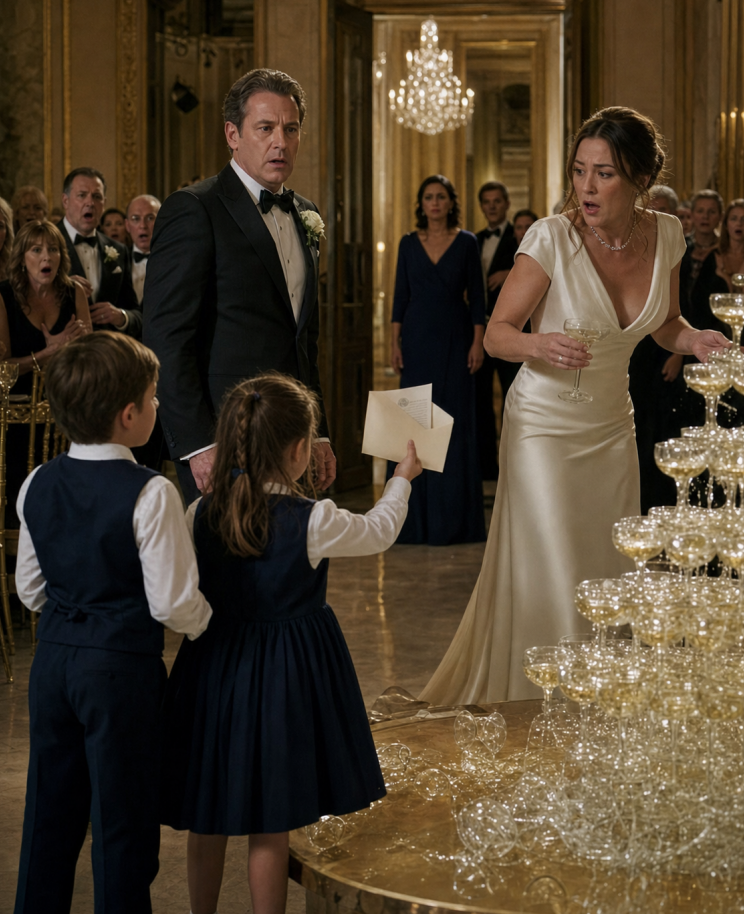
I want to tell you I didn’t understand yet. But I did. Some part of me understood before I broke the seal, because my hands already knew whose handwriting was on the front.
Inside was a birth certificate. Two of them, actually — Leo and Mila, born seven years ago. My name typed in the space for the father. And folded behind them, a single sheet on the letterhead of a fertility clinic, dated eight years back, addressed to me. I had never opened it. Eight years ago I’d thrown a stack of “her doctor nonsense” in a drawer and told Elena I didn’t need a specialist to tell me whose body was broken.
The note said the infertility was mine.
Not hers. Mine. A treatable, specific, documented condition that I had refused to be tested for because I could not stand the idea that the failure might live in me. So I decided it lived in her. I called her barren in front of my mother. I called her a waste of a marriage in front of my friends. I signed the annulment papers and told a very clean, very cruel story about a woman who couldn’t give me children — and everyone believed it, because I was charming and certain and she was quiet and gone.
What I didn’t know, standing in the wreckage of my second wedding, was that Elena had already been pregnant the night I threw her out.
She’d found out three days after I made her leave. She told me later — much later, when we could finally speak — that she’d stood in the driveway with the test in her hand and decided she would rather raise them alone than hand them to a man who could say the things I’d said. She’d carried them, delivered them, raised them for seven years in a small apartment two towns over, working two jobs, never once asking me for a dollar. She’d kept the clinic letter because she knew that someday the truth might need proof.
She hadn’t planned the champagne tower. The kids had gotten away from her at the coat check — she’d only come to hand me the envelope quietly, in a hallway, away from the cameras. But children are children, and the tower was bright, and the rest happened in front of two hundred guests.
Sabrina, my bride of ninety minutes, set down her glass very slowly. She didn’t scream. She just looked at me the way you look at a stranger who’s been wearing a familiar face, and she said, “You told me she couldn’t have kids.” And then, softer, almost to herself: “You told everyone.”
She was gone before the cake was cut. The marriage was annulled inside a month — a real annulment this time, on grounds of fraud, and the irony of that word was not lost on me.
Here is the part I have to live with. Elena never came to that gala to ruin me. She’d tried for years to tell me gently, through a lawyer, through a letter I returned unopened, through a phone number I blocked. The only reason it happened the way it did — loud, public, humiliating — is because I had spent seven years making myself impossible to reach. The reckoning was as loud as the wall I’d built to keep it out.
The children are the reason I’m not going to pretend this story has a villain who isn’t me.
Leo has my hands. Mila laughs with her whole face the way I’m told I did as a boy, before I learned to guard it. I have spent the last year earning fifteen minutes at a time — supervised at first, then a Saturday, then a weekend — not because a court forced me, though it could have, but because Elena decided, against everything I’d earned, to let her children know their father if he was willing to become someone worth knowing.
I go to every session the counselor sets. I have apologized to Elena in words that will never be enough and I’ve stopped expecting them to be. I don’t get to have the marriage back. I don’t get those seven years. What I get is the chance to not waste the next seven the same way.
People at that reception still talk about the champagne tower coming down. They think that was the dramatic part.
The dramatic part was a letter I could have opened eight years ago, in a drawer I chose to slam shut. Everything the twins lost, and everything I lost, was already written on that single page. I just decided I’d rather blame her than read it.
Comments are closed.