The date on the back of the bookmark was the tenth of September, and I watched a man in a slate-gray suit go the color of the marble floor when he read it, because he knew exactly what had happened to him nine months after that night.
I’ve been a charge nurse for nineteen years and I have learned to read faces in the half-second before people decide what expression to wear. His, when he understood, was not grief. It was arithmetic. He was counting backward, and the number he landed on was a due date, and the woman attached to that due date was dying eight feet away on my gurney.
Her name was Elena. I know that now. That night I only knew her vitals, which were the kind that make you move faster and hope harder. Preeclampsia gone to eclampsia, a blood pressure incompatible with two hearts continuing to beat, a pregnancy far enough along that we were suddenly caring for two patients and losing ground on both.
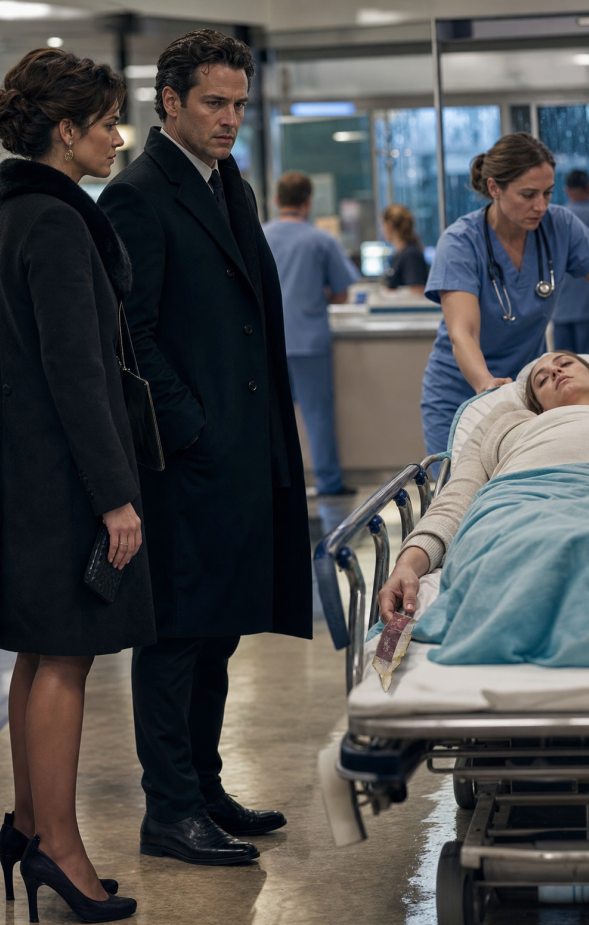
The man’s name was Salvatore Conti, and half the city knew the vineyard on that torn label. He was at our hospital for a donors’ gala two floors up, the kind of event where men like him have their photos taken handing over checks. He’d waved my gurney out of his way. He’d complimented the red gown on the woman beside him while my team called out numbers that meant a mother and child were slipping.
Then the book fell, and the label rolled to his shoe, and everything about the evening he’d planned came apart.
He didn’t rush to her. I want to be precise about that, because later there would be a version of this story where he was the frantic father at the bedside, and it isn’t true. What he did first was look around the lobby to see who had noticed. Then he barked at his own security to “handle this,” to get the crowd back, to keep phones down. His instinct, in the first seconds of learning he might be about to lose a woman who carried his child, was containment.
His date, Gia, was the one who actually asked if Elena would be okay. She didn’t know either. You could see it. She’d walked in on his arm and was walking out of the whole arrangement in real time.
We took Elena up to surgery. I won’t pretend the next part was tidy. Eclampsia that far along is a fight you don’t always win, and there were minutes in that OR I still don’t like to think about. But she was strong, and she’d gotten to us just in time, and somewhere in the small hours the second heart we were fighting for arrived — early, furious, alive. A daughter.
Elena had carried that torn scrap of wine label for the better part of a year. I understood why once she was awake enough to talk, days later, in a quieter room. The tenth of September had been the last good night before Sal Conti decided she was inconvenient. She’d told him she was pregnant a few weeks after that date, and he had told her, in the flat administrative voice men like him use for the people they discard, that it was being taken care of, that there were arrangements, that a woman in her position surely understood.
She hadn’t taken the arrangements. She’d taken a bus, and a new city, and a job that didn’t ask questions, and she’d kept a torn piece of the label from the bottle they’d shared because it was the only proof she had that the good night was real and not something she’d invented to survive the bad ones that followed.
She never planned to see him again. She’d collapsed at a train station six blocks from our hospital and the ambulance brought her to the nearest doors, which happened to be under the same roof where Salvatore Conti was buying himself an evening of admiration. The universe has a cruel sense of staging.
Here is the part I think about. He had a choice, in that lobby, and again in the waiting room, and again in the weeks that followed. He knew the date. He could do the same arithmetic I could. And what Salvatore Conti chose, when the containment failed and the story got out anyway, was lawyers. He chose to question the paternity he’d already counted to on the floor of my lobby. He chose to fight the very existence of the child rather than admit that the woman he’d waved out of his way had been carrying his daughter while he complimented a stranger’s dress.
The date on the bookmark did what dates do in a courtroom. Paired with the birth records and a paternity test he tried and failed to keep sealed, it drew a line he couldn’t erase from a specific September night to a specific January morning. Elena hadn’t kept that scrap of label as a keepsake, it turned out. She’d kept it as evidence, the way you keep the one thing that proves you were somewhere and someone, before a powerful man decided you were no one.
Elena and her daughter are fine now. Better than fine. She let me hold the baby before they were discharged and told me she’d named her after her own grandmother, not after anyone connected to a vineyard.
Sal Conti got exactly the outcome his own arithmetic had predicted — child support calculated against a fortune, his name on a birth certificate he’d fought, and a story that made the rounds of every gala he used to preside over. He is not in that baby’s life. Elena made sure of it, and honestly, so did he, by showing everyone in my lobby precisely who he was before he ever knew there was a daughter to abandon.
I’ve thought about why he screamed at his security before he ever moved toward the woman on my gurney. I’ve decided it’s the truest thing he ever told us. Some men, when the floor drops out, reach for the person falling. And some reach for the phones, to control how the fall will look. The tenth of September told Elena which kind he was long before the bookmark ever hit the marble. She’d just needed the rest of us to finally see it too.
Comments are closed.